


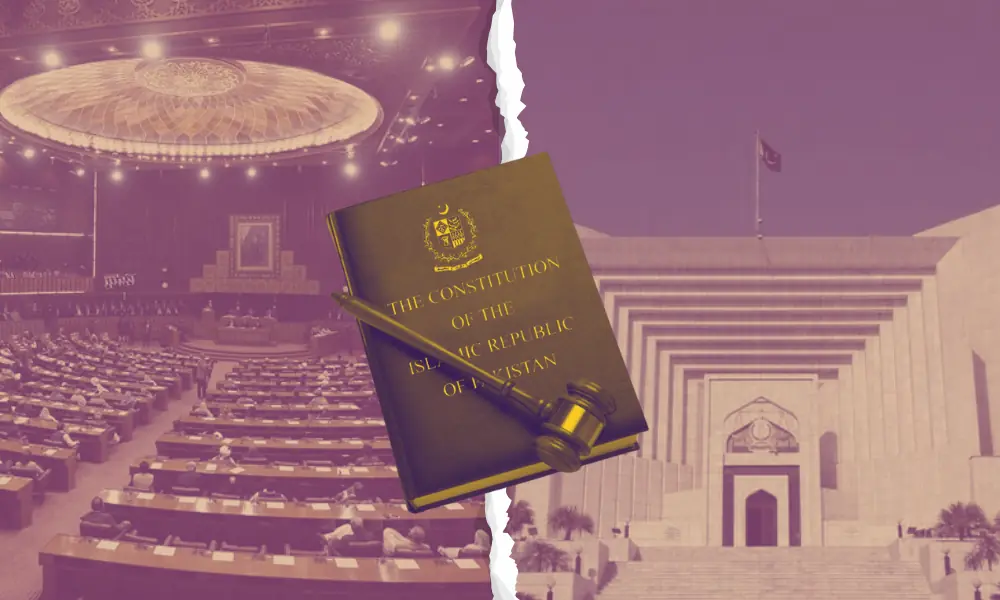
The 27th Amendment to Pakistan’s Constitution was passed by the National Assembly on 12 November 2025 and received Presidential assent the following day. For an amendment that redrew the country’s judiciary and civil–military relations and vested extraordinary powers in a single military office, the pace of change was staggering. On 27 November, the Chief of the Joint Chiefs of Staff Committee retired, leading to the body’s dissolution; Field Marshal Munir was notified as the Chief of Defence Forces on 5 December. The Federal Constitutional Court, established in pursuance of the law, has already begun its first proceedings.
Pakistan’s 27th Constitutional Amendment is not unprecedented but represents a deliberate effort to formalize the country’s hybrid regime by securing the Field Marshal’s central role and insulating it from institutional challenge. By weakening judicial oversight and reducing checks and balances, the Amendment reshapes the Supreme Court into a less effective counterweight to executive and military power. Traditional political actors, particularly the Pakistan Muslim League (Nawaz) and the Pakistan People’s Party, have been encouraged to comply with this arrangement. However, rather than stabilizing governance, the Amendment is likely to deepen political fragility by narrowing space for dissent and intensifying inter-provincial and popular tensions.
Key Provisions
The 27th Amendment fundamentally reshapes Pakistan’s constitutional and military architecture. It establishes a Federal Constitutional Court (FCC) as the country’s highest authority on constitutional interpretation, stripping the Supreme Court of its exclusive jurisdiction over constitutional questions. The FCC will hear challenges to constitutional amendments, presidential references, and intergovernmental disputes, and its rulings will be binding on the Supreme Court. Resultantly, the Supreme Court is effectively confined to appellate and non-constitutional matters.
Alongside this judicial reordering, the Amendment overhauls the military command structure. It abolishes the Joint Chiefs of Staff Committee and creates the post of Chief of Defence Forces (CDF) as the single commander of all three services, appointed for a fixed five-year term. The CDF is granted lifetime rank, privileges, and legal immunity, shielding the office from judicial scrutiny. The Amendment also expands the CDF’s authority over key strategic appointments, including within the nuclear command apparatus. Civilian executives are co-opted into this framework through provisions granting the President and provincial governors lifetime immunity from prosecution.
Taken together, these changes concentrate constitutional, military, and strategic authority in a narrow set of offices, weaken institutional checks, and embed a more hierarchical and militarized model of governance within Pakistan’s constitutional order.
Causes and Impact
The steps, though significant, are not unprecedented: the political leadership’s actions, since the beginning of the hybrid system introduced by Munir’s predecessor, Gen. Qamar Javed Bajwa, have originated from and, in turn, intensified the legitimacy of the Establishment’s interventions. However, the country is no stranger to this power struggle. The Supreme Court became an obstacle for the Establishment after its initial 2024 verdict in the Reserved Seats Case, which confirmed the PTI as the largest group in the National Assembly, and after it ordered snap elections in Punjab in 2023.
Last year, the 26th Amendment introduced Parliamentary control over the appointment of the Chief Justice of Pakistan, replacing the principle of seniority with a Special Parliamentary Committee for this task. The Amendment changed the composition of the Judicial Commission that nominates Judges of the Supreme Court and the High Courts, increasing Parliamentary and Executive influence. The Supreme Court’s suo motu powers, which were a point of contention between the Sharif Cabinet and the Supreme Court of Chief Justice Qazi Faez Isa, were eliminated following this Amendment. The Court’s ability to review the constitutionality of advice given by the President from the Cabinet was limited, and, as a precursor to the FCC, Constitutional Benches were established to decide on constitutional matters. After the Supreme Court (Practices and Procedures) Act, 2023, was stayed by the then Chief Justice Bandial, the government, in 2024, issued an ordinance to the same effect, restricting the Chief Justice’s powers by forming a bench to hear cases brought before the Supreme Court.
The formalization of the hybrid regime is not merely coincidental but is supported by conjunctural factors. Pakistan’s society had been unravelling before May, torn apart by inter-provincial river disputes, ethno-nationalist movements, and a legitimacy crisis. It benefits the Establishment’s cause that Pakistan has been embroiled in an ongoing conflict.
In 2024, tensions between Iran and Pakistan spiked due to the cross-national Baloch insurgency. Kabul and Islamabad’s ties reached their lowest point when they exchanged fire in October. In May, Pakistan and India broke the ceasefire of 2021, descending into conflict after the terror attack in Pahalgam. Over two years, Pakistan has recorded nearly 5000 fatalities in terror-related incidents, as insurgencies in Khyber Pakhtunkhwa and Balochistan worsen domestic instability. As a result, concerns over sub-nationalism, corruption, and electoral rigging have been marginalized. Insofar as the Establishment sees itself as the guardian of stability, its central role in the political landscape remains reinforced.
Munir gains an exalted status in this crisis as the leader of the Establishment. However, his all-encompassing role is not solely due to the circumstances of insecurity. He has shaped an image of piety to present himself as the protector of Pakistan’s Islamic values, especially following the removal of Imran Khan, when divisions within the Establishment and public discontent escalated dramatically. Furthermore, unlike his predecessor, Gen. Bajwa (Retd.), he aims for a constitutional, rather than informal, consolidation of power and a visible assertion of authority to deter opposition. His personality appeals to Donald Trump, who has a strong inclination towards strongmen, resulting in improved relations with the US, with promises of economic support.
However, the 27th Amendment is likely to hinder inter-agency coordination. While the need for unified action has been emphasized by Pakistan’s internal security issues, centralizing authority at the expense of collective decision-making will foster dissent within the Establishment and among the public. It aggravates the dominance of land-based strategy and the imbalance between agencies. Munir will also recommend the Commander of the National Strategic Command, who will oversee the country’s vast strategic and nuclear assets, and will essentially be from the Army. The Army is expected to receive the largest share of resources, which will benefit its commercial interests but may provoke displeasure among other forces, damaging their morale. Recent conflicts with Iran, India, and Afghanistan highlighted the importance of air defence and high-technology warfare, which will be ill-served by the current structure.
In conclusion, the 27th Amendment marks a significant event in the ongoing power struggle among Pakistani elites. Recent months have seen debates over the state adopting a firmer stance to crush insurgencies: the promotion of Munir and the removal of judicial oversight threaten citizens’ rights. Disputes over resource-sharing, especially between Sindh and Punjab, have intensified since the floods. The Federal Government’s conflicts with Khyber Pakhtunkhwa, governed by PTI-backed Independents, have reached a critical point; under the current judicial system, removing the Provincial government will be straightforward. The outlook for national unity is therefore grim as Pakistan’s most popular leader, Imran Khan, remains in prison. This amendment further limits avenues for dissent, which will inevitably fuel conflict. India also needs to remain careful, as the provocative remarks of the Field Marshal indicate a conjunction of unfettered powers with a continuing aggressive posture.




Add comment