


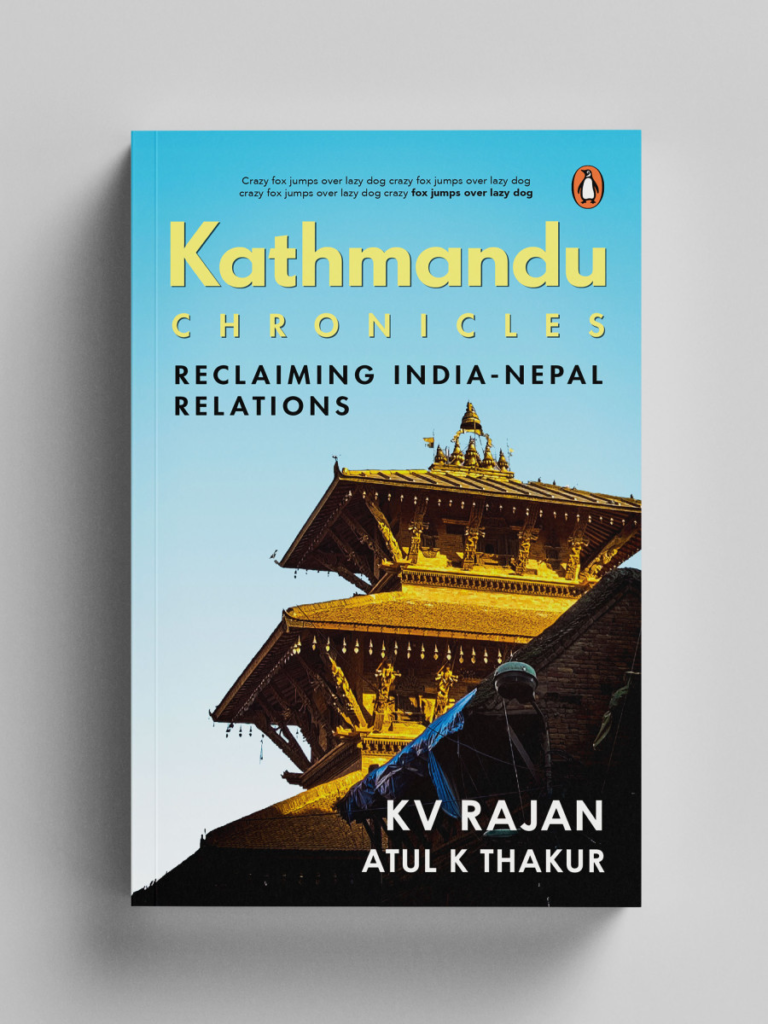
“Kathmandu Chronicle: Reclaiming India-Nepal Relations” by K.V. Rajan and Atul K. Thakur is a particular kind of book that only gets written once a diplomat has stopped worrying about what he can and cannot say. Rajan has the distinction of being India’s longest-serving ambassador to Nepal, spending more than half a decade in Kathmandu from 1995 to 2000. He watched a Hindu kingdom lurch toward a republic it had not quite decided it wanted. For this book, he paired with Thakur, a policy analyst with years of tracking the country’s economic drift. Together, they have produced something rarer than a diplomatic memoir. It is an account that treats Nepal as a subject with its own agency, rather than as a problem India needs to manage.
The book opens with Rajan’s first-person recollections. There are palace intrigues. There is the whispered fear of a king who sensed his own assassination coming. There is the scramble after the IC-814 hijacking. From that moment. it widens into a joint historical sweep covering seven decades. It closes with a section that is less retrospective than prescriptive. That last section is where the book earns its subtitle. “Reclaiming” is not a passive word, and the authors do not treat it as one.
What struck me most is how little the book indulges in the self-congratulation that so often creeps into accounts of Indian diplomacy in the neighbourhood. Rajan is unusually candid here. He is candid about the instinct in New Delhi to treat Nepal’s sovereignty as something to be managed rather than respected. He traces this instinct partly to inherited British attitudes towards the hill kingdoms. Those attitudes, in his telling, were absorbed wholesale into independent India’s bureaucratic culture. He recounts Pranab Mukherjee’s own blunt admission to him that the trouble was never really Nepal, but “the pettiness of the Indian bureaucratic mindset”. It is a hard line to include in a book by a former ambassador. Its presence tells you that the authors were more interested in an honest diagnosis than a comfortable one. Where the book is less generous is in its description of Nepal’s own political class. It is also less generous towards the intellectuals who have, in the authors’ telling, romanticised Beijing’s role as a counterweight to India, without reckoning with what “Wolf Warrior” diplomacy actually looks like up close.
None of this reads as an indictment of either country. It reads, instead, like something India’s foreign policy establishment has needed for a while, which is a mirror that does not flatter and is held up by someone who has clearly never stopped caring about the outcome.
That is also what makes the book feel unusually timely. Nepal has since lived through the kind of rupture Rajan’s generation of diplomats spent careers trying to prevent. The so-called Gen Z-led (tellingly, an imported US sociological jargon) protests of September 2025 were triggered by a social media ban. They were fuelled by years of accumulated anger at nepotism and stalled opportunity. Within 48 hours, they toppled the Oli government. They put Sushila Karki, the country’s first woman prime minister, into an interim office. Six months later, voters delivered an even sharper verdict. They handed Kathmandu’s young mayor Balendra Shah, and his five-year-old party a governing majority few analysts had priced in. This is precisely the pattern the book describes: weak institutional structures, eleven governments in seventeen years since the monarchy’s abolition in 2008. That pattern reached a kind of breaking point in 2025. Then, characteristically for Nepal, it found its own unconventional way through.
What has followed is a useful test of the book’s central thesis. Prime Minister Shah made early remarks in parliament on the long-standing Kalapani-Lipulekh-Limpiyadhura boundary dispute. He suggested it be examined “objectively” through diplomatic channels, rather than treated as a grievance to be nursed. That aligns with the register that Rajan and Thakur call for throughout the book: firm on sovereignty, yet allergic to grievance theatre. Then, in August 2026, catastrophic glacial-lake flooding tore through the Bhote Koshi and Trishuli valleys. It killed thousands and gutted hydropower infrastructure both countries had spent years building. New Delhi’s response offers something closer to the book’s prescription than to its critique. Indian technical teams worked alongside the Nepal Army inside collapsed tunnels. Assistance was dispatched without the usual bureaucratic lag the authors lamented in the book. Prime Minister Modi has invited Prime Minister Shah for an early state visit. Progress on hydropower continues quietly but steadily. Nepal is now eyeing 10,000 MW of power exports to India over the coming decade, with projects like Arun-3 and Arun-4 moving forward despite the disaster. All of this suggests that the “people-centred development over security-first thinking” advocated for in the book is no longer just an aspiration in a policy chapter. It is, slowly, becoming practice.
Kathmandu Chronicle was never written as a history book waiting to be overtaken by events. It reads more like a brief for the relationship that India and Nepal are still in the process of building. Trust here is rebuilt through consistent, low-drama cooperation on the ground, not through grand gestures. An earthquake, a flood, or a popular uprising becomes an occasion to prove that neighbourliness, not hierarchy, is New Delhi’s operating instinct. The authors do not pretend that the road has been smooth. They simply insist, convincingly, that it still leads somewhere worth going.

Add comment