


Societa Italiana di Geopolitica – Vision and Global Trends
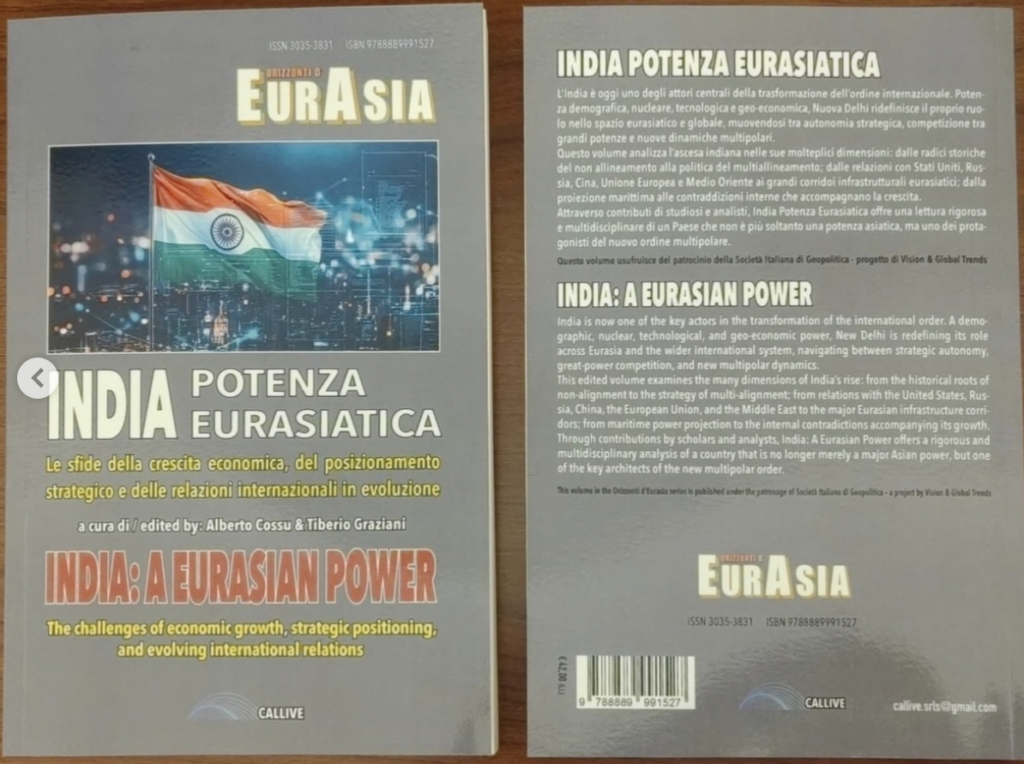
This ambitious collection of chapters authored by experts in various fields, drawn mostly from Italy, some written in Italian preceded by abstracts in English, presents a panoramic, generally objective and open-minded view of India’s recent past, current evolution, and future options and possibilities. At the outset, it argues that India is not only a South Asian subcontinental hegemon, it is also a Eurasian power. Its economic and cultural influence is slowly rising across West Asia, Europe, America and member-states of the British Commonwealth. Although India is not ubiquitous or predominant like China has become, and does not loom large militarily like Russia, its presence is being felt in many areas, as the authors of this book consistantly demonstrate.
The two forewords, written respectively by Côme Carpentier and former Italian Ambassador to India Antonio Armellini, lay out the basic thesis of the book, which is that, despite many remaining weaknesses and vulnerabilities, due in part to centuries of colonial subjection, overpopulation, and the burden of widespread poverty, India has remained relatively stable politically, thanks to its constitutional system of government and semi-federal status. The young nation-state, born out of a very ancient civilisation and inheritor of several mighty empires, is growing in strength in a troubled and penurious neighbourhood, and in the world at large, while tackling daunting domestic challenges that might doom less resilient countries. The world’s largest country by population, strategically located between Africa and the Far East, it is also the fifth largest economy in terms of GDP and intends to be the third in less than twenty years.
The book is divided into five sections. The first, entitled ‘From The Origins of Non-Alignment to Strategic Autonomy’ -The historical and theoretical roots of India’s international posture, highlights the continuity of India’s foreign policy, from Mahatma Gandhi’s vision of non-violent self-sufficiency and universal benevolence, to Prime Minister Nehru’s pursuit of Non-Alignment and socialist autarky, and Rajiv Gandhi’s dual outreach to China and the USA, leading up to Manmohan Singh and Narendra Modi’s multi-aligned diplomacy, in a quest for rapid economic development supported by international collaborations. Some chapters trace back the principle of non-ideological openness, coupled with the avoidance of permanent alliances, to India’s antiquity, where idealism and pragmatism combined in Emperor Ashoka’s edicts, in the Arthashastra’s prescriptions, and in the lessons taught by the Mahabharata, which are all parts of the Indic ethos. That legacy is enshrined in India’s ‘Middle Way’, including the government’s ‘digital non-alignment’, intended to avoid falling under the control of the rival American and Chinese Deep-Tech hegemonies. The section concludes by describing India’s transition from a Third World advocate to a leader of the Global South, the ‘Non-West’ that aspires to blend modernity with its native traditions and cultures.
The second section is entitled ‘India in the Multipolar System’: Relations, Balances, Competition, International Positioning among Great Powers and Strategic Partnerships’. These chapters describe and analyse the equations between India and the three major powers: China, the United States, and Russia. While relations with the latter have remained stable and mutually beneficial for several decades, they have long been difficult and rather unpredictable with the first two, China and the USA, despite extensive and growing trade links. With China, India’s economic and industrial dependency has become too acute for comfort because of the mounting commercial deficit. In the United States, the old American animosity towards India has come back with a vengeance under Trump’s mandate, partly because of New Delhi’s unwillingness to bend the knee. Yet India has come much (and maybe dangerously) closer to Washington in the last twenty years. With China, despite recent tensions, the relationship is on a more even course, partly due to certain converging interests, enshrined in the joint BRICS and SCO agenda, that prevail over the enduring contestation over borders and the economic and strategic asymmetry. India’s growing cooperation with the European Union stresses the converging interests of two large economic players that need to find suitable partners to maintain some autonomy between China and the USA, and have finally signed a Free Trade Agreement to that effect. The last chapter retraces the evolution of relations between India and Israel, fostered by India’s search for technological cooperation and intelligence about the Middle East, but now hamstrung by the humanitarian and political impact of the tragedy in Gaza, and by the US-Israeli attack on Iran that has harmed India’s economy by jeopardising energy supplies and investment prospects from the Gulf.
The third part is dedicated to the Geopolitics of Connectivity and subtitled ‘Eurasia, Corridors and Strategic Areas – India as a hub of geo-economic and infrastructural networks. It discusses India’s skeptical attitude to China’s Belt and Road Initiative and highlights alternative multi-national projects such as the International North -South Corridor INSTC (across Iran to Central Asia, Russia, and Europe) and the rising industrial synergy between India and Persian Gulf States. The IMEC (a planned multimodal transport highway from India to the Arabian Peninsula and the Mediterranean via Israel) is described as well.
Part 4 is headlined Building Power: Sea, Infrastructure and Industry -The Material Instruments of India’s strategic projection. While describing India’s ambitious maritime plans in the Indian Ocean and outreach in the Western Pacific, it also notes the economic and financial factors that limit the scope of those projects when compared with the momentum and scale of China’s ongoing initiatives in the area. One chapter explains how India is gradually increasing its monitoring capacity and potential to control the Indian Ocean down to the Malacca Strait. Other contributors focus on India’s motor vehicle production (the third largest in the world) and study India’s mix of Keynesian infrastructure-building strategy and controlled liberalisation, always guided by a vision of geo-economic multi-alignment.
The fifth and final section logically draws attention to some of the obstacles, weak spots, and major problems that India faces. It is titled State, Security and the Contradictions of Power and subtitled Internal Vulnerabilities in the process of Global Ascent. Challenges include the uneven pace of development across the country’s regions and the often bitter debate between contrasting concepts of national identity, owing to the apparent contradictions between the Hindutva doctrine upheld by the ruling party and the appeal that constitutional secularism retains for the numerous religious and ethnic minorities. One writer fears that what he perceives as ‘high-tech populism’ in current political praxis may raise India’s leverage and profile abroad while sharpening internal divisions. There are a few other skeptical reflections ending in question marks. Can India overcome its millennial dissensions and modern tensions to become the global power it aims to be? The final assessment is that the nation is, above all, a ‘civilisation on the move’ that may elude understanding when it is dissected according to typically Western ideological and structural categories, which miss essential peculiarities of the country and its people.
In conclusion, the book contains a wealth of information on India’s diplomacy, economy, domestic policy, industrial and commercial strategies, and military capabilities. Nevertheless, it suffers from the inevitable defect of collective academic works, to wit, occasional repetitions and redundancies between chapters. Yet, the diverse viewpoints and interpretations should help readers draw informed conclusions. This volume is indeed an indispensable reference work about contemporary India’s geopolitics and geo-economics.


Add comment