


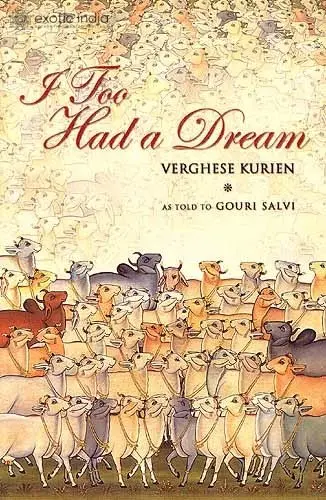
In an era dominated by relentless political friction and bleak news, finding a narrative grounded in hope feels like a quiet sanctuary. Reading Dr. Kurien’s autobiography felt deeply personal, evoking memories of my grandfather while offering an intellectually rich and emotionally resonant reflection on what genuine progress looks like.
The text opens with a line from Tennyson’s Ulysses that sets the stage for the journey ahead:
“Some work of noble note may yet be done.
…Come, my friends,
‘Tis not too late to seek a newer world.”
Across its ten chapters, the narrative captures a cycle of relentless effort, patience, and eventual triumph. It details how rural farmers were granted the agency to break free from exploitation and claim what was rightfully theirs. At the heart of this transformation was Dr. Verghese Kurien. Sent to the quiet town of Anand in Gujarat to fulfill a government scholarship bond, having studied dairy engineering at Michigan State University, he arrived as an outsider to the dairy sector. Yet, under the guidance of Tribhuvandas Patel, a dedicated freedom fighter backed by Sardar Vallabhbhai Patel, Dr. Kurien’s life became inextricably linked with the cause of the local farmers.
Through determination and collective resolve, the farmers of Anand, guided by Dr. Kurien’s vision of the “Anand Pattern,” orchestrated a movement that eventually transformed India from a milk-deficient nation into the world’s largest milk producer. Rather than fearing crisis or market competition, they reframed every obstacle into an opportunity. By taking full ownership of production, processing, and marketing, the farmers built self-sustaining livelihoods. In doing so, they gifted the nation Amul, Operation Flood, the National Dairy Development Board (NDDB), and the Institute of Rural Management Anand (IRMA).
Dr. Kurien was a steadfast figure who frequently clashed with bureaucratic apathy. He was openly critical of administrators who viewed themselves as masters rather than public servants, questioning how the state could train officials to truly serve the people. He ensured that the organizations he helped construct remained free from the rigidity and inefficiencies of state red tape. Outspoken and unapologetic, even in heated exchanges with figures like politician Babu Jagjivan Ram, Dr. Kurien maintained an unshakeable faith in the power of ordinary citizens to shape their own destiny.
His philosophy on national priorities was straightforward and sharp:
“There is nothing wrong in building flyovers in Delhi. What is not fair is when we do not also build an approach road to villages across the nation. There is nothing wrong in having fountains with coloured lights in the capital…But it is unjustified when we have not provided drinking water to all our villages. There is nothing wrong in having a modern, private hospital…But it is not justified when we have not arranged to have two drops of a medicine put into the eyes of a farmer’s newborn baby, and that baby goes blind…Because policy making is in our hands – in the hands of the elite – and naturally, even unconsciously perhaps, when we make policies we make policies that suit us…”
Contrary to modern demands for immediate results, Dr. Kurien advocated for deliberate, gradual social and economic change, believing that lasting transformation requires time, care, and strong foundations.
However, the critique extends beyond government policy to societal attitudes. A widespread sense of civic indifference, the belief that public property belongs to everyone and thus requires care from no one, frequently undermines collective progress. True development cannot rely on top-down handouts; it requires fostering genuine self-sufficiency. National growth must balance modern industrial and technological strides with agriculture and even extend to traditional arts.
As Dr. Kurien noted:
“Our greatest national resource is our people, and too often have we neglected this resource. We have, whether intentionally or not, created the illusion that all resources are in the hands of the government…India would have been a far stronger nation had our people been asked to create resources.”
Entrusting people with responsibility creates accountability and self-reliance. True empowerment comes not from managing resources on behalf of citizens, but from building cooperative frameworks that enable them to generate and manage wealth themselves. This is where India’s ‘Sahakar se Samriddhi’ initiative, which is breathing new life into the cooperative movement through comprehensive structural reforms, comes in. To drive grassroots prosperity, the government is setting up multipurpose local cooperatives spanning agriculture, dairy, and fisheries in unserved rural regions. Modern efforts like White Revolution 2.0, massive decentralized crop storage projects, and the complete digitisation of local credit societies are streamlining operations. Supported by tax relief, higher borrowing thresholds, and new national bodies dedicated to exports and organic goods, these targeted policies are intended to equip rural citizens with the tools, technology, and autonomy needed to achieve lasting economic independence. Dr. Kurien’s vision does appear to be coming into practical reality after all.
If there is a flaw in the book, it lies in its hesitation to explore Dr. Kurien’s personal vulnerabilities or shortcomings. By focusing almost exclusively on his achievements, the narrative leans toward idealization rather than offering a fully rounded, human portrait.
Though a self-proclaimed atheist, Dr. Kurien lived with a deep sense of purpose. Choosing a life of service over easier, more lucrative paths, he laid down a blueprint for future generations. The task of building a balanced, self-reliant nation now rests with us, driven by the understanding that every meaningful effort counts.


Add comment