


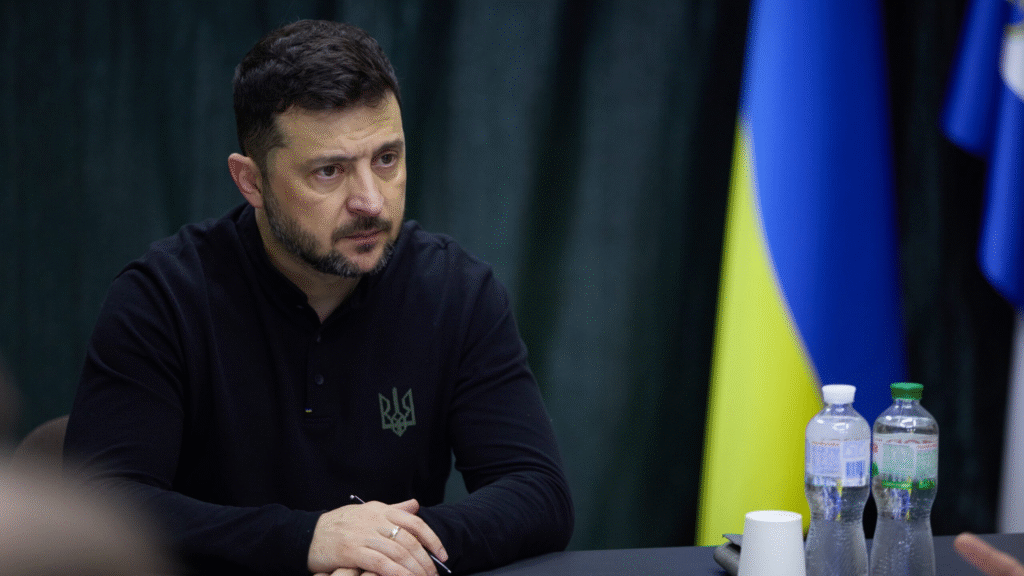
Ukrainian president Volodymyr Zelensky’s cadaverous regime is inching towards an ignominious end, driven partly by its illegitimacy (his tenure expired in May 2024), partly by the desire of the effete elites of the European Union and North Atlantic Treaty Organisation (read Britain, France and Germany) to continue the lost war, but above all by its unsustainable corruption.
The near-end came with the fall of Andriy Yermak, former Head of the Office of the President of Ukraine. Pragmatists in Washington realize that Russia has won the war; President Donald Trump is keen to end it. Accordingly, Washington nudged the National Anti-Corruption Bureau of Ukraine (NABU) that raided Yermak’s home and office and forced his resignation. Isolated by Yermak’s exit, Zelensky is reluctant to end the war because peace will put him out of office and possibly in jail.
Trump suspended aid to Ukraine because Kiev was misusing US funds. He said, “Biden handed out $350 billion like candy. It’s a colossal amount of money, and most of it was in cash, and a lot in equipment.” The White House may order a full audit of the expenditure.
Ukrainian MP, Oleksandr Dubinskyi wonders if the US and Russia will coordinate to transfer power to Ukrainian MP Davyd Arakhamia. In a post on X, Dubinskyi stated that journalists in Ukraine and abroad have revealed that Zelensky’s inner circle has been siphoning money through Cypriot offshore accounts and huge real estate purchases in Dubai, with ties to businessmen Maksym Krippa and Andriy Hmyrin. He demanded a full investigation by the United States.
Verkhovna Rada member Artem Dmytruk reported on his Telegram channel (Dec 02, 2025) that the Ukrainian president has been ordered to resign this week (ending Saturday Dec 06, 2025), but did not say by whom. He said Zelensky may look for excuses to delay the inevitable, but may have to be “forced out” in handcuffs.
Russian President Vladimir Putin insists that the battlefield reality must be respected, the root causes of the conflict addressed, that is, Ukraine cannot join NATO or the European Union, or the war will continue till Moscow achieves its objectives. Hungary Prime Minister Viktor Orbán, who met Putin on December 1, 2025 to discuss his country’s energy security and an end to the Ukraine war, told the German weekly newspaper, Die Zeit, that “the only solution is for Ukraine to be a buffer state again”. Pointing out that “territorial concessions to Russia are inevitable”, he warned that “the longer peace is delayed, the more people and territory Ukraine will lose”.
Witkoff-Kushner in Kremlin
On Dec 02, 2025, an American delegation led by special envoy Steve Witkoff and Jared Kushner (Trump’s son-in-law) arrived in the Kremlin and presented Putin with four documents besides the original 28-point Trump plan. The five-hour talks did not yield a solution, but Russia and the US agreed to continue to dialogue and not disclose the essence of the talks. The delegation flew back to Washington without meeting Zelenksy.
Putin’s foreign policy adviser Yuri Ushakov informed the media that the US side presented proposals on territorial control. Putin insisted Russia will take the entire Donbas region through negotiations or by force, and asked Witkoff and Kushner to convey some messages directly to Trump. Ushakov revealed that US plan was revised from 28 points to 19 after negotiations with Ukraine in Geneva on November 23, 2025. Speaking with journalists in Bishkek, Putin said Russia wants international recognition of territorial realities, especially legal recognition of Crimea and Donbass as part of Russia.
In Geneva, Kiev accepted most of Trump’s plan, barring the three key issues concerning restrictions on the size of the Armed Forces of Ukraine, prospective NATO membership, and territorial concessions. The US-Ukraine delegations met again in Miami on November 30, with no agreement.
NBC News said Russia is adamant about three key points, namely, the entire Donbas, including areas controlled by the Armed Forces of Ukraine; significant reduction in the size of the Ukrainian army and renunciation of key categories of weapons; and recognition of new Russian regions by America and Europe. The Kremlin said Europe was excluded from the peace table because it is fixated on inflicting a “strategic defeat” on Russia.
While the US delegation was in the Kremlin, China’s top diplomat, Wang Yi, was also in Moscow for the 20th round of consultations on “strategic security and military cooperation” with Sergei Shoigu, Secretary of the Security Council of the Russian Federation, and Foreign Minister Sergey Lavrov. The purpose was clearly to show that Moscow is not alone and to deepen the multipolar world order where national interests are not stifled under ideological pressure from dominant states.
Reflecting on the failure of the peace talks, Trump observed that the terms for a settlement in Ukraine are far worse now than they were during his Oval Office meeting with Zelensky in February 2025. “I said, you have no cards. That was the time to settle… But they, in their wisdom, decided not to do that. They have a lot of things against them right now.”
EU-NATO demise
As the EU-NATO struggle for relevance, their demise is inevitable. The EU-NATO leaders will have to explain to their people why they destroyed the industrial base of their own countries, disrupted the energy security provided by Russian oil and gas, gutted their middle classes, and routed billions of dollars in weapons and cash into the Zelensky corruption machine. This pandering did not end even after it became evident that Zelensky and his close aides were buying luxury goods and property abroad and their children were living it up in foreign lands even as ordinary Ukrainians were being abducted and forced to the frontline to fight a war that they considered illegitimate.
These elites are determined to continue the proxy war that began with the US-backed Maidan coup of February 2014, even after President Trump declared that the war is lost and it is time to negotiate peace.
Addressing a press conference in Brussels on December 02, 2025, the EU High Representative for Foreign Affairs, Kaya Kallas blithely stated that the corruption scandals around Zelensky will not affect Europe’s sponsorship of the anti-Russian war. She said, “Europe and Ukraine must build, produce and innovate together. This is beneficial for both sides. Ukraine has combat experience, and we need it for our defense industry. I am glad that more and more member countries are doing this. For example, today the Netherlands signed an agreement with Ukraine on the establishment of a production line on its territory”.
But all is not well within the proxy warrior camp. NATO’s secretary general, Mark Rutte, admitted in Brussels that there is no consensus on bringing Ukraine into NATO. Yet the organisation remains delusional and talks of strikes against Moscow. Italian Admiral Giuseppe Cabo Dragone, NATO Military Committee chair, referred to drone incursions, cyberattacks, train derailments, and mysterious factory fires across Europe and the US.
US Secretary of State Marco Rubio refused to attend the Dec 03, 2025 foreign ministers meeting in Brussels, sending Deputy Secretary Christopher Landau instead. For European diplomats, cut out of the Ukraine negotiations, this is a wake-up call. America could soon withdraw funding to NATO. It has already ceased sharing intelligence with Germany due to its obstinacy in continuing the Ukraine proxy war.
Russia’s frozen assets
Recognising the changing scenario, the European Central Bank refused the European Commission’s proposal to provide a €140B ($152B) loan to Ukraine using Russia’s frozen assets. Trump is certain to ensure that Russia gets back its funds. When EU Sanctions Envoy David O’Sullivan visited Washington some months ago, he was firmly told that the US wants the assets returned to Russia once a peace deal was done.
Trump’s original 28-point blueprint included unfreezing the Russian assets and using them for a joint Ukraine reconstruction effort, under which the US would take 50 percent of the profits. The proposal enraged the EU.
The story, according to the Politico is that when the European Union’s leaders arrived in Brussels on Oct. 23 for a summit with Zelenskyy, they hoped to gift him some Russian assets frozen in a Belgian bank, to carry on fighting Russia for another two years. But Belgian Prime Minister Bart De Wever refused to expropriate Russian sovereign assets even as Ukraine slides closer to the financial precipice. Oleksandr Dubinskyi states that Ukraine’s national debt is close to $200 billion, almost 100 per cent of its GDP.
Hungary presents another challenge. Russia’s assets are frozen because all EU leaders, including Viktor Orbán, agree every six months to extend the sanctions immobilizing the funds. Should Orbán change his mind, Russia could promptly reclaim the assets. Belgium would be in trouble if the assets were given to a third party.
Odessa
Ukraine’s adamant attitude will cause it to lose more territory. On Nov 21, Ukraine launched a MAGURA V5 naval drone packed with ~200 kg of explosives at the Russian tanker SIG, a civilian vessel transporting fuel. Earlier, on September 13, a coordinated drone-and-missile strike hit Sevastopol’s shipyard, damaging a patrol ship. In October, multiple MAGURA V5 drones attempted to strike the Sergey Kotov, a patrol corvette; footage released by Ukraine’s GUR bears the hallmark of British-assisted targeting and mission-planning systems. The Caspian Pipeline Consortium near Novorossiysk was also attacked.
Attacks in the Black Sea will compel Moscow to take Odessa and control access to the Black Sea. In a stern warning against attacks on civilian and commercial vessels, Putin warned that Russia could cut off Ukraine’s access to the sea if attacks continue. “We will strike Ukrainian ports and vessels.”
Endgame
Many believe that the Ukrainian forces could mutiny. Analyst Col. Macgregor points out that the Ukrainian army is surrendering in droves, senior commanders are walking into a kind of prisoner-of-war deal with the Russians; the ranks talk about going to Kiev and finishing off the regime, holding Zelensky and his friends accountable for the billions they’ve stolen, and the millions of lives they’ve destroyed.
Zelensky’s days are clearly numbered. The only question is whether he will flee to some haven, be deposed in a coup, or face a popular insurrection.


Add comment