


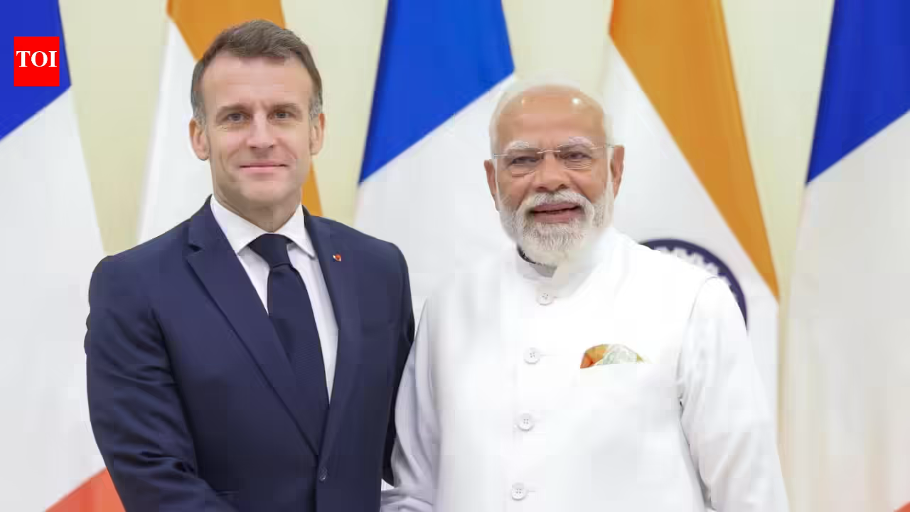
India and France have demonstrated an exceptional degree of strategic resilience and a truly “all-weather friendship” through decades of mutual support and cooperation. In February 2026, this enduring friendship entered a new era when, during President Emmanuel Macron’s fourth visit to the subcontinent, it was officially designated a “Special Global Strategic Partnership”.
This landmark visit, notably his first to the financial hub of Mumbai before concluding in New Delhi, signals a strong partnership for a stable and enduring multipolar global future. His three-day visit was marked by a series of high-level interactions that culminated in the summit, with a comprehensive list of 21 official outcomes covering several domains, including defence, critical minerals, renewable energy, healthcare innovation and digital technology. The following table includes 21 outcomes:
| S.no. | Title | Area |
| 1. | Upgrading of the India-France relationship to “Special Global Strategic Partnership” | Political, Overarching |
| 2. | Establishment of annual Foreign Ministers Dialogue for regularly reviewing implementation of the elevated partnership and Horizon 2047 Roadmap | |
| 3. | Launch of the India-France Year of Innovation | Technology and Innovation |
| 4. | Launch of the India-France Innovation Network | |
| 5. | Inauguration of H125 Helicopter Final Assembly Line at Vemagal, Karnataka | Defence and Security |
| 6. | Renewal of the Agreement between Government of India and French Republic on Defence Cooperation | |
| 7. | Joint Venture between BEL and Safran to produce HAMMER missiles in India | |
| 8. | Reciprocal deployment of officers at Indian Army and French Land Forces establishments | |
| 9. | Constitution of a Joint Advanced Technology Development Group | Critical and Emerging Technologies including defence |
| 10. | Joint Declaration of Intent for Cooperation in Critical Minerals and Metals | |
| 11. | Letter of Intent to establish a Centre on Advanced Materials between DST and CNRS | |
| 12. | Amending Protocol on the Double Tax Avoidance Agreement between India and France | Economy, Startups, Science and Technology, Health, Renewable Energy and Skilling |
| 13. | Letter of Intent between T-Hub and Nord France on strategic cooperation in start-up ecosystems, innovation and technology | |
| 14. | Memorandum of Understanding for Scientific collaboration between DST and CNRS | |
| 15. | Joint Declaration of Intent on establishing an Indo-French Centre for Digital Sciences and Technology | |
| 16. | Launch of the Indo-French Centre for AI in Health at AIIMS, New Delhi | |
| 17. | Letter of Intent between DBT and ANRS on Cooperation in Research and Development on Infectious Diseases and Global Health Research | |
| 18. | Agreement for the establishment of Indo-French Centre for Metabolic Health Sciences | |
| 19. | Letter of Intent to establish a National Centre of Excellence for Skilling in Aeronautics | |
| 20. | Renewal of the Memorandum of Understanding between the Ministry of New and Renewable Energy and the Ministry for the Economy, Finance and Industrial, Energy and Digital Sovereignty on Renewable Energy Cooperation | |
| 21. | Letter of Intent between the Department of Posts, Ministry of Communications and La Poste, France |
Table 1: List of Outcomes: Visit of the President of the French Republic to India | Source: PM Official Website
Historically, defence cooperation has been the cornerstone of this partnership, and developments in this area have occurred during bilateral talks. It can be said that this summit marked the end of the traditional ‘buyer-seller’ dynamic and ushered in a ‘strategic co-creation’ era. For instance, discussions included the procurement of 114 Rafale fighter jets, with 96 for domestic production. President Macron even highlighted “Make in India will be core to this new Rafale order,” emphasising maintenance capabilities, technology sharing, and operational sovereignty. Furthermore, the Summit also involved an arrangement for the reciprocal deployment of officers at Indian Army and French Land Forces establishments, which certainly indicates the highest level of mutual trust and cooperation. The discussions also covered crucial areas such as the production of HAMMER missiles, a precision air-to-ground weapon used by Rafale jets, in India. Another project supporting “Make in India” is the establishment of the H125 Helicopter Final Assembly Line, a private-sector collaboration of its first kind between Tata and Airbus.
Similarly, at the AI Summit 2026, President Macron, in his address, proposed a “third path”, an alternative to the AI dominance of a few global powers. He noted that “the smartest AI is not the most expensive; it is the one built by the best people and for the right purpose“. In addition, both countries inaugurated the Indo-French Centre for AI in Health (IF-CAIH) at AIIMS New Delhi. In parallel, the Centre for Metabolic Health Sciences at ILBS targets liver and metabolic diseases, leveraging AI for early diagnosis. This vision for scientific research and innovation is expected to be sustained by the target of hosting 30,000 Indian students in France annually by 2030. Furthermore, programmes such as “Classes Internationales” (International Classes) provide a foundation year of intensive language training, while the 5-year alumni visa aims to support further professional integration.
Apart from this, collaboration between the energy and climate sectors further cements the structural depth of this partnership. For example, civil nuclear, renewable energy transitions, green hydrogen initiatives, and cooperation on critical minerals, which are essential for batteries, semiconductors, and defence systems, add a geoeconomic layer to this partnership that also targets supply chain diversification.
This advancement must also be understood through the broader European lens. For instance, France has emphasised greater European strategic autonomy, which also resonates with India’s emphasis on non-alignment. On the other hand, amid evolving geopolitical and geoeconomic uncertainties, it was hardly a coincidence that the EU and several European countries, along with India, rediscovered a strategic purpose. This momentum became clearly visible in the following unfolding – the visits of UK Prime Minister Keir Starmer in October 2025 and German Chancellor Friedrich Merz in January 2026; the participation of António Costa, President of the European Council, and Ursula von der Leyen, President of the European Commission, as chief guests at India’s Republic Day celebrations; and the EU-India Free Trade Agreement 2026. This momentum continued with French President Emmanuel Macron’s recent visit.
However, within this broader Indo-European context, France holds a special position. France incorporates defence, technology and geopolitical coordination in its dealings with India. Most importantly, it is a time-tested relationship that has only grown stronger over decades. Therefore, the shift from strategic to special global strategic partnership is more than mere diplomatic symbolism; it is about long-term cooperation for institutional consolidation.


Add comment