


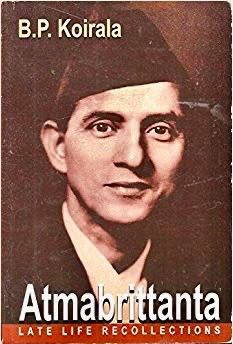
Let me confess at the outset that I didn’t pick up Atmabrittanta expecting it to feel this urgent.
B.P. Koirala, Nepal’s first democratically elected Prime Minister, dictated this book into a microphone in 1981-82 while dying of throat cancer. Since he couldn’t write anymore, he just talked to his lawyer, who sat beside him and recorded everything: no edits, second drafts or careful image management. Atmabrittanta is the story of a man at the end of his life, taking an honest trip down memory lane
And this week, as I was reading his words, RSP Chairman Rabi Lamichhane was in New Delhi meeting Prime Minister Narendra Modi, Home Minister Amit Shah, External Affairs Minister Jaishankar and NSA Ajit Doval. Then Foreign Minister Shisir Khanal followed for the highest-level government-to-government engagement since Prime Minister Balendra Shah’s administration took office in Kathmandu. These visits carry great promise against the backdrop of the Lipulekh territorial question, which has been simmering for some time.
I kept putting the book down to read the news, then picking it up again as the two felt inseparable.
The Man Behind the Book
What translator Kanak Mani Dixit calls Koirala’s “master storyteller” voice comes through on every page, but what stays with you is not the eloquence. It is the honesty.
Generally, most political autobiographies are exercises in careful forgetting. Koirala had no time for that luxury as he was dying, and he knew it. So, he talked about his failures as openly as about his victories. He talked about the years spent in exile, not with bitterness, but with the reflectiveness of someone who had learned to find meaning even in displacement. He talked about eight years in prison without self-pity. Despite all his setbacks, he never lost his sense of identity and purpose. Neither should we. These are rare qualities in any human being, let alone a politician.
What struck me most as an Indian reader is how deeply his story is intertwined with ours. He grew up in Varanasi. He joined our independence movement. Gandhi, Nehru, Jayaprakash Narayan and Lohia shaped his thinking. The struggle for democracy in Nepal did not happen in isolation; actually, it drew its breath from the same ideals that animated our own freedom movement.
That connection runs deep, and this book makes you feel it on every page.
The Moment That Stopped Me
There is an episode in the book set in New York. Indian Ambassador V.K. Krishna Menon suggests to Koirala, who at this point is Nepal’s Prime Minister, that he come along to the airport to receive Prime Minister Jawaharlal Nehru, framing it as a friendly gesture. Koirala politely declined, understanding that such optics would blur the line between personal warmth and national equality. He later reflected that Menon “just didn’t understand clean diplomacy.” To Koirala, Nehru was like a beloved elder brother, but Nepal was nobody’s younger sibling in the political sense. He held both of those truths at the same time, and he never let either cancel out the other. He wanted camaraderie between India and Nepal expressed through genuine equality; a vision India has always shared and continues to uphold.
I thought of that episode a lot while reading about this week’s visits.
What Happened This Week
The reception accorded to Lamichhane in New Delhi was remarkable as it involved meetings with the highest levels of Indian leadership, with seating arrangements resembling a full official government delegation meeting. PM Modi told Lamichhane that India is always with Nepal and ready to partner in its endeavour for development, economic progress and prosperity. Lamichhane, for his part, spoke of shared civilisational bonds, digital corridors and seamless connectivity. In short, he presented a vision of development diplomacy moving beyond past constraints.
Such warmth in bilateral relationships matters. Koirala spent decades trying to build exactly this kind of warm relationship between India and Nepal that felt like genuine friendship between equals. On the territorial question, both sides acknowledged progress achieved through patient institutional work and quiet bilateral dialogue rather than spectacle or rhetoric. Koirala would have deeply respected this approach. He had no patience for dramatic gestures that played well at home but eroded trust across the border. Diplomacy, for him, was a long game.
What the Book Ultimately Taught Me
Atmabrittanta is not really about politics, or rather, it is about politics the way a river is about water. It tackles some fundamental questions, such as how a person or a nation maintains its dignity and integrity when the world keeps pressing in.
What is remarkable about Koirala as a narrator is the generosity with which he views everyone around him, including his political opponents. He writes about Nepal’s successive political phases and leaders not with rancour but with genuine understanding, acknowledging the complexity of their positions and their sincere concern for Nepal’s stability. He saw political differences not as personal enmities but as honest disagreements between people who all cared for their country. That magnanimity of spirit is perhaps the most enduring quality of the book.
For an Indian reader, Atmabrittanta is also a quiet reminder of how much our civilisational neighbourhood has given us and how much responsibility we carry to nurture it well. The relationship between India and Nepal is not merely diplomatic. It is familial, cultural and historical. Reading this book in the same week that New Delhi and Kathmandu renewed that bond with such evident warmth felt like a privilege.
A book review is supposed to tell you whether a book is worth reading. So let me just say this: Atmabrittanta is one of those rare books that will make you feel less alone in the world as it reminds you that the hardest questions you are grappling with have been dealt with by someone before you, honestly and with great dignity. Isn’t that enough reason to read it?

Add comment