


“Land-Linked, Not Land-Locked: Reading Nepal’s Future from Delhi”
There is a particular kind of silence that settles over you at Pashupatinath at dawn, when the mist still lingers on the Bagmati and the first bells have not yet rung. The sight of pilgrims walking barefoot, the lit diyas along the riverbank, and the smoke from the pyres mingling with incense feels less like death and more like continuity. In Lumbini, the Buddha was born on ground that always feels like ours. Janakpur, Sita’s birthplace, sits quietly within Nepal’s borders as if the Ramayana never bothered with modern maps. These are not tourist stops. They are places where an Indian heart recognises home in another country.
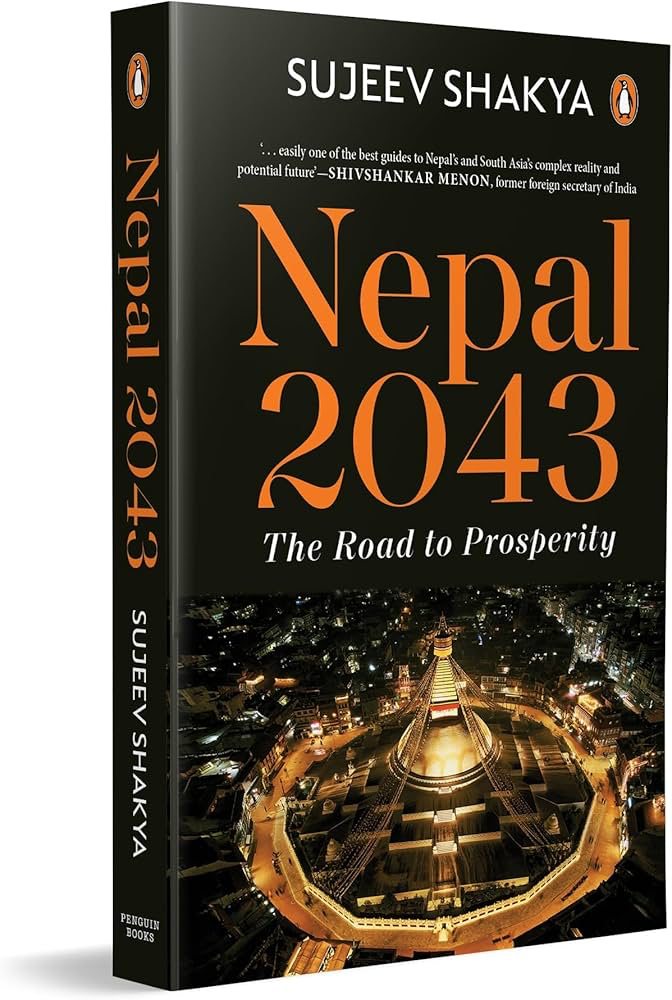
Since this country feels so much like home, one wants to see it progress and prosper. So when I came across Sujeev Shakya’s “Nepal 2043: The Road to Prosperity”, it was sure to catch my attention. I opened it not as an analyst assessing a neighbour’s economic outlook, but as someone who has always been fascinated by Nepal.
The timing is worth sitting with. Nepal’s Gen Z uprising in September 2025 brought down the government, and elections in March 2026 installed a new one. Against that backdrop, a book arguing that Nepal could become a high-income country by 2043, roughly a sixfold increase in GDP, sounds almost naive at first glance. But the argument isn’t built on wishful thinking. It is backed by data, grounded in case studies, and an honest accounting of what hasn’t worked alongside what has.
The idea the book hangs on
Nepal isn’t land-locked; it’s land-linked. Sitting between India and China, two of the world’s biggest and fastest-growing economies, is not a geographic curse but, as the book puts it, “the most valuable piece of real estate” Nepal has. A country wedged between two giants can spend its life being squeezed by both, or make itself indispensable to both. Which outcome occurs is a policy choice, not a geography lesson. From there, the book outlines five enablers: hydropower, digital transformation, agriculture, tourism and the diaspora.
Climate, energy and shared rivers: the real common ground between India and Nepal
As someone who works in this space, I found the hydropower and natural resource chapters the most quietly consequential part of the book, even if they don’t delve as deeply as a specialist might want. Nepal’s rivers and glaciers are shared regional infrastructure on which hundreds of millions downstream depend. Under the 2014 Power Trade Agreement, Nepal and India are already working towards exporting 10,000 MW of Nepali hydroelectricity to India within a decade. Just this month, the two sides agreed to raise the combined transmission capacity between the Dhalkebar and Muzaffarpur-Sitamarhi corridors from 1,100 MW to 1,650 MW. Meanwhile, Indian firms such as SJVN and NHPC are developing projects like Arun-3, Arun-4 and West Seti on Nepali soil. This is precisely the kind of concrete, unglamorous cooperation — transmission lines, joint river-basin management, coordinated glacier and forest monitoring — that the book’s land-linked thesis depends on, and where there remains enormous unrealised potential for a genuine exchange of capital, engineering capacity and climate risk management.
The book’s real strength is honesty
To its credit, the book doesn’t shy away from Nepal’s governance problems, policy flip-flopping, or the tug-of-war between tradition and modernity. It also makes a point that is relevant well beyond Nepal: that excessive nationalism gets in the way of economic cooperation, a fair warning where jingoism too often crowds out trade. This is where it earns its pragmatism, never asking Nepal to pick a side between India and China, only to extract value from both while getting its own institutions in order.
It’s only fair to note where the book falls short. Written just before the Gen Z protests broke out, it couldn’t foresee how quickly things would shift, and some of its talk about “thriving in chaos” reads a bit too generous towards institutional weakness. It also runs wider than it runs deep in places, more of an introduction than a deep dive for specialists, though none of this sinks it.
The book makes the case, with data rather than nostalgia, that 2,500 years of surviving earthquakes, blockades and pandemics isn’t misfortune so much as practice. Read from this side of the border, the book also serves as an invitation. If Nepal becomes the land-linked corridor it describes, India gains a stable, prosperous neighbour, greater energy and climate security, and a real partner in the Himalayan region. A confident Nepal that stays close to India through culture, faith, rivers and trade is squarely in India’s interest.
“Nepal 2043: The Road to Prosperity” isn’t a perfect book, but it’s an honest, necessary one. For anyone who cares about Nepal and how closely its story is bound to India’s, it offers something rarer than a forecast: a reason to hope, earned rather than borrowed.

Add comment