


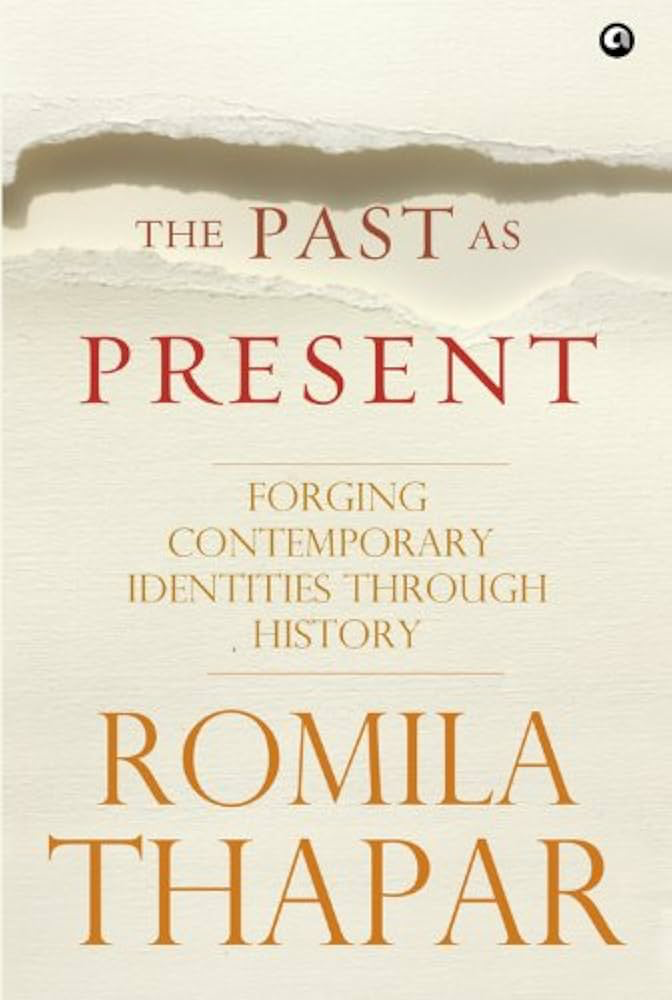
Dr Romila Thapar is a renowned historian known for her extensive contributions to the social, political, and cultural history of ancient India. She has spent decades researching Indian history with the sole aim of producing an evidence-based version of India’s past that challenges colonial narratives. Did you wonder what sparked her passion for studying Indian history from a different perspective? Here is the story of a young girl in her final year of school in Pune, who was anxious about giving a speech on the Indian Independence Day. Her account of that day shows her discomfort in speaking before a public audience. But who would have known that this discomfort would give birth to one of the eminent historians of India, Dr Romila Thapar?
‘The Past as Present’ is a compilation of essays that encapsulates broad themes highlighting how history has been used in contemporary times, particularly giving rise to debates on Indian identity. The underlying objective of these essays is to acquaint the public with the ideas and controversies that historians work with and to familiarise the general readership with the questions and investigations that they pursue. On this note, it is imperative to read between the lines and decode our history.
The legitimacy of the past
Most essays in the first part show how the present draws on the past and how it is being used to legitimise the present. Owing to this, she refers to a statement made by an English historian, E.H. Carr, who states that “history is a dialogue between the past and the present, but perhaps with a caveat.” She particularly explores the interrelationship between history as an academic discipline and its wide public usage. The nature of this change can perhaps be encapsulated in the methof of questioning existing knowledge through a critical inquiry into evidence and its reading. This applies to all forms of knowledge and not just history.
Methodologies to Interpret Early Indian History
Research generally involves two stages: collecting the data and checking its reliability, and then interpreting it. Most people are familiar with the first stage; therefore, it becomes essential to focus on the second. Dr Thapar points out how the interpretation of historical evidence has changed in the modern period, making it necessary to report it in a way that avoids ambiguity. She examines the broad trends that have shaped the interpretation of Indian history from about 1000 BC to AD 1300.
She elaborates on how the history of the subcontinent relies on two substantial views of the past – the colonial and the nationalist. Both views are believed to share contemporary techniques of historical research. Three arguments held relevance to the colonial view of Indian history. The first being Periodisation, for which Thapar refers to James Mills’s book, ‘The History of British India’, which argued for three broad periods – Hindu Civilisation, Muslim Civilisation and the British Period (pg. 9). Additionally, she explains how these two religious groups came into existence due to the prevalence of the ruling dynasties – primarily the Hindu and the Muslim – which were considered mutually hostile. She emphasised how religion was believed to have superseded all other authority. This theory became axiomatic for the interpretation of Indian history and was the basis for the partition of the subcontinent into two nations. (pg. 10)
The second view represents the concept of ‘Oriental Despotism’, which lays accent on the alleged absence of private property and state absolutism. Being a colonial concept, it emphasises and justifies Western takeover of Asian countries by arguing that the latter lacked a sense of history, and that it was their obligation to ‘civilise’ these societies.
Coming to the third view, it emphasises the innate nature of the ancient Hindu society, divided into four main castes – the varnas. The author describes that caste plays a vital role in the mechanism of segregation. Therefore, the social order changed little through history. Furthermore, she believes in the relationship between language and race, pointing out the ‘Aryan’ foundations of Indian civilisation..
● Language and Race – The author here clearly emphasises the interrelationship between language and race, highlighting the use of a particular language in a defined geographical location by a substantial number of speakers. For instance, Dravidian became the counterpoint to the Aryan, as Sanskrit came to be associated with the Aryans, and the hegemonic religion was ‘Vedic Brahmanism’.
● Data Collection – Attempts were made by the British colonisers to discover the past of the colony. The archaeological excavations began with Cunningham. Ancient scripts, such as Brahmi, were deciphered by James Prinsep and others, providing extensive and fresh information. Unfortunately, this data was not interpreted in a way that could have exposed the flaws of the colonial theories. Therefore, nineteenth-century European notions of ancient history failed to provide a complete understanding of the Indian material.
Perspectives on Nation-Building
The concept of a nation-state is the outcome of a historical moment. The present-day problems that we, as a nation, witness arise from our inability to comprehend the nature of this historical lag. The Indian educational system in the nineteenth century was based on a colonial mindset, susceptible to intellectual analysis, which the conservatives prefer to disown to cover up problems with their own theories. If we truly want to create a period of ‘renaissance,’ we need the ability to maintain a sustained, questioning dialogue on issues rather than relying on self-serving interpretations. (pg. 31).
It is evident that history is an essential component of nation-building; perhaps it signifies that history is perceived in different ways by different communities when the paradigm changes. A nation-state represents a new historical experience and therefore requires a new identity, providing equal rights and opportunities to every single citizen of this country (pg. 41).
Creation of an identity
The mid-twentieth century is considered a watershed moment in the history of South Asian nations, marked by liberation from colonial rule. This liberation posed a question about who we are and how we define ourselves. The author clarifies that the word ‘identity’ is used with reference to a collective of people or a community itself.
Romila Thapar assesses the relationship between the identities of race, caste, language, tribe, and religion and how this colonial perspective is still embedded in our society. Similarly, the Aryan or Indo-Aryan languages were named by the colonial scholars after those who called themselves ‘Aryas’ in the Vedas, although no mention of race has been made in the historical texts. Thapar frequently emphasises the colonial, deep-rooted attitude in the historical research.
She quotes Herbert Risley’s interpretation, who undertook to measure cephalic index and nasal width to prove the racial equation (pg. 48). She emphasises that a nation needs broad identities transcending morphological and cultural differences.
Dimensions of Religion
The second section of the book discusses the interrelationship of religion and history.
Communalism – The author notes that communalism is a policy which identifies communities mostly according to their religions and points out that political parties use it to serve their vested interests. This is completely different from the past, when community identities were not defined by religion, caste, language, and occupation.
● Another section of Dr Thapar’s book emphasises the interpretation of social ethics that was pre-eminent in early Buddhism. It elaborates the relationship between the individual and society. The Buddhists define social behaviour as determined by ethical norms conducive to universal well-being. Additionally, she notes that Buddhism and Jainism gave women the option to become nuns, offering an alternative to a conventional life (pg. 133). She yet again points out that the colonial narrative focuses on Hinduism and Islam, thereby ignoring the presence of other religions in the country.
● How the term ‘Hinduism’ has been perceived in contemporary times is a matter of great concern. It is more than the discussions on Hindu philosophy and theory. She contends that the new ‘Hinduism’ that is being propagated in some circles attempts to depict it as monolithicm, uniform set of beliefs and practices (pg. 139).
The author analyses the evolution of ‘idol worship’ and points that many aspects of Hinduism that are considered relevant today have been shaped more in the last thousand years than in the previous millennia. She discusses the teachings of the Ramayana and Mahabharata and shows these texts have been shaped in contemporary times.
Another interesting angle to her discussion is the definition of ‘Hinduism’ in the Hindu diaspora abroad. She notices that Hindu communities settled abroad mostly look for sects that can support their need for cultural stability and financial security, (pg. 162).
Debates
The third section of the book comprises six chapters that discuss overlapping concepts. ● It discusses a long-running controversy regarding the historical authenticity of the Ramayana and the Mahabharata that flared up in 1975. It had been debated in daily newspapers and by academics, and any statement is a matter of public scrutiny. She further points out that an ‘ancient tradition’ poses two broad problems – the need to either disprove it by dismissing it as valueless or verify its authenticity.
Our Women
The last section of the book emphasises the condition of women in early India and how it has worsened in contemporary times. She explains the deteriorated conditions of women in the nineteenth century. They were at the margins of history and were neglected. She shows that women from lower castes were denied education, and this was reflected in a few texts.
Concluding remarks
The book reflects on the desired parameters for the society we should aspire to live in, and shows how far we have come since India attained independence. It emphasises the continuing need to address age-old injustices that are still embedded in our mindset.

Add comment