


Introduction
In the Research and Analysis Wing’s (R&AW) R.N. Kao Memorial Lecture earlier this year, the Union Home Minister warned the representatives of forty nations against allowing “narco-states to become the world’s next power centres”. Although it is well established that narcotics fund terroris, a fundamental transformation in the operation of insurgency movements across South Asia is underway, and has been for a while. This piece examines how insurgencies have transformed from highly politically dependent organizations to self-sustaining economic enterprises.
For most of the post-Cold War era, insurgencies survived due to the support of external actors. The Liberation Tigers of Tamil Eelam (LTTE) relied on Tamil diaspora funding, Kashmiri terrorist groups operated on the Pakistani state’s financing, while insurgencies in the Northeast depended on external sanctuaries and cross-border sympathisers. The old model was inherently fragile, for it gave external actors full control over the conditions under which these insurgencies would operate.
The Transformation
To understand this transformation, we shall look at how the United Wa State Army (UWSA) in Myanmar operates. With an estimated 20,000 to 30,000 troops, it controls territory in the northeastern Shan State. The UWSA manufactures hundreds of tonnes of methamphetamine annually using precursors from China, transported across the Shan-Yunnan border. Unlike insurgencies of the previous generation, it is self-sustaining, not relying on ideology, a political causes, or state patronage. Put simply, the UWSA does not suffer from a narcotics problem, but is a narcotics-based enterprise that maintains an army.
There are three reasons why this transformation is taking place. First, international financial oversight has made conventional terror financing detectable. Pakistan’s financial strangulation through three Financial Action Task Force (FATF) grey-list periods ended up straining formal channels through which the state funded proxy groups. Second, the industrialisation of synthetic narcotics has created a continuous, scalable stream of revenue independent of geographical factors. Unlike opium which is seasonal and land-intensive, methamphetamine requires merely a laboratory and precursors. Third, ideological recruitment has weakened across the region. Organisations such as the Lashkar-e-Taiba (LeT) and LTTE that once relied heavily on ideological appeal, must now offer sufficient wages to its recruits, which require revenues on the scale that only narcotics can provide.
The Pakistani Angle
The transformation is best observed in Jammu and Kashmir. In contrast to the 1990s and 2000s when thousands of local youths were recruited annually to sustain the insurgency, only seven locals joined terrorist ranks in 2024, and only a single person in the first half of 2025. Of the 125 to 130 active terrorists in J&K, security agencies estimate 115 to 120 are Pakistani nationals, who are salaried operatives sustained by revenues from narcotics smuggling and digital-wallet financing outside of FATF monitoring. However, heroin abuse in Kashmir has surged over 2,000 per cent in five years, with cross-border narcotics smuggling being used as an instrument of societal incapacitation.
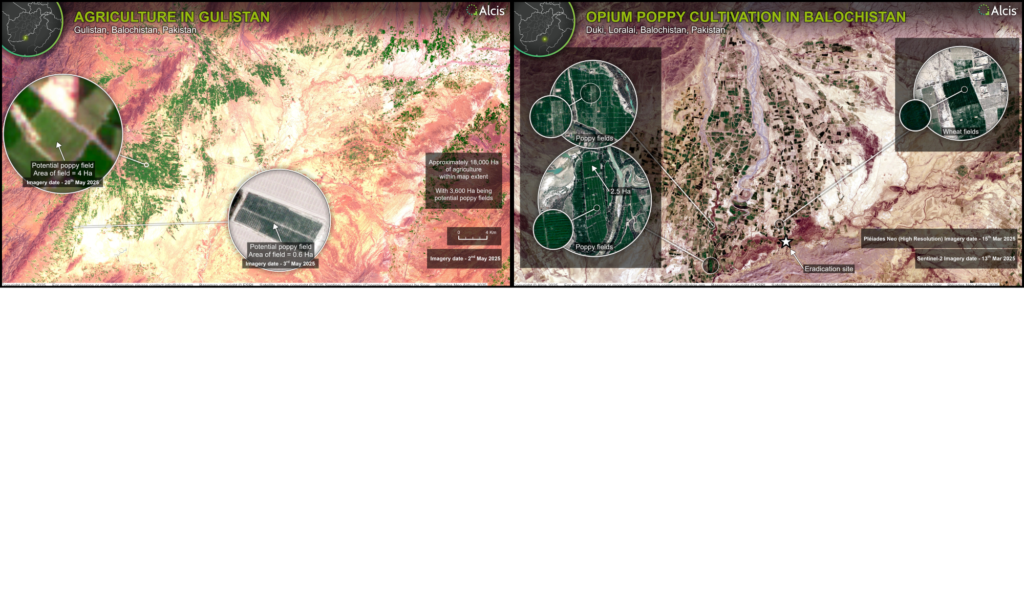
After the FATF grey-listings, Jaish-e-Mohammed (JeM) migrated roughly 80 per cent of its operational finances to EasyPaisa and SadaPay, both Pakistani fintech companies invisible to SWIFT. Three months after Operation Sindoor destroyed JeM’s headquarters in Bahawalpur, they launched a public fundraising campaign through these wallets to collect PKR 3.91 billion (~14 million USD) for 313 new training centres. In the meantime, satellite imagery by Alcis shows the expansion of Balochistan’s poppy economy. In districts such as Duki and Gulistan, poppy occupies up to 70 per cent of farmland, with poppy cultivation on a scale that exceeds Afghanistan’s peak production years. The National Investigation Agency’s (NIA) filing in October 2025 documents 500 kg of heroin smuggled from Pakistan to Gujarat via waterways, with proceeds directly funding Lashkar.
The Neighbourhood
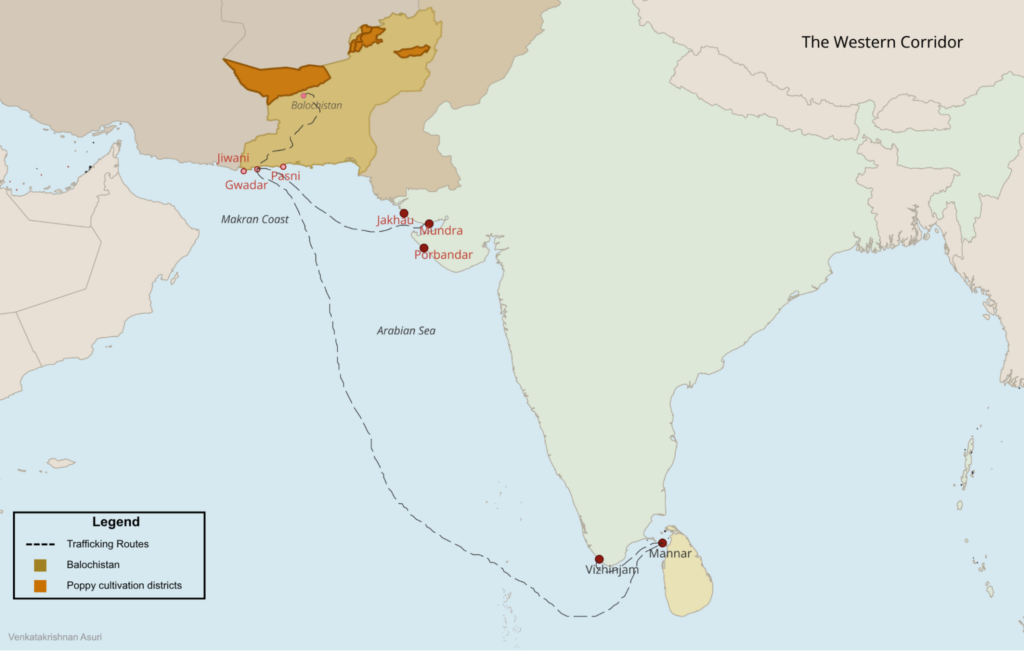
While India’s counter-narcotics architecture has historically been turned toward the western border, the threat has now spread. The civil war in Myanmar has made it the world’s largest opium producer, surpassing Afghanistan, and the epicentre of global meth production, with significant quantities being smuggled into India through the largely unfenced northeastern border. Throughout the Northeast, where armed groups like the National Socialist Council of Nagaland-Khaplang [NSCN(K)] now depend on drug trafficking for revenues, opioid prevalence in Mizoram and Nagaland has exceeded the national average by more than tenfold. The Chittagong Hill Tracts (CHT) in Bangladesh serve as a transit corridor, with Rohingya camps in Cox’s Bazaar redistributing yaba. Similarly, Sri Lanka is used as a relay point for narcotics originating from Makran in Balochistan, with networks linked to the Inter-Services Intelligence-backed (ISI) drug lord Haji Salim routing consignments of drugs and arms operating in Sri Lankan waters and vessels before reaching India’s south-western coast.
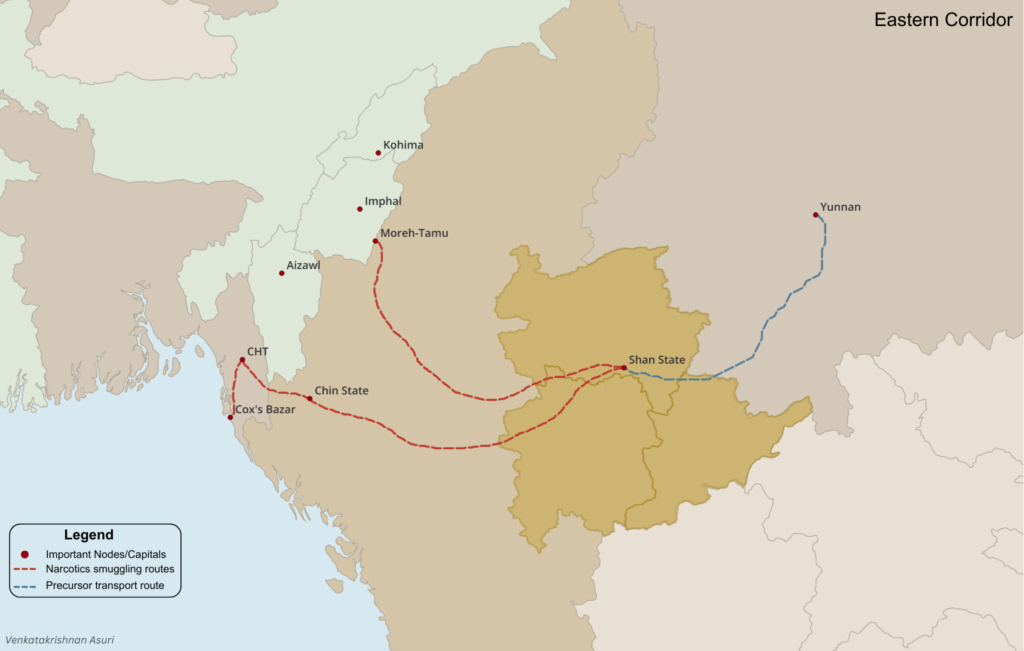
The transformation will prove to be more problematic than the conventional systems. The integration of insurgent groups into the narco-trafficking economy makes political settlements economically irrational, as illustrated by the disturbances in Manipur. Myanmar’s civil war has transformed the region into a major hub for opium and methamphetamine production, with drugs being smuggled into India through corridors such as Moreh-Tamu. With both Meitei and Kuki armed groups deeply involved in the drug economy, continued instability has been more profitable than conflict resolution.
Conclusion
The most persistent insurgencies in South Asia increasingly exhibit the characteristics of commercial enterprises with armed wings, not the other way round. This challenges India’s traditional security doctrine, which was built to combat state-sponsored insurgencies. As long as the underlying financial ecosystem, including production and supply chains, remains intact, insurgencies will continue to spawn and expand throughout India’s neighbourhood. This new era of self-financed insurgencies requires an entirely different approach to security and counterinsurgency. That must involve targeting financial ecosystems as well as physical infrastructure, while treating narcotics as the primary instrument of proxy war.



Add comment