


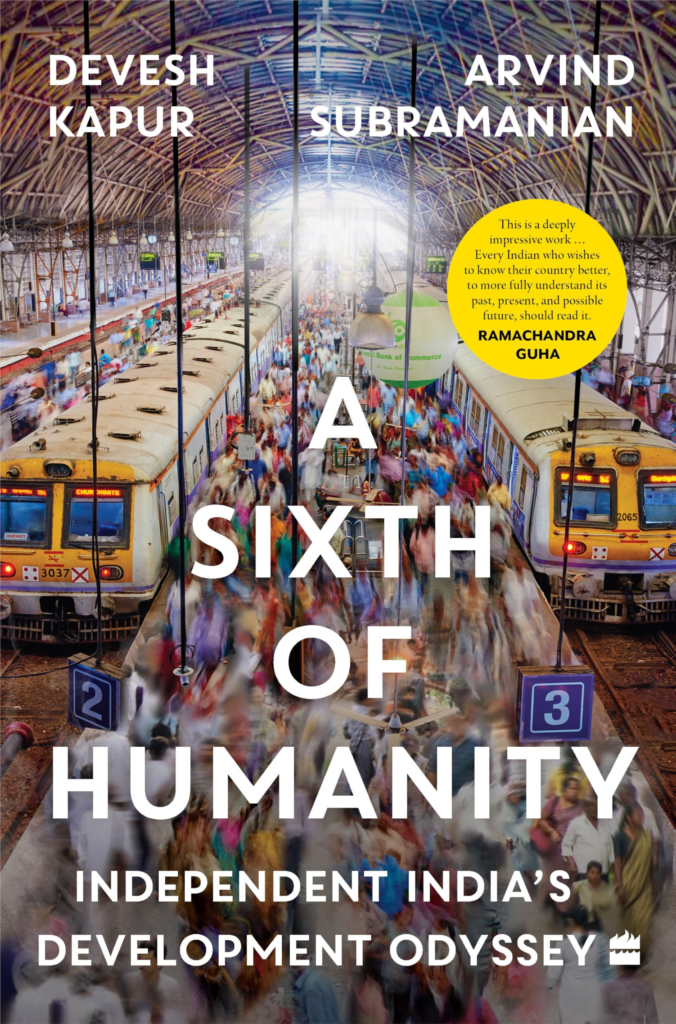
Most books on the Indian economy settle for describing what happened. A Sixth of Humanity, the sprawling new work by the political scientist Devesh Kapur and the economist Arvind Subramanian, sets out to do something harder: explain why India’s development had to unfold the way it did. At 760 pages, it is not a book one finishes in a weekend, and it does not pretend to be. But for readers willing to sit with its argument, it offers something most accounts of India’s growth story do not: a single explanatory thread running through seventy-five years of state-building, economic policy, and social change.
The authors’ central claim is that India’s development was “precocious”, that it did things out of order compared with almost every other successful late developer. Universal suffrage arrived before industrialisation. A services-led boom overtook manufacturing before the country had absorbed its surplus agricultural labour. Talented, English-speaking Indians left for Silicon Valley and the Gulf even as hundreds of millions at home remained locked out of decent jobs. Where South Korea, Japan, and China built rural productivity first and let cities and factories follow, India tried to compress every stage of development into a shorter, messier timeline, with democracy as both an engine and a brake.
That framing produces one of the book’s most useful contributions: a reassessment of what actually happened in the “socialist” decades between 1950 and 1980. Kapur and Subramanian argue that this period is better described as a scarcity economy than as one of straightforward import substitution. Licensing rules, entry barriers, and a deep suspicion of large-scale meant that Indian firms were rarely large or efficient enough to replace imports even where they wanted to. Public sector enterprises, meanwhile, were expected to be at once engines of industrialisation and guarantors of employment – two goals that pulled in opposite directions and, according to the authors’ figures, left state enterprises without a single profitable year between 1970 and the present.
The book’s more provocative argument concerns what the authors call India’s default political instinct: a kind of statism they capture in the Hindi phrase mai-baap sarkar, or “government as mother and father.” This is not simply a description of left-wing economic thinking; the authors suggest it cuts across the ideological spectrum and has shaped how ordinary Indians relate to the state ever since independence. Government is expected to provide and protect, even as it routinely fails to deliver the most basic public goods such as functioning schools, clean water, and reliable electricity. The result, in their telling, is a state that intervenes constantly yet remains strangely absent where it matters most, a paradox they illustrate with a memorable image: a “Kamdhenu state,” after the wish-granting cow of Hindu mythology, endlessly milked by competing constituencies for subsidies, quotas, and protections, with no politician willing to bear the cost of weaning the country off them.
Where the book is most persuasive is in its treatment of human capital. The authors show, with considerable statistical detail, how India consistently chose physical capital over people: tertiary education over primary schooling, urban elites over rural populations, industrial policy over public health. Adult literacy roughly doubled between 1950 and 1980, they note, but China’s more than tripled over the same stretch. Even the growth that followed liberalisation in 1991 did not translate into learning gains or mass formal employment at anything like the pace seen in East Asia. This, more than any single policy misstep, is where the authors locate India’s “durable disappointment” – a phrase that runs through the book like a refrain.
The chapters on India’s states are the most rewarding, precisely because they complicate the book’s own thesis. Kerala’s history of land reform and its networks of women’s collectives, Tamil Nadu’s pivot toward manufacturing, Punjab and Haryana’s Green Revolution gains, and Himachal Pradesh’s early success in primary education are not similar stories reflecting a national failure; they are divergent regional experiments, some of which worked remarkably well. If there is a criticism to be made here, it is that the book, for all its statistical richness, occasionally treats these regional successes as footnotes to the larger narrative of dysfunction rather than as evidence that India’s problems were never quite as inevitable as the “precocious democracy” framing suggests.
The book is denser with data than with argument in places, and its treatment of more recent policy shifts, including the turn towards industrial policy and welfare delivery through digital infrastructure over the past decade, reads more descriptively than analytically, an observation rather than a verdict on any particular government’s record.
None of this diminishes what Kapur and Subramanian have accomplished. Few books manage to hold economics, political science, and social history in the same frame without one discipline swallowing the others. A Sixth of Humanity does, and it does so while resisting the two easiest narratives available to writers on India: uncritical celebration of its democratic resilience and flat condemnation of its economic failures. The truth, as the authors show at length, sits uncomfortably between the two. India built one of the world’s most durable democracies under conditions that, on paper, should have made that impossible, and then struggled for decades to convert that political achievement into broad material progress for its citizens.
Whether the “precocious democracy” thesis fully explains that gap, or whether it is one factor among several, including choices that were reversible and specific rather than baked into the country’s founding conditions, is a question readers will keep arguing about long after they close the book. That, perhaps, is the surest sign of a work worth taking seriously.

Add comment