


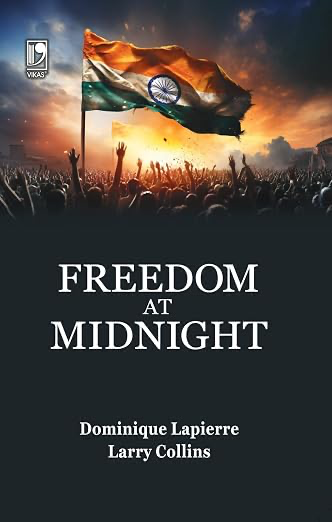
Freedom is the greatest blessing a nation can achieve, but some free nations are born at the cost of blood, tears, and immense human suffering. India’s independence and Partition represent one such momentous event. On August 15, 1947, the centuries-old dream of an entire nation was finally realised. At the same time, the country was divided along religious lines, forcing millions of people to abandon their homes and become refugees. The excitement and tragedy of this momentous transformation are vividly captured in Freedom at Midnight, the celebrated book by Larry Collins and Dominique Lapierre.
Published in 1975, the book has completed fifty years and remains a favourite among readers interested in modern Indian history. Rather than presenting history as a collection of dates, events, and political decisions, the authors transform it into a compelling narrative of human emotions, personal experiences, and political drama. The book takes readers through the final months of British rule, the horrors of Partition, and the assassination of Mahatma Gandhi.
Lord Mountbatten, the last Viceroy of British India, occupies a central position in their account. As the man entrusted with the task of writing the final chapter of the British Empire in India, his experiences and impressions are historically significant. Extensive interviews with Mountbatten and access to his personal records provide the authors with valuable material. Nevertheless, this strength also becomes one of the book’s limitations. Mountbatten’s perspective receives considerable attention, sometimes overshadowing the responsibilities of the British imperial establishment. The narrative occasionally presents the transfer of power through the eyes of the departing colonial rulers rather than those who had endured centuries of colonial exploitation.
The political positions of Winston Churchill and Clement Attlee, the British withdrawal, and the hurried decisions surrounding the transfer of power are important parts of this history. While remembering the grandeur of the British Empire, we must also acknowledge the enormous human and economic costs of colonialism. Independence was a triumph of India’s political struggle, but the circumstances of Britain’s departure created one of the greatest humanitarian disasters of the twentieth century.
The tendency to concentrate the responsibility for Partition exclusively on Muhammad Ali Jinnah and the Muslim League also deserves critical examination. Jinnah’s political ambitions and the League’s demand for Pakistan were undoubtedly important factors. Nevertheless, Partition cannot be explained through the actions of a single individual. British haste, growing mistrust between the Congress and the Muslim League, communal politics, and regional tensions all contributed to the tragedy. Jinnah’s sister, Fatima Jinnah, also provides an interesting illustration of the political and personal contradictions surrounding his life. A comprehensive understanding of Jinnah and the Muslim League requires a broader historical perspective.
Sardar Vallabhbhai Patel deserves particular recognition as one of the principal architects of independent India. His extraordinary contribution to the difficult process of integrating hundreds of princely states into the Indian Union remains one of the greatest achievements of post-independence statecraft. Patel combined political realism with a remarkable understanding of the personal pride and concerns of princely rulers. His close associate, V.P. Menon, played an indispensable administrative and diplomatic role in this historic undertaking. The contributions of national leaders and diplomats, including V.K. Krishna Menon, must also be understood within the wider political context of India’s emergence as an independent nation.
The book’s descriptions of princely India make up its most appealing section. Palaces, jewellery, elephants, hunting expeditions, and extravagant royal lifestyles reveal a world of extraordinary opulence and refinement (with some journalistic sensationalism). Yet, outside these magnificent palaces, millions of ordinary Indians struggled with poverty, hunger, and deprivation. The wealth of the Nizam of Hyderabad, one of the richest rulers of his time, offers a striking illustration of the contradictions between royal extravagance and the everyday realities of ordinary people. Personal anecdotes about Rajas and Nawabs make the narrative entertaining, but they should not distract readers from the acute social inequalities of the period.
Mahatma Gandhi emerges as the most emotionally compelling figure in the book. Far removed from the splendour of political power, Gandhi embraced simplicity and identified with the suffering of ordinary Indians. His refusal to participate in the celebration of independence while communal violence continued reflects the moral foundation of his political philosophy. His personal sacrifices were immense, and his life continues to inspire debates about the relationship between morality and politics.
Gandhi’s journey through the violence-stricken villages of Noakhali remains one of the most remarkable episodes of the Partition period. While religious hatred turned neighbours into enemies, Gandhi travelled through the affected villages, attempting to restore peace and mutual trust. His presence demonstrated the power of moral courage and personal commitment in situations where political and military authority often failed. At the same time, the inability of his efforts to prevent widespread communal violence reveals the tragic limitations of individual intervention.
Partition also destroyed economic relationships that had developed over generations. Eastern Bengal was a major producer of raw jute, while many jute mills were located in western Bengal. The division disrupted established agricultural, industrial, and commercial networks. Borders separated not only communities but also economic resources, livelihoods, and interconnected markets. The colonial splendour of Shimla, with its magnificent landscapes and its elite administrative legacy, similarly reminds us of the contrasting realities of British imperial India.
Freedom at Midnight remains a remarkable historical narrative, but it is not the final word on India’s independence. Its dramatic storytelling and personal anecdotes contributed significantly to its bestselling status. Translated into several Indian languages, including regional ones in India, the book introduced generations of readers to the complexities of independence and partition. Its popularity, however, should encourage critical engagement rather than unquestioning acceptance of every interpretation given by its authors.
Fifty years after its publication,Freedom at Midnight continues to illuminate the triumphs and tragedies of India’s birth as an independent nation. The midnight of freedom brought hope, dignity and national pride, but its shadows were filled with displacement, communal hatred and human suffering. Reading this book helps us understand both sides of that historic transformation.The true purpose of studying history is not merely to remember the past,but to learn from it and build a more just, peaceful and united India.In understanding the price of freedom,this remarkable bestseller remains an indispensable starting point.

Add comment