


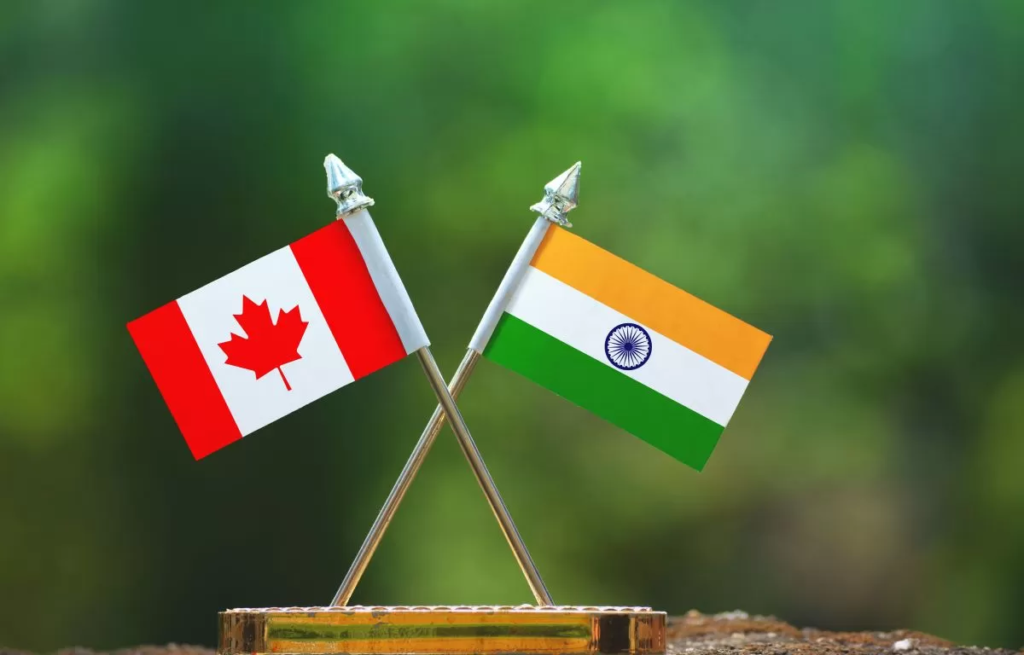
When Canadian Prime Minister Mark Carney concluded his visit to India on Monday, it symbolised the closing of one of the most turbulent chapters in India–Canada ties and the beginning of a deliberate effort to rebuild the relationship on firmer foundations. Less than three years ago, ties were in deep freeze; today, both sides are again speaking of trade expansion, energy security, technological collaboration and Indo-Pacific coordination. It reflects political change in Ottawa, economic compulsion triggered by Washington, and a recognition that narrow politics must not override strategic logic.
The Political Reset and the Trump Shock
The rupture of 2023 under former Prime Minister Justin Trudeau marked the lowest point in bilateral ties. Public allegations over the killing of Hardeep Singh Nijjar led to diplomatic expulsions, suspended trade negotiations and a collapse of political trust. Trudeau’s minority government, dependent on the New Democratic Party led by Jagmeet Singh, was constrained by domestic vote-bank pressures.
Carney’s arrival in mid-2025 altered that calculus. With a stronger mandate and a technocratic reputation, he chose to depoliticise the most contentious issues. The rhetoric subsided. The investigation into Nijjar was allowed to proceed through judicial channels rather than political podiums. Quiet diplomacy replaced megaphone rhetoric.
The symbolic turning point came when Carney invited Prime Minister Narendra Modi to the 2025 G7 summit in Kananaskis. The meeting signalled political intent: the relationship would not remain hostage to a single dispute.
If leadership change created space for a reset, external pressure provided urgency. The return of Donald Trump to the White House jolted Ottawa. With roughly three-quarters of its trade in goods tied to the United States, Canada confronted tariff threats and questions about its economic autonomy. Diversification ceased to be a slogan — it became a survival imperative.
India, as the world’s fastest-growing major economy and a vast consumer market, naturally emerged as central to that strategy. Carney has spoken of the need for middle powers to build resilience in a fractured global order. In that context, India is indispensable.
Economics and the Human Bridge
Even during the diplomatic freeze, the economic underpinnings of the relationship proved more durable than politics. Canadian pension funds — often described as the “Maple 8” — continued expanding their exposure to Indian infrastructure, logistics and renewable energy. Their cumulative investments in India now approach $100 billion. For Canadian pension systems facing an ageing population at home, India offers scale, growth and long-term returns through infrastructure, digital expansion and energy transition.
Trade ambitions reflect the same logic. Negotiations toward a Comprehensive Economic Partnership Agreement have been relaunched, with an eye on doubling bilateral trade to $50 billion by 2030. Energy is central to this vision. Canada, a major producer of uranium and liquefied natural gas, has positioned itself as a reliable long-term supplier to India’s expanding energy matrix. The recent uranium agreement with Cameco underscores this complementarity.
Agriculture remains critical. Canada is a leading supplier of pulses to India, while its potash reserves are vital to India’s fertiliser security. In critical minerals and clean technologies, both sides see the opportunity of reducing overdependence on concentrated supply chains elsewhere.
Perhaps the most underappreciated stabiliser in this relationship is the human dimension. Canada, though roughly one-tenth the population of the United States, hosts nearly twice as many Indian students. More than 400,000 Indian students contribute billions of dollars annually to the Canadian economy while filling labour shortages, particularly in STEM sectors. This human bridge embeds the relationship in families, campuses and communities across both countries, making prolonged estrangement costly.
Security Dialogue and the Indo-Pacific Convergence
A crucial lesson from the past crisis has been the need to move sensitive matters into structured channels. The February 2026 visit of National Security Adviser Ajit Doval to Ottawa, where he met his counterpart Nathalie G. Drouin, marked an important step. Agreement on a high-level security dialogue and cooperation against transnational crime and extremism signalled institutional maturity.
From the outset, attempts to publicly link India to unlawful activity in Canada destabilised the bilateral relationship. India has nothing to gain from undermining the institutions of a fellow democracy with which it is deeply interconnected. At the same time, India’s concerns about extremist elements operating openly in Canada are longstanding and reflect legitimate security considerations. Compartmentalisation may help in the short term, but a resilient partnership will require acknowledging these realities and building a shared understanding of each other’s red lines.
There is also a broader geopolitical canvas. Canada’s growing emphasis on the Indo-Pacific, and Carney’s outreach to partners such as Japan and Australia following his visit to India, signal recognition that the region will shape the balance of power in the decades ahead. For India, a greater Canadian role in a free and open Indo-Pacific is a net positive. Cooperation in critical minerals, artificial intelligence and space — including engagement between ISRO and the Canadian Space Agency — adds substance to this convergence.
From Tactical Reset to Structural Alignment
The reset of bilateral ties is real, but its durability will depend on institutional depth rather than personal chemistry. Indian diplomacy would do well to use this opening to impress upon Ottawa that the turbulence of recent years was deeply shaped by partisan calculations. Future governments must resist allowing domestic political compulsions to hijack a consequential partnership.
Carney appears intent on building a relationship anchored in trade, energy security, technology and geopolitical coordination. India should reciprocate — not from sentiment, but from calculation. A stable Canada–India partnership strengthens supply chain resilience, diversifies energy routes and reinforces a multipolar Indo-Pacific order.
The task now is to convert tactical accommodation into structural alignment. If both sides internalise the lessons of the recent rupture — that public recrimination serves no one and that quiet institutional engagement works better — this reset may endure. Whether the recent visit becomes a footnote or a foundation for a restored partnership will depend on what New Delhi and Ottawa choose to build next.

Add comment