


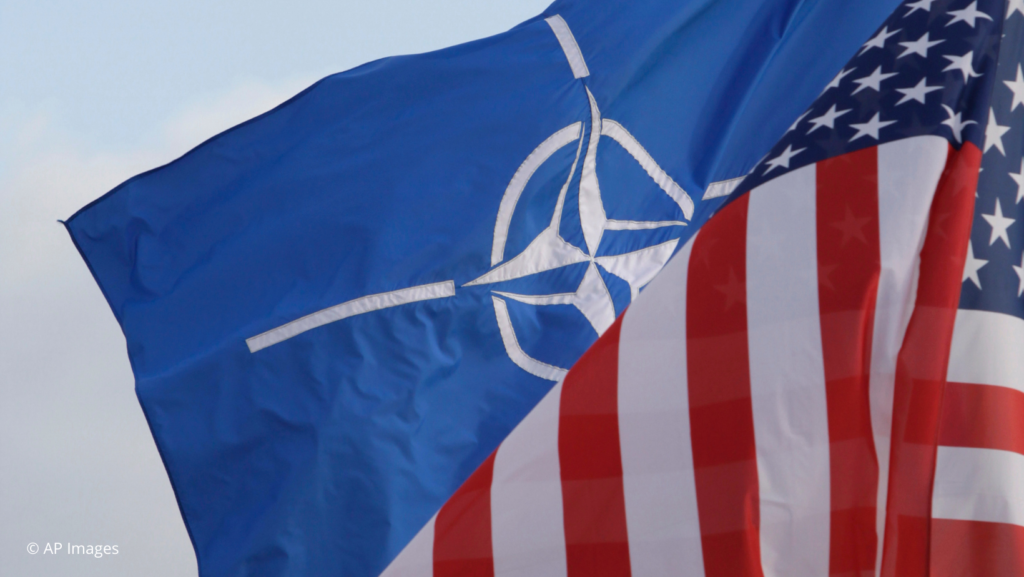
Reports circulating in recent days about a possible reorganisation of the military leadership of the Atlantic Alliance have reignited the debate on the role of the United States in Europe and on the very nature of American leadership within NATO. According to several journalistic sources, Washington would be prepared to transfer the command of two major operational headquarters to European officers: the Joint Force Command in Naples, set to be entrusted to Italy, and the command in Norfolk, which would pass to the United Kingdom.Some observers have interpreted this development as a signal of U.S. retrenchment from the European theater, or even as the beginning of a “Europeanisation” of the Alliance. Such an interpretation, however, risks capturing only the apparent significance of the decision. When placed within a broader theoretical and analytical framework – namely that of reciprocity and asymmetric alliances in hegemonic contexts – the reorganisation of NATO commands should be seen instead as a functional adaptation of U.S. hegemony, rather than as a substantive reduction of it.Command, Responsibility, and Hierarchy: Three Levels Not to Be ConfusedThe first analytical issue concerns the distinction – often overlooked in public debate – between formal command roles and effective strategic prerogatives. Alliances led by a hegemonic power are not based solely on the distribution of specific senior positions, but rather on a deeper structure of access, procedures, and decision-making capabilities that ultimately determine who exercises real control over joint action. From this perspective, reciprocity can be divided into three closely interconnected yet analytically distinguishable dimensions: a political and symbolic dimension, which concerns the distribution of appointments, the visibility of command, and the rhetoric of partnership; an operational dimension, related to the day-to-day management of forces, access to infrastructure, and the execution of missions; and a properly strategic dimension, which concerns the definition of priorities, the selection of theaters, the control of escalation, and, ultimately, the decision of whether, when, and how to employ force.The transfer of commanding roles in Naples and Norfolk to the host governments falls primarily within the realm of political reciprocity and, to a more limited extent, operational reciprocity, without affecting the decisive level of strategic reciprocity, which remains firmly in the hands of the United States. Washington, in fact, retains leadership over the Alliance’s main functional commands – air, land, and maritime – as well as control over the command, communications, and intelligence architectures that make strategic direction effective. Above all, it continues to hold the position of Supreme Allied Commander Europe (SACEUR), which remains the true fulcrum of NATO’s decision-making chain. In this sense, the Alliance’s hierarchy is not dismantled, but rather reorganised in a way that further accentuates the separation between the politically visible roles and the substantive control over strategic prerogatives.An Apparent Transfer, a Preserved PrerogativeRead from this perspective, the U.S. “relinquishment” of leadership over two operational commands cannot be interpreted as a loss of power, but rather as a rationalisation of responsibilities within the Alliance. It reflects a hegemonic logic aimed at preserving the freedom of action of the decision-making center while simultaneously reducing the political and symbolic costs of leadership. Entrusting European partners with the management of regional commands allows the United States to respond to European demands for greater political recognition, to reinforce the narrative of burden sharing, and to limit direct exposure to regional dossiers that are regarded as secondary to global strategic priorities. All this, however, takes place without opening the door to full strategic reciprocity, which would imply a genuine sharing of control over the Alliance’s fundamental choices. The distinction between a predominantly managerial form of command and a genuinely directive one remains intact, confirming the persistence of a functional hierarchy at the core of the allied order.Europe, Growing Burdens, and Conditional SovereigntyFor European allies, the assumption of greater command responsibilities entails formal recognition of their status as allies, but also a burden. Managing NATO commands entails taking on operational functions, political risks, and organisational costs, without enjoying a corresponding degree of strategic autonomy. In this sense, the reorganisation may reinforce a familiar dynamic: the increase in Europe’s responsibilities does not automatically bring more decision-making power. European states become seemingly more involved in managing the system, yet remain peripheral to critical decision-making.The outcome is a form of functional sovereignty—expanded at the operational level, but constrained at the strategic one. Over the medium to long term, however, the accumulation of operational responsibilities and command functions by European allies could generate political and strategic requirements for greater decision-making autonomy, particularly if the gap between the burdens assumed and the capacity for effective influence were to widen. At present, however, such dynamics do not lead to a structural transformation of the alliance: the growing responsibilities borne by Europe remain embedded within a hierarchical framework that maintains the decisive strategic prerogatives of the hegemonic state.The Indo-Pacific Factor and the Reallocation of PrioritiesThe global context in which this decision takes shape is equally significant. The increasing centrality of the Indo-Pacific theater and the rising strategic competition with China are prompting Washington to concentrate resources, political attention, and military capabilities in an area regarded as decisive for the preservation of US preponderance. From this perspective, Europe does not disappear from the American agenda, but is rather reclassified—from a primary theatre to a peripheral space to be stabilised through outsourcing, integration, and indirect management. The transfer of some NATO commands fits squarely within this logic of priority reallocation, rather than signaling a strategy of disengagement.Conclusion: Adaptation, Not a Post-Hegemonic TransitionThe reorganisation of NATO commands does not mark the emergence of a “post-American” Alliance, nor does it signal a transition toward genuine Euro-Atlantic balance. Rather – at least for the time being – it signals an adaptation of U.S. hegemony to new systemic conditions, in which it aims to retain final decision-making power while delegating peripheral roles and burdens to junior partners.From this perspective, hegemony is not measured by the number of commands formally held, but by the capacity to define strategic priorities, to control decision-making structures, and to maintain global freedom of maneuver. As long as these conditions remain intact, the “transfer” of command responsibilities will be less a sign of decline than a method to manage power asymmetry, essential to the continuance of the NATO system.In this sense, more than a contingent exception, the reorganisation of commands can be read as a replicable model for managing power imbalances, one likely to be duplicated whenever the hegemon is called upon to try new forms of leadership without relinquishing its fundamental strategic prerogatives.



Add comment