


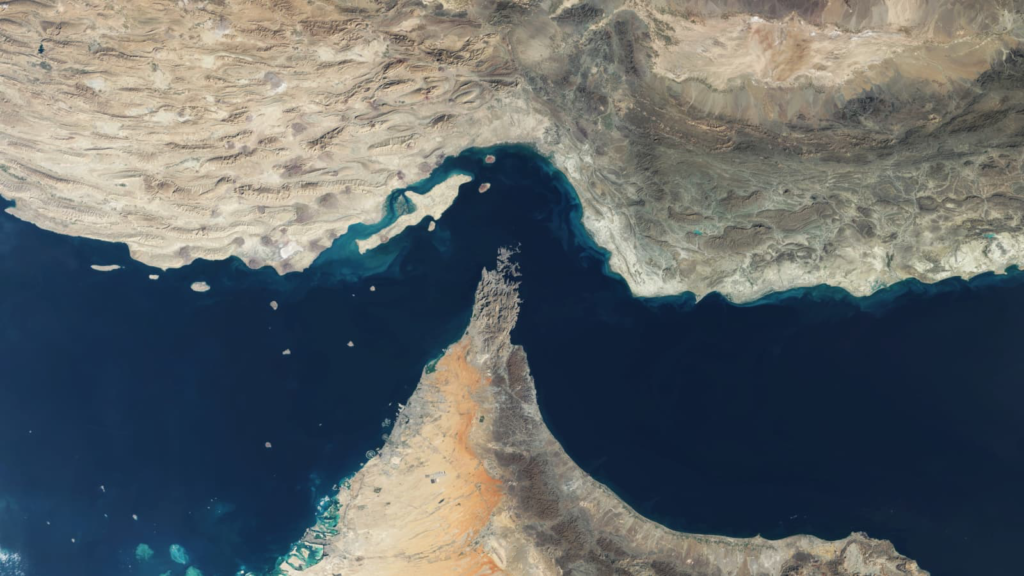
The Strait of Hormuz is no longer a Middle Eastern energy-security problem. It is, in effect, an Indo-Pacific problem – structurally and operationally. From 1990s, Western analysts have viewed Hormuz almost exclusively through the lens of the Iran–Gulf Arab States–United States geopolitical rivalry, taking it for granted that any disruption of the strait of Hormuz would be a regional crisis with global energy implications but that framework and the assumptions it implies are now obsolete because it neglects the perspective of those states that are most harmed by a closure of the strait of Hormuz.
The current Strait of Hormuz crisis, precipitated by US-Israeli strikes against Iran in late February, makes this structural shift glaringly clear in operational terms, and the most vulnerable countries to Hormuz disruption are not the Gulf oil producers or Western energy consumers, but the major Indo-Pacific consumer economies, such as India, Japan, South Korea, and China, who import between about 40 to 85 per cent of their total crude and liquefied natural gas imports via Hormuz.
The Energy Geography: Eastward Demand Concentration
The demand side of the eastward concentration claim is evident from the changing nature of energy flow through Hormuz, because nearly 90 per cent of the crude oil and condensate transiting through the Strait of Hormuz has been heading to Asian markets with China, India, Japan and South Korea making up about 75 per cent of that total. In 2025, about 20 million barrels of oil per day were transiting through Hormuz, which was approximately 20 percent of global petroleum liquids consumption and about 34 percent of all crude oil traded internationally. The directional skew is equally asymmetrical as China received about 38 per cent, India 15 per cent, South Korea 12 per cent and Japan 11 per cent, while the US received about 2.5 per cent from the crude oil transiting through Hormuz.
The LNG pattern is just as striking. In 2025, Qatar, for instance, exported more than 112 billion cubic metres of LNG through the Strait of Hormuz, and about 90 percent of it went to Asian countries. Bangladesh, India, and Pakistan received almost two-thirds of their total LNG imports through Hormuz. Thus, the obvious strategic implication of this demand-side concentration is that any disruption of the Strait of Hormuz would primarily create an Indo-Pacific supply crisis, with global price repercussions, over and above a Middle-Eastern export crisis. So, Hormuz is now a structural chokepoint whose risks are shouldered mainly by Indo-Pacific economies that have neither sufficient domestic production nor robust strategic petroleum reserves.
From Blockade to Selective Passage: Tehran’s Evolving Coercive Doctrine
Tehran’s initial plan to enforce a complete blockade of the Strait of Hormuz may have resulted in catastrophic military escalation. Thus, the Iranian State adopted selective passage coercion tactics where Iran distinguishes between ships based on their flag, the destination of their cargo, the political orientation of the countries involved, to permit or prevent transit as Iran sees fit.
In the present Hormuz crisis, Iran has only allowed ships from China, India, Russia, Iraq and Pakistan to transit the strait of Hormuz while restricting the vessels associated with Western-aligned states. By differentiating between “friendly” and “hostile” navies, Tehran reveals that its Hormuz strategy is not premised on using energy as a weapon, but rather, the strait is used as a targeted tool of coercion, calibrated to reward or punish states based on their strategic posture in the Indo-Pacific.
Naval Responses: Indo-Pacific Identities in the Arabian Sea
The naval response to the ongoing crisis in the Strait of Hormuz confirms the operational dimension. Gulf maritime security operations now reflect Indo-Pacific strategic identities rather than purely Middle Eastern contingency planning. India’s Operation Urja Suraksha, launched in March 2026, is a case in point; it involves New Delhi deploying over five frontline warships to escort Indian-bound crude and LPG tankers through the Gulf of Oman after they exit the Strait of Hormuz. Urja Suraksha builds directly on the Indian Navy’s Operation Sankalp, which has been in place since 2019, and therefore turns India’s description as a ‘net security provider’ in the Indian Ocean Region into a tangible naval posture around one of the world’s most critical energy chokepoints.
The PLA Navy has also been permanently deployed to the Arabian Sea energy corridor, operating out of its Djibouti logistics base and taking advantage of its access to the port of Gwadar. The presence of the two navies means that India and China now have parallel naval deployments in the same waters, each securing its energy lifelines on different strategic rationales. Therefore, these developments show that the Arabian Sea or the Western Indian Ocean has become an operational front in the great-power competition of the Indo-Pacific.
Asymmetric Vulnerability
The strategic implications of the crisis are worsened by the asymmetric distribution of risk across Indo-Pacific states, because for years, China has methodically built overland energy transport routes to decrease its reliance on sea lanes and chokepoints susceptible to interdiction. The China-Myanmar oil and gas pipelines and the Russia-Central Asia-China gas pipeline network collectively provide Beijing with a degree of hedging capability that no other major Indo-Pacific energy importer can match, while Japan, South Korea, and India, by contrast, remain utterly dependent on seaborne supplies, with no realistic overland substitute available at the required scale.
Structurally, this means that Iran’s model of selective passage coercion penalises US-aligned or strategically non-aligned Indo-Pacific countries the most, while China is only partially exposed, and this asymmetry benefits Beijing in two ways by decreasing China’s relative vulnerability to disruptions through the Strait of Hormuz and simultaneously increasing the energy insecurity of its main Indo-Pacific competitors. Consequently, since there is no short-term substitute route or supply source large enough to compensate for even a limited disruption through Hormuz, this imbalance cannot be rectified in the short term.
The Institutional Lacuna in Indo-Pacific Energy Security Architecture
All these vulnerabilities become infinitely more menacing in the absence of any collective response mechanism because the new strategic architecture taking shape in the Indo-Pacific in the last decade is marred by a glaring omission. There is yet no common framework for the security of key energy corridors. The Quad grouping talks about technology, health, climate, maritime domain awareness, and infrastructure, but energy supply chain resilience and chokepoint security are not on its formal agenda. Similarly, AUKUS is about undersea capabilities and advanced technology transfers, and not about securing energy routes. Additionally, ASEAN-led forums, such as the East Asia Summit, the ASEAN Regional Forum, and the ADMM-Plus, lack the mandate and operational capabilities to orchestrate serious, large-scale responses to an energy security crisis.
The Indian Ocean Naval Symposium, for example, is still basically a confidence-building and dialogue mechanism rather than an operational coordination instrument, but the gap is not just an institutional one. It is also a conceptual one because the Indo-Pacific policy framework establishment across the region has yet to internalise fully the idea that Hormuz is now their problem. It is a regional vulnerability in the Indo-Pacific that requires a regionally coordinated response from littoral countries. Instead, there is still a default assumption that the security of Gulf chokepoints is in essence the responsibility of US Central Command and its Gulf Cooperation Council state partners, and that assumption persists even though the empirical basis for it has largely vanished. The principal consumers of energy transiting Hormuz are now Indo-Pacific economies, (although European countries are also very dependent on it) and the regional security planning of Indo-Pacific nations has yet to adapt to that reality.
Conclusion
Robert Kaplan in his book ‘Monsoon: The Indian Ocean and the Future of American Power’ had argued that the Indian Ocean would be the central theatre of 21st century geopolitics, and the present crisis in the Strait of Hormuz has broadly vindicated that thesis. It has also shown that we can no longer think of the Indian Ocean as divided into “western” and “eastern” halves, each with their own distinct strategic logic. From Japan’s Free and Open Indo-Pacific vision, to India’s MAHASAGAR doctrine, to Australia’s Defence Strategic Review, Indo-Pacific strategies of all nations must now explicitly incorporate the Western Indian Ocean and the Gulf chokepoints within their operational horizon, since the notion that ‘the Gulf is someone else’s problem’ simply won’t work when close to 90 per cent of the oil passing through the world’s most vulnerable chokepoint is being consumed by Indo-Pacific economies. Today, Hormuz is no longer a Persian Gulf problem that has repercussions in the Indo-Pacific, but rather it is an Indo-Pacific structural and operational vulnerability that happens to be located in the Middle East. Until the Indo-Pacific states in their security planning begin to treat it as such, the world’s most consequential energy chokepoint will remain the exposed Achilles’ heel of the Indo-Pacific region, vulnerable to attacks and disruption in every future crisis.

Add comment