


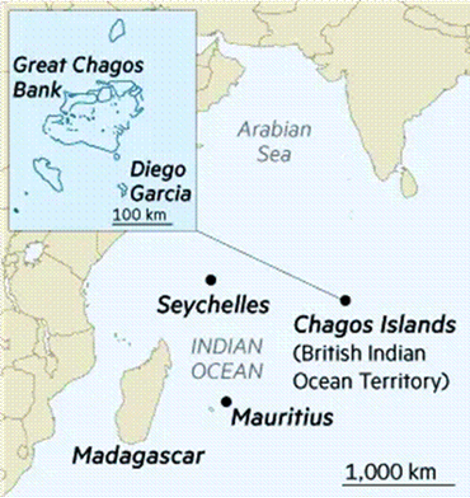
The historic restoration of Mauritian sovereignty over the Chagos Archipelago marks a significant geopolitical turning point in the contemporary Indian Ocean. Comprising over 60 low-lying islands, the territory was administered by the United Kingdom as the British Indian Ocean Territory (BIOT) and remained the subject of prolonged legal and diplomatic contestation. In 2021, a United Nations maritime tribunal ruled in Mauritius’s favour, reaffirming the primacy of international law in sustaining a rules-based order.[1][2] On 22 May 2025, London and Port Louis signed an agreement transferring sovereignty, while permitting the United Kingdom and the United States to retain control of the strategically vital Diego Garcia under a 99-year lease.[3]
Thus, even as the colonial arrangement draws to a close, long-term military access is secured through contractual means. As host to a major US facility, Diego Garcia remains central to great-power rivalry and Indo-Pacific strategy. U.S. President Donald Trump’s criticism of the transfer underscores Washington’s enduring strategic concerns. For India, the outcome carries considerable implications, as the central Indian Ocean is critical to energy security, sea-lane stability, and regional balance. How this transition is managed will shape strategic stability amid intensifying geopolitical competition.[4]
Historical Legacy
The Chagos Islands are an archipelago of over 60 remote yet strategically vital islands in the central Indian Ocean. Britain acquired Chagos along with Mauritius in 1814. In the 1960s, Mauritius became independent, but Britain retained Chagos. In 1968, the UK declared Chagos a British Indian Ocean Territory (BIOT), a move Mauritius maintains was unlawful. A secret UK-US agreement soon led to the leasing of Diego Garcia, the largest atoll, for military use. Between 1967 and 1973, nearly the entire population of around 1,500–2,000 Chagossians was forcibly displaced to Mauritius and Seychelles to facilitate the construction of the US base.
Britain later apologised for this move and promised to hand the islands to Mauritius, but for years, that day never came. Over time, it faced mounting international pressure, with UN bodies backing Mauritius’s claim. Several nations, including India, have played their part as well. In October 2024, London agreed to transfer sovereignty to Mauritius while leasing Diego Garcia for 99 years at an annual payment of $130 million. The United States initially supported the arrangement, though former President Donald Trump publicly criticised the move, reflecting the base’s enduring geopolitical sensitivity. Trump’s remarks, irrespective of their political framing, underscore the strategic significance of the islands’ territory, especially in light of tensions with Iran, suggesting the base could be vital if conflict erupts in West Asia.[5] This historical trajectory explains why Diego Garcia evolved from a colonial outpost into a central node of Indo-Pacific power projection.
Strategic Significance for the US and the Wider World
It is often argued that whoever controls Diego Garcia commands a critical fulcrum of the Indian Ocean. This oceanic expanse is strategically indispensable, carrying over 80 per cent of global seaborne oil trade and linking the major economies of Asia, Africa, and Europe. The Chagos Archipelago, located roughly 9,300 kilometres southeast of the United Kingdom and about 2,000 kilometres northeast of Mauritius, occupies a geographic position that enables simultaneous reach into South Asia, the Gulf, East Africa, and the wider Indo-Pacific. For the United States, Diego Garcia is not merely territory but a guarantor of operational continuity—facilitating deployment, logistics, and sustained force projection. Its value extends beyond runways and fuel storage to encompass communications networks, surveillance architecture, and space-linked infrastructure. Modern power projection depends as much on data transmission, command-and-control systems, and satellite tracking as on ships and aircraft. The atoll’s integration into the global digital backbone, including submarine cable connectivity and GPS ground facilities, reinforces its military and technological significance.
In an era of intensifying competition with China, strategic advantage hinges less on fleet numbers and more on access, infrastructure, port ecosystems, trade routes, and logistical resilience. Diego Garcia thus remains a constant reference point in Indian Ocean geopolitics. The current debate over sovereignty transfer centres not on whether the base will continue to operate, but on how potential political uncertainty may affect long-term operational flexibility – an issue London argues is mitigated through formalised legal agreements. Therefore, the debate is less about whether the base will exist and more about how to manage the risk of uncertainty.[6] Against this backdrop of great-power recalibration, India’s response assumes particular significance.
India’s Indian Ocean Strategy: Balancing Principle and Pragmatism
India has welcomed the United Kingdom – Mauritius treaty, which restores Mauritian sovereignty over the Chagos Archipelago, including Diego Garcia, in line with its long-standing support for decolonisation, respect for sovereignty, and the territorial integrity of nations. India remains committed to working closely with Mauritius and other like-minded countries to strengthen maritime security and regional stability, and to ensure peace and prosperity in the Indian Ocean region.[7]
As New Delhi deepens its maritime profile under the SAGAR (Security and Growth for All in the Region) doctrine, the Chagos transition presents both opportunity and complexity. India’s approach reflects a calibrated balance: affirming solidarity with Mauritius while recognising the stabilising role of Diego Garcia within the broader Indo-Pacific security architecture amid rising Chinese influence. To translate principle into strategy, India should intensify cooperation with Port Louis on fisheries governance, coastal surveillance, and counter–illegal maritime activity, including integrating the Chagos zone into the Indian Ocean Information Fusion Centre (IFC-IOR) network and into wider radar–satellite domain awareness grids across the Mozambique Channel and the Seychelles–Maldives belt.
Supporting Mauritius-led resettlement efforts would reinforce India’s moral credibility, while backing a continued U.S. presence in Mauritius under a structured lease arrangement would preserve deterrence and freedom of navigation. By aligning sovereignty restoration with maritime security cooperation and multilateral diplomacy, India can consolidate its role as a net security provider and contribute to enduring stability in the Indian Ocean region.[8]
Conclusion
Amid intensifying global and Indian Ocean rivalries, marked by overt and covert military posturing, the Chagos issue requires careful, measured management to prevent escalation and preserve strategic stability. The dispute reflects the evolving nature of power in the region, where sovereignty claims intersect with enduring security imperatives. President Trump’s remarks underscore persistent American strategic concerns, yet sovereignty restoration and continued strategic access need not be mutually exclusive. For India, the task is to maintain balance – supporting Mauritian sovereignty in line with normative principles while ensuring continuity of stable security arrangements that sustain deterrence.
[1] https://chintan.indiafoundation.in/articles/chagos-archipelagos-handover-to-mauritius-how-it-affects-security-in-the-indian-ocean/Chagos Archipelago’s Handover to Mauritius: How It Affects Security in the Indian Ocean, Trishala Sancheti June 3, 2025
[2] United Nations General Assembly Resolution 73/295, “Advisory Opinion of the International Court of Justice on the Legal Consequences of the Separation of the Chagos Archipelago from Mauritius in 1965,” 22 May 2019.
[3] https://chintan.indiafoundation.in/articles/chagos-archipelagos-handover-to-mauritius-how-it-affects-security-in-the-indian-ocean/Chagos Archipelago’s Handover to Mauritius: How It Affects Security in The Indian Ocean, Trishala Sancheti June 3, 2025
[4] https://www.firstpost.com/opinion/chagos-islands-india-indo-pacific-security-great-power-rivalry-13982229.html, Chagos Islands: A strategic pivot in Indo-Pacific great power rivalry Mohammed Badrul Alam • February 21, 2026
[5] https://www.youtube.com/watch?v=cFcYArXOQsc, First Post, Trump vs the UK: Why the Chagos Islands Sparked A Clash …
[6] https://politicstoday.org/the-chagos-diego-garcia-case-and-the-language-of-new-geopolitics/
[7] Statement by MEA on Chagos Treaty signed between the United Kingdom and Mauritius regarding return of Mauritian sovereignty over Chagos Archipelago, May 22, 2025
[8] https://www.sios.org.in/upload/SIOS%20Commentary_The_Chagos_Treaty.pdf , The Chagos Treaty and India’s SAGAR Vision in the Western Indian Ocean.


Add comment