



President Sheikh Mohamed bin Zayed Al Nahyan’s recent whirlwind visit to New Delhi to meet Prime Minister Narendra Modi was not a routine diplomatic engagement. Brief in duration but dense in strategic meaning, the visit reflected how key Middle Eastern actors are recalibrating their external partnerships amid a changing security landscape. Abu Dhabi’s outreach to India signals a pressing need to further strengthen a regional security architecture with dependable stabilising stakeholders, rather than external guarantors with fluctuating commitments.
This recalibration is unfolding as the United States adjusts its security posture in West Asia. The region is not entering a vacuum, but an era of strategic ambiguity. Washington’s focus has shifted decisively toward the Western Hemisphere and the Pacific. While the US continues to maintain an extensive military footprint across the Middle East, with CENTCOM and more than 40,000 troops, bases and substantial hardware, its engagement has become increasingly selective, politically constrained and conditional. For regional states long accustomed to assured American intervention, this thinning of guarantees has unsettled assumptions and sharpened existing fault lines.
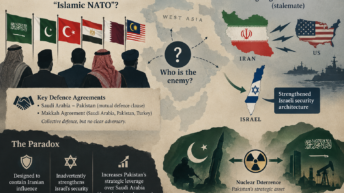
A major cause of instability is the escalation of the longstanding volatile confrontation between Iran and Israel. What was once a shadow conflict has escalated into a more direct confrontation following the October7, 2023 Hamas attacks, with strikes, counter-strikes, and proxy escalations significantly raising the risk of miscalculation. Iran’s internalpressures, economic stress, social unrest and political rigidity, are increasingly intertwined with its external posture. For Gulf states, the concern is less about choosing sides than about preventing escalation that could imperil energy infrastructures, maritime traffic and domestic stability.
The recent buildup of US defence forces in the region, including the deployment of the USS Abraham Lincoln and its aircraft carrier group, additional fighter aircraft, aerial refuellers and other assets to the Gulf in response to rising tensions with Iran, underscores Washington’s selective and crisis-driven approach to the region rather than a return to comprehensive regional security underwriting.
These uncertainties are driving hedging behaviour across the region. The expanding Saudi–Pakistan defence relationship, now intersecting with Turkey’s ambitions as an assertive middle power, is often portrayed as the emergence of a new security bloc. In reality, it reflects collective unease rather than collective strength. Pakistan seeks strategic relevance amid economic distress; Turkey, a NATO member, projects influence beyond traditional frameworks; Saudi Arabia is insuring against ambiguity rather than replacing the US security umbrella.
Saudi Arabia and the UAE are increasingly competing across Yemen (from where the Emirates recently announced they would withdraw), Sudan and Somalia, backing different actors and political outcomes while seeking control over ports and maritime access along the Red Sea and Horn of Africa, underscoring a rivalry rooted in divergent strategic ambitions rather than temporary disagreement.
These destabilising dynamics are causes of concern for the United Arab Emirates, which views political Islam, not Israel or Iran, as the principal long-term threat. Qatar’s continued patronage of transnational Islamist platforms and its activist mediation posture further complicate Gulf cohesion, sharpening ideological and strategic divergences within the GCC.
The Middle East today is therefore not structured around a coherent security architecture, but fragmented into overlapping and situational alignments. The Abraham Accords have not erased Arab–Israeli mistrust. Gulf unity is fragile, strained by differing approaches to Iran, political Islam, energy policy and regional interventionism. Non-Arab actors such as Turkey pursue opportunistic strategies that cut across traditional alignments. The common denominator across these dynamics is uncertainty over the American resolve.
In this environment, India’s stabilising value stands apart. Unlike traditional external actors, India brings no colonial legacy, no regime-change impulse by and no ideological agenda. Its engagement with the Middle East is rooted in civilisational ties and lived interdependence, energy security, trade, maritime stability and the welfare of nearly nine million Indian citizens working across West Asia, including over three million in the UAE alone. For regional states, India is not an interloper but a resident stakeholder whose prosperity is inseparable from regional stability.
India’s rise as a stabilising power does not imply power projection or alliance leadership. Rather, it rests on calibrated contributions that lower risk without reshaping balances of power.
Maritime security is the first pillar. India is already a leading naval actor in the Western Indian Ocean, with extenive experience in anti-piracy operations, humanitarian assistance and sea-lane protection. As energy flows through the Strait of Hormuz and Bab-el-Mandeb face persistent risks, from state tensions to non-state actors, India can provide regional reassurance through maritime domain awareness, coordinated patrols and effective crisis responses. Mechanisms such as the Information Fusion Centre–Indian Ocean Region, joint naval exercises with Gulf partners and tanker-protection coordination directly address regional vulnerabilities while complementing, not competing with, existing security arrangements.
The second pillar is counter-terrorism and internal security cooperation. India’s experience in dealing with terrorism that is local, transnational, ideological and technologically adaptive is widely recognised. Gulf states increasingly confront threats from lone-wolf radicalisation, drone attacks and residual extremist networks. India’s expertise in intelligence fusion, financial tracking of extremist flows, urban counter-terror operations and counter-drone technologies is relevant and politically acceptable, delivered without ideological conditionality or public pressure. Quiet intelligence liaison and joint training exercises can deepen trust without visibility-driven escalation.
A third pillar lies industrial and technology defence partnerships. Gulf states are seeking co-development and technological sovereignty rather than dependence on external suppliers. India’s growing defence manufacturing base, particularly in unmanned systems, electronic warfare, coastal surveillance and missile-defence components, are aligned with these ambitions. When paired with Gulf capital and manufacturing capacity, such partnerships anchor security cooperation in shared capability better than transient alignments.
Connectivity initiatives such as the India–Middle East–Europe Economic Corridor should also be understood through a security lens. Secure ports, resilient digital infrastructure and protected supply chains are now integral to national security. By embedding security standards into economic integration, India contributes predictability, often the most undervalued stabilising force in the region.
Diplomacy remains India’s most understated asset. New Delhi’s ability to maintain working relationships simultaneously with Israel, Iran, the Gulf monarchies and key Arab states is not accidental but the product of disciplined strategic autonomy. In an increasingly polarised environment, this enables India to function as a quiet stabiliser, keeping channels open during crises, facilitating de-escalation and supporting dialogue without assuming the burdens or visibility of formal mediation.
There are, however, clear red lines India must not cross. Militarisation has limitations when not acting as a surrogate for US security interests. Public alignment in intra-regional rivalries would compromise credibility. Strategic autonomy must remain visible in practice, not merely asserted in rhetoric.
India’s rise as a stabilising power in the Middle East will therefore be incremental, understated, and pragmatic. It will be measured not by treaties or troop deployments, but by reliability, prompt intervention in crises, protecting commons, sharing intelligence, capacity-building, and respecting regional agency.
In a region weary of American unpredictability, Chinese transactionalism and European marginality, India offers something different: stability without dominance. MBZ’s visit to New Delhi suggests that key regional actors already recognise this and see India not as a power to fear, but as a partner to rely on.



Add comment