


The Pradhan Mantri Ujjwala Yojana stands as one of the more significant social interventions of recent decades, extending LPG access to millions of households previously dependent on biomass and solid fuels. The health and quality-of-life benefits have been well-documented: they have reduced indoor air pollution, diminished the daily drudgery for women, and improved cooking efficiency [1].
Yet the supply disruptions witnessed in recent weeks—precipitated by geopolitical tensions in West Asia—have exposed a structural vulnerability in this model [2]. With approximately 60% of India’s LPG requirements met through imports, external shocks are transmitted rapidly to domestic supply chains [3]. Reports of delayed cylinder deliveries, extended waiting periods, and regional shortages have necessitated advisories against panic booking. Commercial establishments, including hostels and small eateries, have faced acute procurement difficulties as household supplies received priority allocation. In certain instances, food service operators have been compelled to curtail operations or temporarily revert to coal and firewood—developments that merit serious policy attention [4].
The appropriate response, however, does not lie in the proliferation of new governmental schemes. Rather, it lies in the more deliberate convergence of initiatives already operational—including established institutional products that have undergone systematic field validation.
The Induction Phenomenon: Evidence of Readiness
The market response to supply constraints has been instructive. Appliance retailers across multiple urban centres have reported rapid depletion of induction cooktop inventories as households sought immediate alternatives to LPG-dependent cooking [5]. This surge was not the product of sustained public awareness campaigns or subsidy inducements; it was a spontaneous adaptation to scarcity.
Such behaviour carries significant policy implications. It demonstrates that consumer readiness for electric cooking exceeds what formal adoption metrics might suggest. The barrier has not been a lack of willingness, but rather circumstance, and the removal of that barrier during crisis conditions has revealed substantial latent demand.
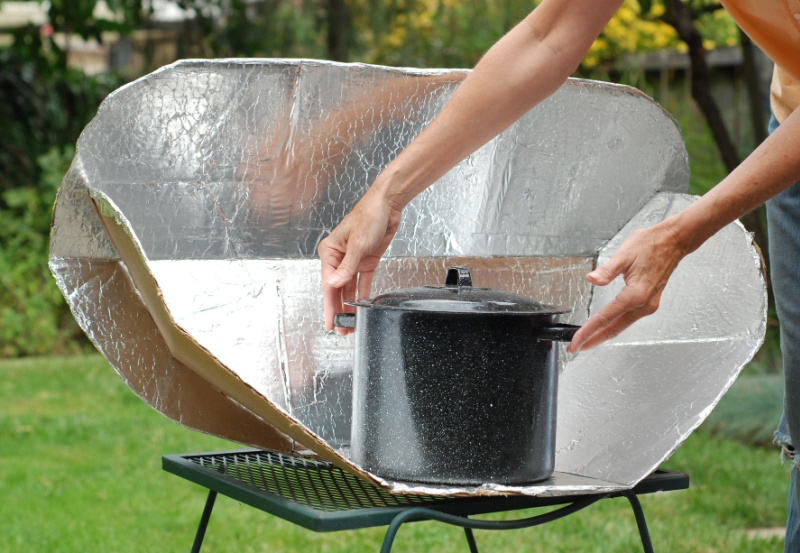
It is essential, at this juncture, to distinguish contemporary electric cooking from earlier solar thermal interventions. The devices now entering Indian kitchens—induction stoves, electric pressure cookers, rice cookers, and associated appliances—operate on standard electrical supply and offer performance comparable to LPG systems. Unlike first-generation solar cookers, they impose no constraints regarding sunlight availability or cooking schedules. Provided electricity access is stable, they constitute viable substitutes for conventional fuel-based cooking.
Beyond induction, the category of electric cooking appliances includes rice cookers, electric pressure cookers, and multifunctional cooking devices that automate preparation and reduce the need for active supervision[6]. These have gained traction in urban households for their convenience, though they remained secondary to LPG until recent shortages altered consumer calculus.
For households seeking deeper energy independence, solar-integrated cooking systems—such as the Surya Nutan developed by IndianOil—offer a hybrid alternative [7]. These systems combine rooftop solar generation with battery storage to power indoor cooking units capable of handling standard Indian culinary requirements. While the initial investment exceeds that of conventional electric appliances, the operational autonomy from both LPG supply chains and grid instability represents a distinct value proposition.
Such a performance and technological availability carry significant policy implications. They demonstrate that consumer readiness for electric cooking exceeds what formal adoption metrics might suggest. The obstacle has not been a lack of public willingness but rather circumstances, and the removal of that barrier during crisis conditions has revealed substantial latent demand.
Critically, the Ministry of Environment, Forest and Climate Change, through the office memorandum dated 07.06.2024, has recognised solar cookers as greenhouse gas mitigation tools eligible for carbon credit trading under ITMO Articles 6.2 and 6.4. This creates a financing mechanism for their deployment without requiring fresh subsidy allocations [8].
The existence of this institutional infrastructure—technologically validated, commercially available, and carbon-credit eligible—obviates the need for new research and development outlays or scheme notifications. What is required is integration: connecting products such as Surya Nutan with the rooftop solar generation capacity being installed under PM Surya Ghar, and with the beneficiary base established under Ujjwala.
The Policy Architecture: Existing Foundations
India’s policy framework for household energy transition already contains the elements necessary to address current vulnerabilities. The challenge is not the absence of means but the need to align them..
The PM Surya Ghar Muft Bijli Yojana, launched in 2024, aims to install rooftop solar systems in approximately one crore households. The scheme provides capital subsidies to enable residential solar generation, with the explicit objective of reducing electricity expenditure and enhancing energy self-sufficiency. The technical and financial infrastructure for decentralised generation is thus being established at considerable public investment [9].
Parallel to this, the Pradhan Mantri Ujjwala Yojana has created a national constituency accustomed to clean cooking and receptive to further technological transition. The behavioural foundation for fuel switching has been laid; what remains is to extend the logic of that switch from LPG to solar-electric cooking.
The convergence of these streams—rooftop solar generation, institutional solar cooking products, and established clean cooking adoption patterns—offers a pathway to genuine household energy security without additional scheme proliferation. Solar electricity generated at the point of consumption can directly power hybrid cooking systems, reducing simultaneous dependence on imported LPG and centralised grid supply.
Acknowledging the Generation Mix
A rigorous assessment requires recognition of present constraints. India’s electricity sector remains substantially dependent upon coal-fired generation, which continues to provide base-load reliability amid growing demand [10]. A mechanical shift from LPG to grid-dependent electric cooking would, in the immediate term, transfer rather than eliminate fossil fuel dependence.
This reality reinforces, rather than diminishes, the case for integrated rooftop solar and solar cooking deployment. Decentralised renewable generation enables households to bypass the coal-intensive grid for significant portions of their consumption. Hybrid systems such as Surya Nutan—capable of simultaneously drawing from solar panels and the grid—provide operational continuity while maximising renewable utilisation.
As national renewable capacity expands—and the trajectory is firmly established—each unit of self-generated solar power becomes more valuable. The transition of the power sector and the transition of household cooking can proceed in parallel, each reinforcing the other.
Fuel Stacking as Energy Security
The concept of fuel stacking—maintaining multiple cooking options rather than exclusive reliance on single sources—deserves greater policy prominence. Empirical observation indicates that even LPG-connected households frequently retain alternative arrangements, such as traditional biomass, kerosene, or rudimentary electric devices, as insurance against supply interruptions [11].
The recent disruptions validate this risk-mitigation behaviour. Households with electric cooking capacity demonstrated superior adaptive capacity during the shortage period. Formal recognition of solar-electric cooking as a critical component of the household fuel stack—rather than as an eventual replacement for LPG—would enhance national resilience without requiring structural policy innovation.
Existing Ujjwala infrastructure could be leveraged to promote this diversification. The scheme’s beneficiary identification and distribution networks—already established down to the gram panchayat level—could facilitate awareness and access to institutional products such as Surya Nutan, particularly in regions with demonstrated supply vulnerabilities.
The Imperative of Integration
India’s energy policy has evolved incrementally. The Jawaharlal Nehru National Solar Mission laid the foundation for renewable expansion; subsequent programmes addressed off-grid applications and rural electrification; Ujjwala tackled access to cooking fuel; PM Surya Ghar now targets residential power generation; and public sector undertakings have developed product-specific solutions. This sequential development has served its purpose, but present conditions demand more explicit articulation of interconnections.
The alignment of rooftop solar promotion with institutional solar cooking products and existing clean cooking adoption represents precisely such an articulation. It requires no new scheme notification and no fresh administrative architecture. It requires, instead, focused attention to technology adaptation and market accessibility. Electric cooking appliances currently available in the Indian market—induction stoves, electric pressure cookers, rice cookers, and hybrid solar cooking systems—must undergo further refinement to run on solar supply.
The coordinated implementation of existing mandates—ensuring that households installing solar systems receive appropriate guidance on solar cooking utilisation, and that Ujjwala’s last-mile networks facilitate access to validated products.
At the 2023 Ministry of Power Conference on Consumer-Centric Approaches, it was asserted that e-cooking represents the future of Indian kitchens and marks the next stage in India’s clean cooking transition, following electrification and the expansion of LPG [12]. The present moment offers an opportunity to operationalise this sequencing with greater urgency, utilising institutional products that have already undergone rigorous field validation.
Conclusion: Resilience Through Convergence
The LPG supply disruption should be understood not merely as a temporary logistical challenge but as a diagnostic indicator of systemic vulnerability. India’s household energy security remains contingent on international fuel markets and maritime supply routes, and is subject to geopolitical disruption.
The remedy lies not in retreat to earlier fuel regimes, nor in the multiplication of protective schemes, but in the more intelligent deployment of capabilities already under development. Rooftop solar generation, institutional solar cooking systems such as Surya Nutan, and the established Ujjwala beneficiary network—pursued as integrated objectives rather than parallel initiatives—offer households a measure of genuine autonomy from external supply shocks.
The policy infrastructure exists. The technological solutions have been validated. The consumer readiness has been demonstrated. What remains is the administrative coordination to assemble these elements with appropriate urgency.
Energy security, ultimately, is not achieved through fuel substitution alone but through the construction of resilient, diversified systems capable of withstanding disruption. India’s existing policy framework contains the components of such resilience. The task now is to make them convergent.
References:
[1]. https://www.pmuy.gov.in/about.html
[2]. https://www.bbc.com/news/articles/cm2xg0p4y84o
[3]. https://www.pib.gov.in/PressReleasePage.aspx?PRID=2238525®=3&lang=1
[7]. https://iocl.com/pages/SolarCooker
[8]. https://moef.gov.in/storage/tender/1755586183.pdf
[9]. https://www.pib.gov.in/PressReleaseIframePage.aspx?PRID=2111106®=3&lang=2
[10]. https://iced.niti.gov.in/energy/electricity/generation
[11]. Yadav, P., Davies, P. J., & Asumadu-Sarkodie, S. (2021). Fuel choice and tradition: Why fuel stacking and the energy ladder are out of step?. Solar Energy, 214, 491-501.
[12]. https://www.pib.gov.in/PressReleaseIframePage.aspx?PRID=1929859®=3&lang=2




Add comment