


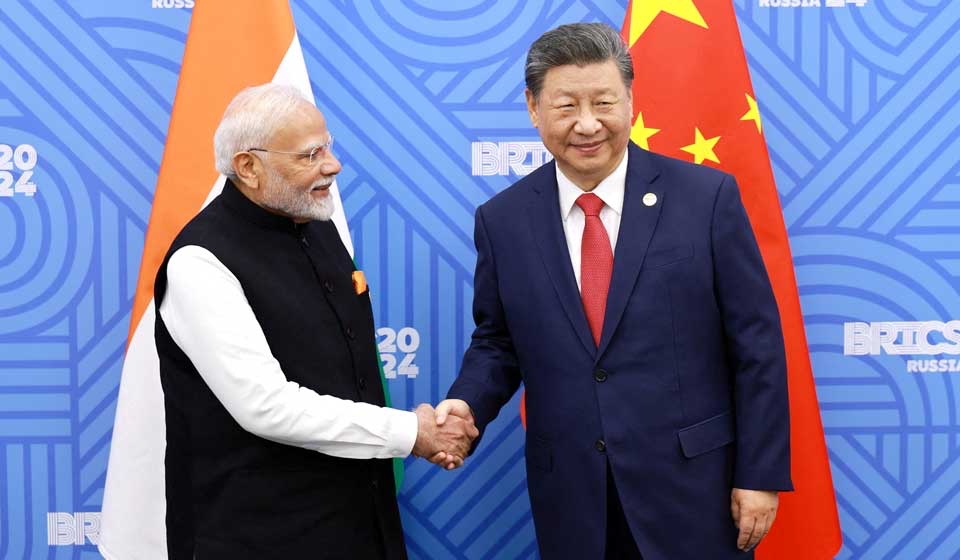
The recent visit of Chinese President Xi Jinping to New Delhi for the BRICS Summit, his first to India in seven years, was an important episode in a relationship marked by deep strategic distrust since the 2020 Galwan crisis. Yet its significance lies less in the summit itself than in the sequence of engagements that preceded it. From the October 2024 Modi-Xi meeting in Kazan and the subsequent border understanding, to their meeting at the recent SCO summit in Tashkent and the interactions between National Security Adviser Ajit Doval and Chinese Foreign Minister Wang Yi, India-China ties have been moving through a gradual process of recalibration.
These developments point to a dual-track approach in New Delhi: deterrence alongside dialogue. India is neither returning to the assumptions that shaped the relationship before 2020 nor treating China as a neighbour that can simply be managed through confrontation. Instead, it appears to be seeking a more stable and predictable relationship in which strategic competition continues, accompanied by sufficient diplomatic engagement to prevent new confrontations.
The recent diplomatic opening should therefore neither be mistaken for a strategic rapprochement nor dismissed as diplomatic theatre. India appears less interested in totally transforming the equation than in making a difficult relationship manageable.
The first element of this approach is deterrence. The experience of the past six years has reinforced the importance of military preparedness along the Line of Actual Control. Disengagement at several friction points has reduced the immediate risk of confrontation, but it has not erased the underlying boundary dispute or the strategic mistrust that increased from 2020 on.
India’s response has extended well beyond diplomacy. Infrastructure along the frontier has received greater attention, while military logistics, surveillance capabilities, and the broader security architecture in the Himalayan region have been strengthened. The objective is not to seek confrontation, but to ensure that diplomatic engagement is conducted from a position in which India retains credible options should deterrence prove insufficient.
Deterrence is also increasingly economic and technological. The disruptions of recent years have highlighted India’s dependence on China for many manufactured goods, intermediate inputs, electronics components, machinery, and other critical supplies. Efforts to diversify supply chains, strengthen domestic manufacturing and scrutinise Chinese investments are therefore part of a broader understanding of economic security. This does not amount to complete economic decoupling. India remains deeply integrated with the Chinese economy, making a clean separation neither simple nor necessarily desirable. The emerging approach is better understood as selective de-risking: reducing vulnerabilities in strategically important areas while maintaining economic involvement where it serves Indian interests.
India’s wider strategic partnerships reinforce this approach. Its sustained engagement with other countries across the Indo-Pacific, involving cooperation on critical minerals sourcing, semiconductors procurement, technology, and defence, is widening New Delhi’s room for manoeuvre. From Japan and Australia to Indonesia and other regional partners, these relationships provide India with additional capabilities and strategic options, whereas uncertainty persists with Beijing. They reflect India’s effort to improve its position in a contested regional environment without surrendering its strategic autonomy.
At the same time, deterrence alone cannot manage a relationship between two major powers sharing a contested border, significant economic interdependence, and overlapping interests in the regional and global system. This is where dialogue becomes important.
The recent diplomatic engagement matters even when it produces no dramatic breakthrough. Leader-level communication, the Special Representatives’ dialogue on the boundary question, and other institutional mechanisms can reduce the risk of tactical disagreements turning into strategic crises. They provide channels to draw and spell out red lines, clarify intentions, and explore areas where cooperation remains possible.
The Modi-Xi meetings are significant in this context. Their importance lies not simply in the symbolism of two leaders meeting after years of tension, but in the political direction they set for an relationship in which even modest diplomatic or administrative steps require sustained efforts. The Doval-Wang Yi dialogue is similarly important because the boundary question remains central to the broader relationship. Dialogue mechanisms are therefore part of the infrastructure required to prevent the border from once again causing relations to nosedive..
Functional interaction is also making a comeback in areas such as travel, economic contacts, and people-to-people exchanges. These steps do not resolve strategic differences, but they can restore some of the institutional connectivity disrupted during years of heightened tensions.
The distinction between stabilisation, normalisation, and rapprochement is important here. India and China may be moving towards greater bilateral stability without having reached normalisation, which may not necessarily diminish the underlying strategic competition. India has consistently linked the improvement in relations to peace and tranquillity along the frontier, reflecting the conviction that political and economic engagement cannot be insulated indefinitely from border contestations.
The two tracks perform different functions. Deterrence shapes the calculations on the other side by ensuring that coercion carries costs; dialogue helps ensure that competition remains bounded and disagreements do not automatically escalate. The two are not necessarily contradictory. For India, the value of dialogue may lie precisely in creating greater space for the strategic competition that deterrence is intended to manage.
The recent opening, however, does not guarantee stability. A border incident, shifts in the regional balance, developments involving Pakistan, economic disputes, or changes in the wider international environment could again place pressure on the relationship. Nor does renewed engagement represent a reversal of India’s post-2020 strategic adjustments. India can improve military preparedness, reduce critical economic vulnerabilities, deepen partnerships with other powers, and maintain a direct dialogue with Beijing at the same time.
For India, greater stability on the Chinese front also creates room for manoeuvre amid economic pressures, technological disruptions, and wider geopolitical uncertainty. The challenge is to ensure that dialogue does not come at the expense of deterrence, and that the latter does not make dialogue impossible.
The trajectory of relations between India and China will not be determined by a single summit or diplomatic breakthrough. It will depend on whether both countries can sustain stability while pursuing strategic competition. The emerging formula is neither confrontation nor rapprochement, but deterrence and dialogue: sufficient strength to protect India’s interests, and sufficient engagement to keep a difficult relationship manageable.

Add comment