


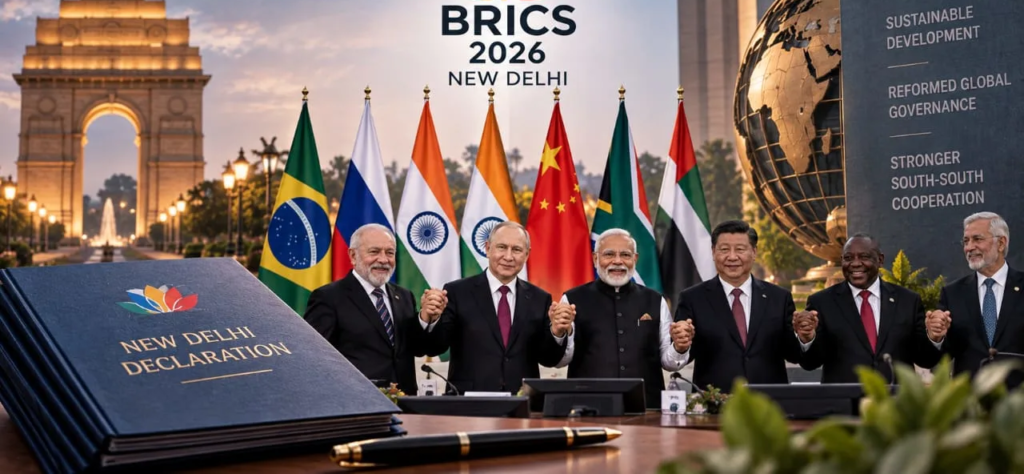
The 2026 BRICS Summit, held under India’s chairmanship, was a resounding success. The 140-paragraph BRICS Declaration was adopted by all members, despite their vast ideological differences, a tremendous achievement in itself. When we evaluate the Summit against the principles enunciated by Kautilya in his Arthashastra, we see striking similarities that highlight the timelessness of those principles, articulated over 2500 years ago.
Kautilya’s world was defined by interests, capabilities, alliances, vulnerabilities, and shifting circumstances. In 2026, India’s BRICS strategy sought to expand its strategic space rather than build a new ideological bloc. New Delhi used BRICS to ensure India could engage with every camp from a position of greater capability, rather than choosing one. The Declaration has greater meaning from an Indian strategic perspective, echoing an old Indian saying: National strength underpins strategic freedom.
India successfully used its 4th BRICS Chairmanship to host more than 350 meetings and high-level engagements with BRICS officials, ministers, experts, businesses, and civil society across more than 25 Indian cities from January to September 2026. The final Declaration listed 400+ meetings and engagements in 30 cities by the time leaders met in New Delhi on 12-13 September. It was much broader than an economic agenda.
India set 12 broad strategic priorities under the theme “Building for Resilience, Innovation, Cooperation and Sustainability”. These were: global governance, peace and security, terrorism, trade and economic growth, finance, health, agriculture and food security, science and innovation, digital technologies and AI, disaster resilience, climate, energy and environmental sustainability, and connectivity and people-to-people exchange. These priorities were linked by three institutional pillars:
- Political and security
- Economic and financial
- Cultural and people-to-people cooperation
Global Governance: From Rule-taker to Rule-shaper
Global governance reform was perhaps the most significant issue, with the Declaration urging reform of the UN Security Council and a more representative multilateral system. China and Russia reaffirmed their support for Brazil and India’s ambitions for the UN Security Council. BRICS also sought greater representation for emerging and developing economies in the IMF, the World Bank, and other institutions. For India, the issue goes beyond institutional fairness. It is about power and representation. This underscored Kautilyan statecraft, which begins with the state understanding its position of power. For a rising India, economic power without institutional influence is incomplete.
Strategic Stability and National Security
The Declaration emphasises conflict prevention, diplomacy, mediation, international law, and peacekeeping alongside military spending and the nuclear threat. It rejects the idea that military accumulation guarantees security. The Declaration also condemned the 22 April 2025 J&K terror attack that killed 26 people and pledged to fight terrorism, terrorist financing, safe havens, and cross-border terrorism and also rejected counter-terrorism double standards. This was politically significant for India. The language matters because India integrated a national-security concern into a multilateral framework, aligning with Kautilyan statecraft.
Trade & Economy: Strategic Autonomy Over Dependency
BRICS 2026 called for WTO reform, an open, rules-based trading system, and opposition to unilateral economic measures, highlighting resilient global value chains and growing economic participation. The Declaration emphasises agricultural productivity, food security, nutrition, and protection against supply shocks. It supports the ‘BRICS Grain Exchange’ and cooperation in agricultural technology. Once again, this aligns with Kautilyan statecraft—“The state, concerned with agriculture, irrigation, production, and revenue, understands immediately that a powerful state must first feed itself”.
On trade, the New Delhi Declaration promotes local-currency financing, financial safety nets, payment interoperability, taxation, development finance, and the New Development Bank. It also helps the NDB mobilise resources and expand local-currency financing. Indian goals should go beyond “de-dollarisation”. Diversification matters more now; when a country has multiple trade, investment, and finance channels, it gains strategic autonomy.
Health: Human Capacity Sovereignty
BRICS health cooperation has expanded beyond pandemic preparedness to digital health, medical production, disease surveillance, traditional medicine, healthy lifestyles, and mental wellness. The Declaration supports the BRICS Mission for Healthy Lifestyle and a mental-health network. The definition of security has changed significantly. Shock-sensitive people, institutions, and health systems make a nation vulnerable. India’s use of traditional, complementary, and integrative medicine shows that modernity doesn’t require abandoning indigenous knowledge.
Technology, Digital Sovereignty and AI
India’s science and technology agenda has been ambitious. The New Delhi Declaration supports research repositories, quantum technologies, infrastructure, joint scientific programs, and the India Centre for BRICS Industrial Competencies. Here, “Viksit Bharat” meets BRICS diplomacy. India is no longer content to be a market or service provider in global technology chains; producing advanced capabilities is the strategic goal.
The Declaration’s digital agenda is perhaps its most modern element. BRICS supported digital public infrastructure, cybersecurity, future networks, digital skills, and AI, recognising the need for a sovereign and self-sufficient digital ecosystem. India has a proposal here. India’s DPI shows that technology can serve as public infrastructure rather than as a commercial product. Kautilya spoke the language of administration, information, and state capacity. Today, data infrastructure and technology extend state power. Technological sovereignty is becoming what territorial sovereignty was in Kautilya’s time: a prerequisite for meaningful strategic independence.
Environmental Concerns
The Declaration states: “Climate-related disasters affect infrastructure, lives, livelihoods, early warning systems, financing, and traditional knowledge”. It seeks to promote community-based approaches alongside scientific and technological capabilities. The most practical logic for resilience is that a strategically strong state can withstand disruption and continue operations.
BRICS’ environmental priorities included climate adaptation, biodiversity, forests, water, the circular economy, and sustainable lifestyles. The Declaration also opposed punitive and discriminatory measures like carbon-border mechanisms that disproportionately affect developing countries. Climate finance, technology transfer, and national transitions were also stressed. Environmental responsibility cannot lock developing nations into technological and economic dependence; instead, India links sustainability to development sovereignty.
Expanding Soft Power
India’s BRICS chairmanship included transport infrastructure, logistics, aviation, education, youth, women, tourism, business, parliamentary exchanges, think tanks, academic institutions, and civil society. The Declaration encouraged BRICS engagement by parliamentarians, businesses, women entrepreneurs, youth, academics, and civil society. This shows an understanding of influence beyond statecraft. India’s civilisational vocabulary, ‘Vasudhaiva Kutumbakam’, becomes strategically meaningful when linked to institutions, networks, and capabilities rather than diplomatic rhetoric.
The Bigger Kautilyan Lesson
India’s 2026 BRICS presidency was brilliant because these agendas were not 12 unrelated topics; rather, they established a national power structure. Energy and food protect the state. Finance and industry boost it. Tech modernises it. Diplomacy increases its flexibility. Capability becomes influence through institutions. Culture and people form lasting bonds. That fits Kautilyan statecraft: internal capacity, material resources, strategic partnerships, and prudent external action must complement each other.
The New Delhi Declaration should be read as a manifesto for a broader BRICS and as a statement about India’s desired international system. No world without great-power rivalry. No ideological war against the West and no dependence on another power. Instead, a multipolar order in which states can defend and exercise sovereignty. The Declaration explicitly links BRICS to multipolarity, sovereign equality, development, and a Global South voice. This may be New Delhi 2026’s most crucial strategic message. The New Delhi Declaration is a blueprint for using that instrument to turn strategic autonomy into national capability. “The objective of Indian statecraft is not to inherit someone else’s order. It is to possess enough power, prudence and purpose to help shape the next one”.



Add comment