


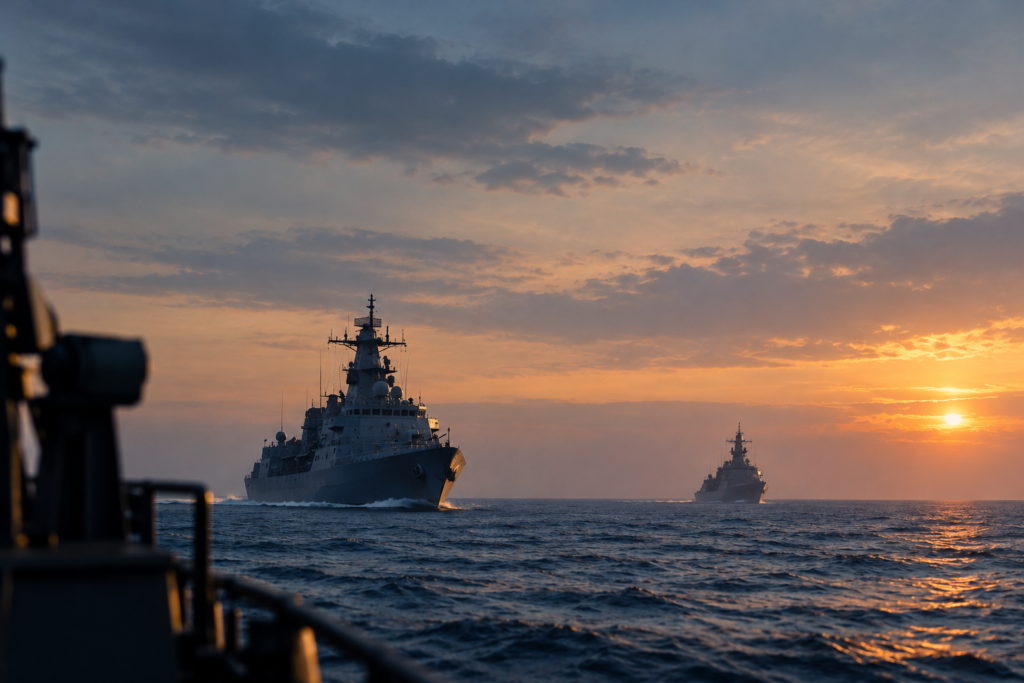
In September 2026, an incident in the Arabian Sea brought a familiar but increasingly important security question back into focus: how far can states test each other’s military resolve without triggering a larger confrontation?
Pakistan Navy’s PNS Hunain collided with the Indian Navy’s INS Kolkata during a high-seas maneuver in the Arabian Sea. India subsequently summoned Pakistan’s Chargé d’ Affaires and lodged a strong protest, describing the maneuver as unprofessional. The incident was not entirely unprecedented. In 2011, Pakistan’s PNS Babur collided with the Indian naval vessel INS Godavari during an anti-piracy escort mission in the Gulf of Aden. Yet the significance of the latest incident extends beyond the collision itself. Indian media and strategic commentators have drawn comparisons with the increasingly assertive maritime operations carried out by China in the South China Sea (SCS) and other contested waters. The question, therefore, is not simply whether the incident was accidental or deliberate. It is whether Pakistan is beginning to adopt operational practices that resemble China’s broader approach to coercion below the threshold of conventional conflict. The 1991 agreement on military exercises between India and Pakistan required them to inform each other of military exercises, manoeuvres and troop movements.
This matters because the character of competition is changing. Grey-zone strategies generally seek to alter behaviour or the status quo without crossing the threshold that would trigger a major military response. They can involve maritime maneuvers, cyber operations, information campaigns, economic pressure, or the use of civilian and quasi-military actors. The objective is often to create uncertainty over intent while testing an opponent’s response.
China’s activities in the SCS provide some prominent instances of this new tactic. Beijing has increasingly relied not only on the People’s Liberation Army Navy (PLA-N), but also on its coast guard and its maritime militia, widely known as the People’s Armed Forces Maritime Militia (PAFMM). The latter has attracted particular attention because it occupies an ambiguous space between civilian and military activities. Vessels can operate in contested waters while making attribution, escalation management, and potential responses more complicated. China’s maritime militia has been particularly active in disputed areas involving the Philippines. Similar concerns have emerged in waters surrounding Japan-controlled islands in the East China Sea (ECS). Such operations demonstrate how maritime coercion can be conducted without necessarily resembling traditional naval warfare. Pakistan’s relationship with China makes this development particularly relevant for India.
The political and military closeness between Beijing and Islamabad is well established. Chinese defence cooperation with Pakistan has expanded over decades, while military exercises, defence equipment, technology cooperation, and strategic coordination have deepened. The two countries frequently describe their relationship in exceptionally close terms—“higher than mountains, deeper than oceans, and sweeter than honey.”
This does not, by itself, prove that Pakistan’s latest naval maneuver was directed or planned by Beijing. But China’s experience offers Pakistan a potential reference point for understanding how coercive actions can remain below the threshold of conventional conflict while still imposing costs on an opponent. For India, this creates a more complex strategic environment. One useful way of understanding the emerging challenge is through what might be called the 3Ds: Denying, Delaying, and Disorientating.
The first is denial. When confronted with allegations that they break established norms or conduct coercive activities, states can deny responsibility, dispute the interpretation of events, or present the incident differently. This can create uncertainty over what actually happened and complicate an opponent’s response.
The second is delay. Governments may delay acknowledging casualties, losses or oher consequences of an incident. The delay can create political space to manage domestic opinion and shape the narrative before acknowledging inconvenient facts. China’s handling of military casualties after the 2020 Galwan clash has often been cited in discussions of this phenomenon. Similar questions have arisen following maritime incidents involving China and the Philippines. During the Galwan clash of 2020 with India, China delayed its acknowledgement of loss of life among its soldiers for about a year. Following the clash with the Navy of the Philippines around Scarborough Reef, Beijing also delayed reporting the loss of its soldiers by a year from the date of the incident that occurred in 2025. Pakistan has used a similar playbook by delaying and denying its losses, both material and human, during its conflict with India and the USA has been doing the same in its ongoing war against Iran.
The third stratagem is disorientation. Information warfare, social media, state-controlled media, and competing narratives can make it difficult for audiences to distinguish between established facts, competing claims, and deliberate misinformation. China’s information campaigns surrounding disputes with India and other regional actors illustrate how the informational dimension can become an extension of strategic competition. This was prominent when China’s Xinhua released a video titled, “7 Sins of India”.
For India, the lesson is not that every Pakistani action should automatically be interpreted as a Chinese-inspired operation. Rather, New Delhi needs to recognize that the security environment is increasingly characterised by actions that occur on the borderline between peace and war. A maritime collision, an aerial incursion, a cyber intrusion, or an unusual military exercise may appear limited in scope. However, a succession of repeated incidents can test an opponent’s reaction thresholds and gradually establish a new operational normalcy.


Add comment