


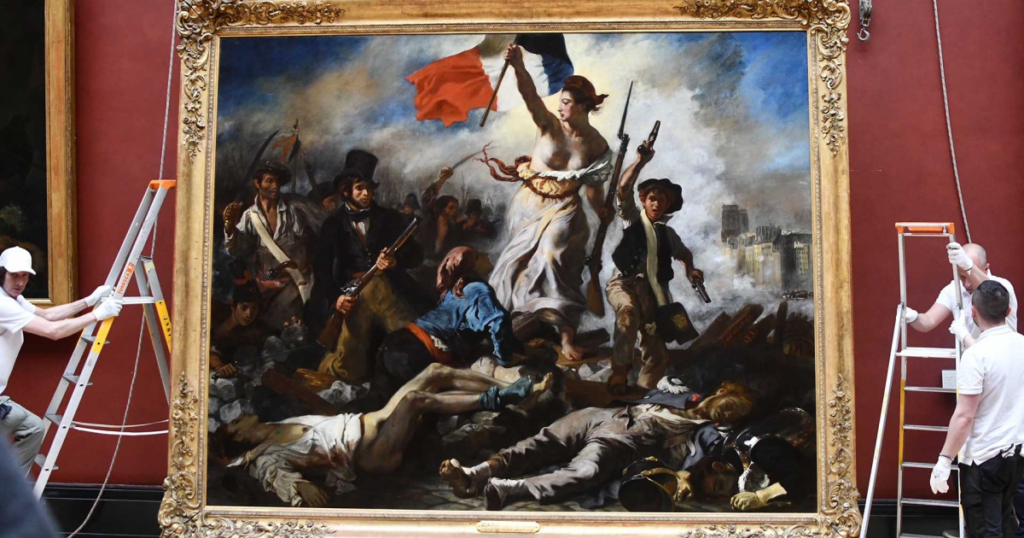
Image 1: La liberté guidant le peuple by Eugène Delacroix
Eugène Delacroix’s Liberty Leading the People is one of the French paintings I admire most. It depicts a woman carrying the tricolour over a barricade, with a worker, a bourgeois in a top hat, and a boy with pistols at her side. The theme is the July Revolution of 1830 in a realistic but allegorical style. The painting stands for the ideas that gave France its motto, liberté, égalité, fraternité, which the Second Republic wrote into its 1848 constitution and which the 1958 constitution still uses as the Republic’s motto. Protest and even insurrection have always been part of that larger concept and over the centuries, France has witnessed several revolutions. For instance, Parisians attacked the Bastille in July 1789, and in October of that year, women marched from Paris to Versailles to protest over the price of bread. Closer to the present, the strikes of 1936 won paid leave for workers. The feminist campaigns of the early 1970s led to the Veil law on abortion in 1975. Today, France is yet again on the streets, but, as often happened before, the protest has turned destructive, and parts of the country are burning again.
The present unrest began in mid-September as a student protest over school conditions: overcrowded classrooms, teacher shortages, and decaying buildings. It started in working-class suburbs such as Créteil, and school blockades soon drew in universities, teachers, parents, and trade unions. The police response was soon criticised. A 15-year-old lost a hand to a police grenade in Lens. Interior Ministry and police union sources state that the student, Evan, picked up an unexploded crowd-control or sting-ball grenade from the ground, which then detonated in his hand. On the other hand, students who witnessed the scene and the victim’s family maintain that the teenager did not pick it up, but was directly struck by a grenade fired into the crowd by riot police. By 13 October, the police inspectorate had opened 36 internal investigations to verify whether police forces violated operational regulations, used unnecessary or disproportionate force, or illegally deployed less-than-lethal weapons at close range against minors.[1]
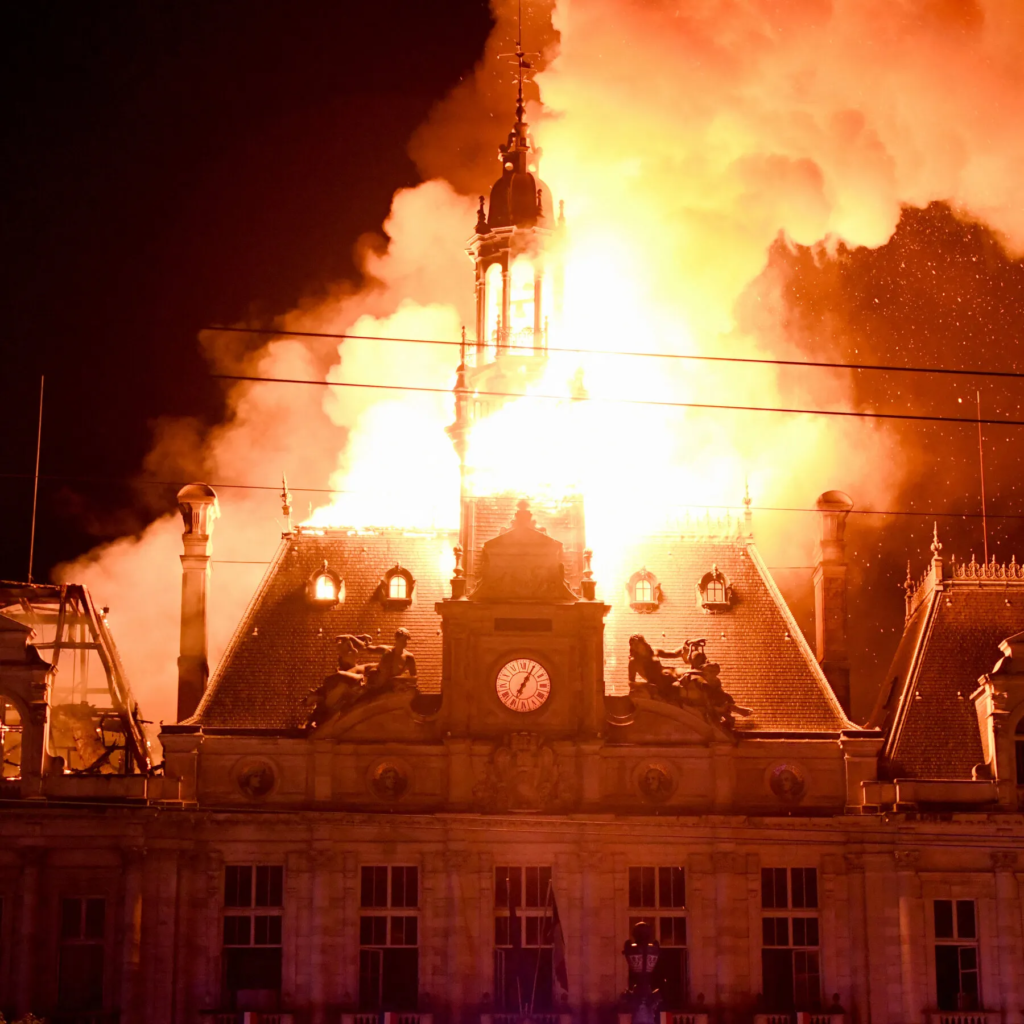
Image 2: Limoges town hall
By mid-October, major labor trade unions (like the CGT), farmers, pensioners, and activists from the 2018 Yellow Vest movement joined the students. They expanded the demands to address broader economic grievances. On 17 October, the Interior Minister counted about 550,000 marchers.[2] Most marched peacefully, but at night masked groups set fires and carried out widespread looting in several cities. Limoges town hall, a neo-Renaissance building of 1883 listed as a historic monument in 1975, lost its roof, upper floors, and bell tower. A tourist office in Lyon and two banks in Rouen were set alight, and town halls in Marseille, Lille, Grenoble, and Angers were invaded or damaged. The Commerce Minister said at least 3,000 businesses had been affected, and nearly 1,000 police officers were injured.[3] Several cities imposed curfews.
It is pertinent to highlight that the vandalism and wanton destruction of public and private property do not answer the grievances nor represent the spirit of France. More teachers, better maintained schools, and pay raises are budgetary choices that are settled by negotiation, legislation, and peaceful protests, and a burned town hall serves no one. The cost falls on the public, since local authorities must now repair a landmark, and on devastated businesses. Violence also changed the subject. Debate moved from classrooms to curfews, and President Macron described the unrest as the work of “far-left splinter groups” and delinquents, while the prime minister pointed to the role of La France Insoumise, whose leader replied that most demonstrations were calm. Allegations of excessive police force are a legitimate and separate grievance, but they can be raised more credibly by a movement that is not setting fire to public buildings.
Over the last few years, France has seen a stark escalation in the frequency and intensity of violent manifestations, marking a volatile shift in its protest culture. The 2018 Yellow Vest movement, the 2023 pension strikes, the summer 2023 suburban riots, and the current October 2026 turmoil have increasingly turned from traditional labour union marches into severe urban unrest. While most demonstrators remain peaceful, radicalised factions and “black bloc” groups have repeatedly hijacked these movements. This has resulted in the systematic targeting of state infrastructure, widespread plunder of shops and supermarkets, and a dramatic rise in casualties, with thousands of law enforcement officers and young protesters severely injured in the clashes.
Mass immigration and Islamic movements have long been part of this problem, and they cannot be ignored, as official sources and mainstream media have tried to. INSEE counted 7.7 million immigrants in France in 2024, or 11.3 percent of the population, of which one third had acquired French nationality. Foreign nationals numbered 6 million, or 8.8 percent.[4] Close to half of immigrants come from Africa.[5] The suburbs where earlier unrest began, as in 2005, have large populations of immigrant origin, and integration, schooling, and policing there are legitimate subjects of public debate. In the current protests, commentators report Algerian and Palestinian flags among some rioters, and the Middle East Forum points to the role of the Muslim student group Étudiants Musulmans de France in promoting the movement. Such claims call for serious investigation, not politically convenient dismissal. French law bars official statistics about ethnic or religious origins, so no state data can show who is in the crowds, and the only available figure is that 87 percent of those arrested in the first weeks were minors. As for the yellow vests, their movement began in November 2018 over fuel taxes and living costs in provincial France, and it also led to widespread vandalism, including at the Arc de Triomphe. The Yellow Vests returned to the streets along with the students on 17 October. An honest analysis distinguishes three components of the agitation: a school-related and cost-of-living list of grievances shared by many constituencies, the opportunism of organised groups known for their vandalism, and rising social tensions about mass immigration without integration that these dramatic events expose.
Delacroix’s Liberty carries a flag and a musket, but the Republic she stands for rests on institutions. France has a long tradition of public unrest (successive regimes in the last two and a half centuries have been more or less violently overthrown) and faces major problems concerning its schools, wages, and the declining economy in general, in addition to a worsening immigration and integration crisis. However, none of these emergencies can justify arson. The students’ case is strongest when it is made through marches, strikes, and argued in negotiations, and weakest when the evening news shows a listed monument on fire.
[1]Al Jazeera, “Paris left reeling as student-led protests turn chaotic,” 18 October 2026, https://www.aljazeera.com/news/2026/10/18/paris-left-reeling-as-student-led-protests-turn-chaotic
[2]CNN, “Police clash with protesters during huge demonstrations across France,” 17 October 2026, https://www.cnn.com/2026/10/17/world/live-news/france-protests-paris-intl
[3]“A mass march, a burning city hall and a country on edge,” Deseret News, 19 October 2026, https://www.deseret.com/the-west/2026/10/19/student-protests-escalate-as-half-a-million-demonstrators-march-across-france/
[4]“Immigrants now make up 11.3% of France’s population, new figures show,” Connexion France, reporting INSEE data for 2024, https://www.connexionfrance.com/news/immigrants-now-make-up-113-of-frances-population-new-figures-show/765281
[5]“Insee Shows Immigrants Now Make Up 11.3% of France’s Population,” VisaVerge, https://www.visaverge.com/immigration/insee-shows-immigrants-now-make-up-11-3-of-frances-population/ (secondary report of INSEE data).



Add comment