


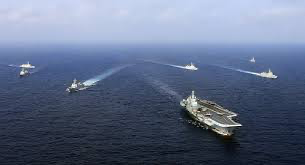
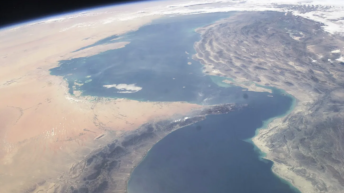
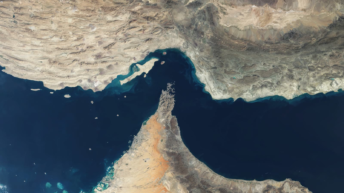
The current conflict in the West Asia, has brought significant challenges to the world including India. With fuel price surging ahead globally due to a limit of supply of crude oil, it for now at least invalidates the argument of “oil is not relevant anymore”. While the conflict in and around the Strait of Hormuz is ongoing , India also needs to keep an eye of another potential tinderbox which is in Eastern Asia, that is in the Taiwan Strait between China and Taiwan.
The dispute between Taiwan and China goes back to the 1930s when the Mao Zedong-led Communist Party (CCP) defeated Chiang Kai-shek’s Kuomintang (KMT) in Mainland China. Aiming to come back to Mainland China one day, the KMT moved its official government under the name of Republic of China (ROC) to Taipei in 1949, and in the same yearthe People’s Republic of China (PRC) was established in Beijing. While those two groups fought over the rights to represent Mainland China, the Indian government recognized PRC as the representative of Mainland China in 1950. The conflict between the PRC and the ROC gradually involved external actors, primarily the United States. The conflict changed its course when the United States came to assist Taiwan’s ROC against missile attacks from the PRC in what is known as the First, Second, and Third Taiwan Strait Crises, in 1954-55, 1958, and 1996 respectively.
Over the years United States became one of the guarantors of the Taiwan’s security through different regulations passed by Congress and through the military sales to Taiwan. The Taiwan Strait is considered one of the potential flashpoints for a major conflict between Beijing and Taipei backed by the United States. Any conflict in the region can lead to a significant challenge to the trade of multiple countries and can also have ripple effect on the global economy. Drawing parallels from the ongoing conflict in West Asia, if there is a war in East Asia, the numerous military bases of the United States can be targeted by the Chinese forces. Such actions may also revive other dormant conflicts in the region, such as the war between North and South Korea that was stopped by an armistice but never ended by a peace treaty.
It is important for New Delhi to be prepared for a conflict in the China Sea as well. The growing assertiveness of China towards Taiwan and the Philippines to the south of the Taiwan Strait can have an economic and strategic impact on India. India has significant trade relations in the region. Major shipping routes with Japan and South Korea pass through or near the strait, therefore raising the stakes for the country. Though diplomatically, India does not have official relations with Taiwan, digital platforms have increased connections between the two countries. Prime Minister Narendra Modi, had sent his condolences to Taiwan during a major earthquake in 2024, whereas President Lai Ching-te congratulated PM Modi on his reelection in 2024. The Prime Minister’s tweet has been a signal to the Taiwan leadership that India is willing to further deepen the non-political relations. At the same time, India’s rapprochement with China is not to resented in the island.
India’s Artificial Intelligence (AI) and semiconductor growth story is also closely linked with Taiwan which hosts some of the world’s most advanced semiconductor technology and has been investing in many countries, including India to boost chip production. This helps India in terms of nurturing future talents and driving forward advanced technologies. Besides Hi-Tech, Taiwan aided India during the COVID-19 pandemic by becoming one of the few countries supplying face masks and much needed medical equipment for the capacity building of India’s own healthcare. India-Taiwan relations took another leap in 2024, when India honored Young Liu from Taiwan, Chairman of Foxconn with the prestigious Padma Award of India. This led to a significant boost in India’s public diplomacy.
Any kinetic conflict between Taiwan and China might force India to organise the repatriation of Indian citizens living in Taiwan who number in the thousands.. India might also be requested by other nations from Southeast Asia, including its strategic partners, for assistance to evacaute their more than 5,00,000 citizens residing in Taiwan as Overseas Foreign Workers (OFWs).
In summary, the Taiwan Strait is another choke point in global trade and is crucial for India. Any disruptions can lead to massive delays and cost escalations for consumers and businesses in India.

Add comment