


The story of India and Seychelles did not begin with diplomatic cables or strategic agreements. It began more than two and a half centuries ago, in 1770, when five Indians arrived on the then-uninhabited archipelago alongside a small group of French settlers and African labourers. Among those first recorded Indians were men identified in historical records as Mutu and Chari, whose journey marked the beginning of a human connection that has endured across generations.
Over the decades, Indians from Tamil Nadu, Puducherry, and later Gujarat settled in Seychelles as traders, artisans, and entrepreneurs. During British colonial rule, the islands were administered for a period under the Bombay Presidency, further strengthening commercial and administrative links with the Indian subcontinent. Today, the Indian diaspora continues to play a prominent role in Seychelles’ economy and public life, while thousands of Indian professionals contribute to sectors ranging from healthcare and education to construction and tourism. These enduring people-to-people ties have provided an important foundation for what has evolved into one of India’s closest partnerships in the western Indian Ocean.
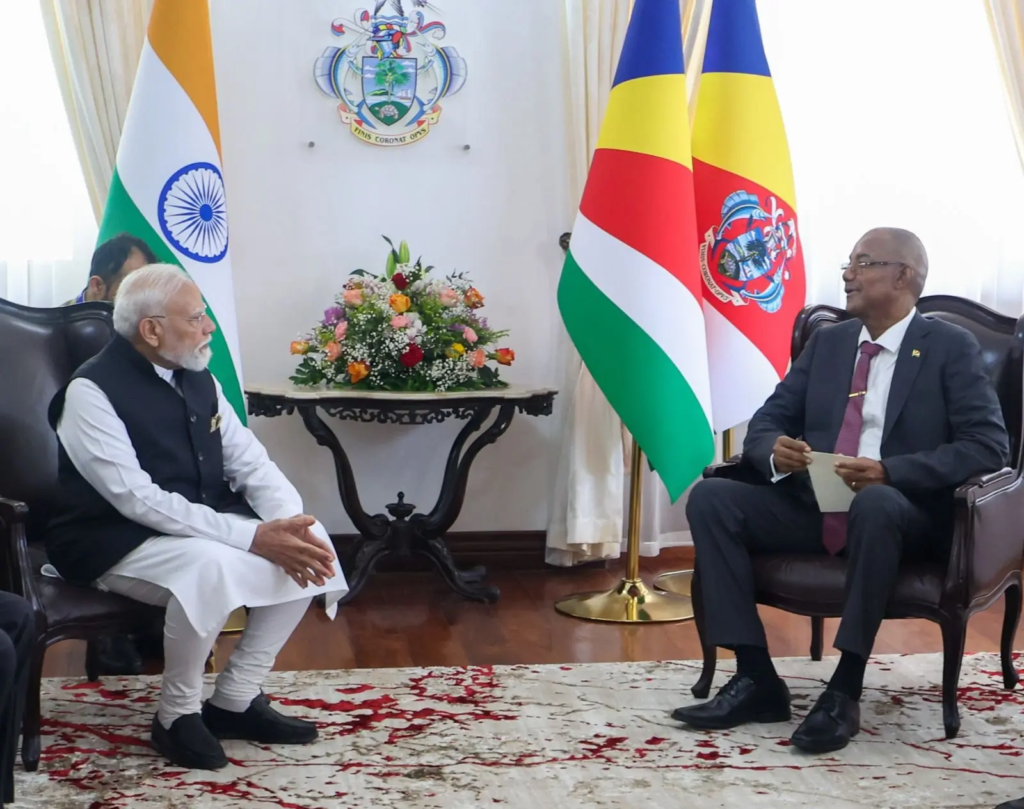
Prime Minister Narendra Modi’s state visit to Seychelles in late June, timed to coincide with the island nation’s fiftieth anniversary of independence and fifty years of diplomatic relations with India, symbolised not merely a ceremonial milestone but the steady maturation of a relationship built on mutual trust, strategic convergence, and shared aspirations for the Indian Ocean region.
For many Indians, Seychelles is synonymous with pristine beaches and luxury tourism. Yet, viewed through the lens of geopolitics, it has a significance far greater than its modest size would suggest.
Although Seychelles has a land area of just about 460 square kilometres, it exercises sovereign rights over an Exclusive Economic Zone spanning nearly 1.3 million square kilometres—almost 2,800 times larger than its landmass. It is, therefore, better understood not simply as a small island developing state, but as a “Large Ocean State.” Situated astride some of the world’s busiest Sea Lanes of Communication linking Asia, Africa, and the Middle East, Seychelles occupies a strategic position in the western Indian Ocean. The security of these waters directly affects global commerce, energy flows, and maritime stability, all of which are vital to India’s own economic and strategic interests.
As India’s maritime outlook has expanded over the past decade, the western Indian Ocean has assumed increasing importance in New Delhi’s strategic calculus. India’s vision of SAGAR—Security and Growth for All in the Region—and its more recent articulation of MAHASAGAR, reflect the recognition that maritime security cannot be separated from sustainable development, climate resilience, and regional prosperity. In this broader vision, Seychelles is not merely a partner on the periphery but an important stakeholder in shaping a secure, stable, and inclusive Indian Ocean.
This strategic convergence is most visible in maritime security cooperation. For decades, India has worked closely with Seychelles to strengthen the latter’s capacity to safeguard its vast maritime domain against piracy, illegal fishing, narcotics trafficking, and other transnational challenges.
The partnership extends well beyond the transfer of defence equipment. India has assisted in developing coastal surveillance capabilities, conducted hydrographic surveys, supported maritime domain awareness, trained personnel of the Seychelles Defence Forces and Coast Guard, and regularly deployed Indian naval ships for joint exercises and goodwill visits. Patrol vessels, Dornier maritime surveillance aircraft, radar systems, and other defence assets supplied by India have substantially enhanced Seychelles’ ability to monitor and secure its expansive Exclusive Economic Zone.
Equally significant has been India’s emphasis on human resource development. Prime Minister Modi recently observed that nearly one in every fifty Seychellois has received training in India. Through initiatives such as the Indian Technical and Economic Cooperation (ITEC) programme, scholarships, diplomatic training and professional exchanges, India has contributed to building institutional and technical capacities across multiple sectors. Such investments underscore an important characteristic of the bilateral relationship: it seeks not merely to provide resources, but also to strengthen local capabilities.
This approach is evident in India’s development partnership with Seychelles. Over the years, Indian assistance has supported infrastructure, healthcare, education, renewable energy, digital connectivity, and community development. The recently announced US$175 million Special Economic Package—comprising a US$125 million Line of Credit and US$50 million in grant assistance—represents the largest Indian economic commitment to Seychelles to date. The package supports projects identified as national priorities, including social housing, public transport, and vocational education.
Healthcare has emerged as another important pillar of cooperation. India has supplied medical equipment, ambulances and affordable medicines while also supporting plans for a new national hospital. Thousands of Seychellois continue to travel to India for specialised medical treatment, further strengthening people-to-people links between the two countries.
Education and skill development have likewise assumed increasing prominence. The ground-breaking ceremony of a new Professional and Technical Education Centre during Prime Minister Modi’s visit reflects a shared commitment to preparing Seychellois youth for emerging economic opportunities. India’s long-standing scholarship programmes and technical training initiatives have similarly contributed to developing skilled human capital in the island nation.
The partnership has also embraced new frontiers. Agreements concluded during the 2026 visit on deploying India’s Unified Payments Interface (UPI), cooperation in the peaceful uses of outer space, agricultural research, and digital technologies point towards a relationship that is adapting to changing technological realities. Simultaneously, cooperation under the International Solar Alliance and Seychelles’ accession to the Coalition for Disaster Resilient Infrastructure demonstrate a shared commitment to climate resilience and sustainable development—issues that are of existential importance for island nations.
India’s role as a dependable partner has also been evident during times of crisis. Whether through the supply of COVID-19 vaccines during the pandemic or the recent provision of food grains, cement, and humanitarian assistance to address supply disruptions, New Delhi has consistently responded to Seychelles’ immediate needs. Such assistance reflects an understanding that resilience in the Indian Ocean is built not only through security cooperation but also through economic stability and societal well-being.
Prime Minister Modi’s 2026 visit captured this multidimensional character of the relationship. Alongside the announcement of the Special Economic Package, India handed over a fast patrol vessel, utility vehicles, laser boats, and ambulances, while also launching new initiatives in vocational education, healthcare, digital payments, and renewable energy. The conferment of the specially instituted “Guardian of the Blue Horizon” award on the Prime Minister recognised not only India’s support for Seychelles but also its broader advocacy of sustainable development and the Blue Economy.
Together, these initiatives illustrate a partnership that has steadily expanded out of historical goodwill to encompass defence, development, technology, climate action, and economic cooperation. They also reflect an approach that has consistently sought to align Indian assistance with Seychelles’ own developmental priorities while respecting the agency of a trusted partner.
In an era when the Indian Ocean is emerging as one of the principal theatres of global geopolitics, relationships with island nations have acquired unprecedented strategic significance. Seychelles may be modest in geographical size, but its maritime space, strategic location, and political importance make it an indispensable partner in India’s engagement with the western Indian Ocean.
The India-Seychelles relationship is therefore not simply a story of diplomacy between a large country and a small island state. It is the story of two maritime neighbours connected by centuries of human interaction, bound by shared interests in a peaceful and prosperous Indian Ocean, and committed to building a partnership that continues to evolve with changing regional realities.



Add comment