


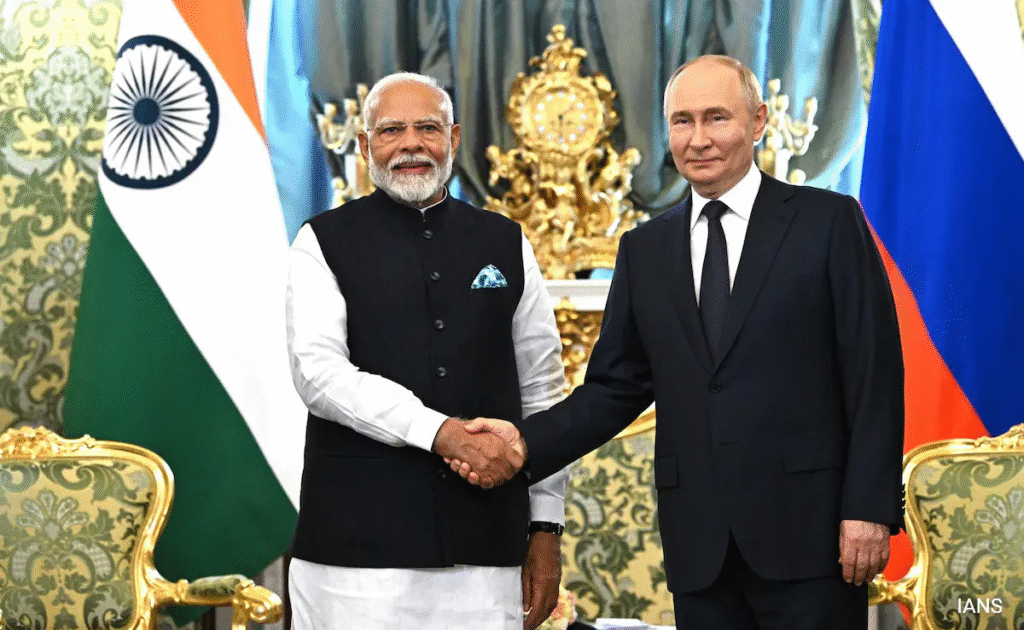
President Putin’s visit to India for the 23rd Annual Summit occurred at a critical moment in global politics and coincided with the 25th anniversary of the India–Russia Strategic Partnership, upgraded in 2010 to a Special and Privileged Strategic Partnership. The meeting reaffirmed strong ties despite geopolitical tensions and underscored India’s pursuit of strategic autonomy. Prior to the visit, Russia approved the Reciprocal Exchange of Logistical Support (RELOS) agreement — a significant defence pact expected to boost military cooperation.
The summit took place against the backdrop of the ongoing Ukraine conflict, Western sanctions on Moscow, and debates over India’s continued purchase of Russian oil, which attracted close attention from Europe and the wider international community. Sanctions aimed at isolating Russia have instead prompted it to seek closer ties with non-Western partners, with India emerging as a significant economic and strategic ally. Rather than weakening Moscow, these restrictions have created opportunities for increased India–Russia cooperation and have enhanced India’s diplomatic influence. Public exchanges between European envoys and Russian representatives in Indian media underscore global interest in how New Delhi manages its relations with both Moscow and the West.
The India–Russia partnership today extends far beyond traditional trade and energy. It is driven by strategic needs on both sides. Sanctions have limited Russia’s access to finance and technology, increasing its dependence on reliable non-Western partners. India — with its large economy and global influence — meets this need, while Moscow remains crucial for India’s defence and energy security.
Indian foreign policy has shifted from Cold War non-alignment to contemporary multi-alignment — engaging the US and its allies while maintaining historic defence and energy cooperation with Russia. The Ukraine conflict has highlighted this balancing act. India increased purchases of discounted Russian crude and abstained on UN resolutions, even as it strengthened cooperation with the US and Europe in defence, space, and advanced technologies.
This engagement, however, carries risks. A prolonged conflict could heighten Western scrutiny of India–Russia relations. Clear messaging and careful diplomacy are essential. Nonetheless, the opportunities are considerable. Maintaining strong connections with both Russia and the West boosts India’s influence as a swing power in a multipolar world.
The summit also expanded engagement beyond security matters. Agreements on labour mobility, healthcare, food safety, maritime training, and counter-terrorism reflect a diversifying agenda. Although not all discussions were made public, the outcomes indicate an intention to establish a more resilient, long-term partnership.
A significant economic milestone was the launch of the India–Russia Economic Cooperation Roadmap, aiming for USD 100 billion in trade by 2030 compared to the current approximately USD 65 billion. This necessitates addressing the trade imbalance, as India’s exports are under USD 5 billion, while imports remain energy-intensive and include some defence goods. To enhance financial flows, both parties agreed to explore rupee–ruble settlements, payment system interoperability, and transactions based on Central Bank Digital Currency (CBDC) — crucial since Russia is cut off from SWIFT and Indian banks are cautious about sanctions exposure. Smooth financial channels are vital for increasing trade volume and reducing risk. India seeks to diversify its exports into pharmaceuticals, machinery, chemicals, textiles, agriculture, and engineering goods to lessen dependence on crude oil-driven trade.
Energy remains a key focus. President Putin assured ongoing supplies of oil, gas, and coal and emphasised that India must maintain freedom of energy choices, just as the US continues to purchase Russian nuclear fuel. Trade has increased from USD 10 billion in 2022 to approximately USD 69 billion, mainly due to Russian discounted crude. Despite a recent dip in value, Russia still supplies over 30% of India’s oil. Looking ahead, Moscow aims for long-term energy sales, while India advocates for balanced and value-added trade.
Nuclear cooperation was a key highlight. President Putin emphasised the Kudankulam Nuclear Power Project in Tamil Nadu, where Russia is providing reactor technology and construction support. The plant will have six reactors, with two already operational and four under construction, generating a total of 6,000 MW. A second nuclear site will be developed, with India designated to allocate land. Russia also expressed its willingness to share advanced technologies, such as Small Modular Reactors (SMRs) and floating reactors, to support India’s goal of 100 GW of nuclear capacity by 2047.
No major new acquisitions were announced in the defence sector, as specifics are typically not disclosed in joint statements. However, defence cooperation was strongly reaffirmed. The focus is shifting from a buyer–seller arrangement to co-development and co-production. Collaboration on spares, components, and platform upgrades — crucial since 60–70% of India’s inventory is of Russian origin — was prominently highlighted. The finalisation of the RELOS logistics agreement will enhance operational cooperation and give India access to Russian facilities, including in the Arctic.
Another key outcome of the summit was the emphasis on stronger people-to-people engagement. India and Russia signed a mobility agreement allowing Indian professionals to work in Russia across sectors such as construction, engineering, textiles, manufacturing, and electronics — potentially creating up to 70,000 job opportunities. India also announced 30-day free e-tourist visas for Russians to boost tourism and cultural exchange. Recently, India opened two new consulates in Russia to improve outreach. The summit clearly signals an effort to deepen human connections and facilitate easier mobility between the two countries.
Both countries condemned terror attacks in Pahalgam, Jammu & Kashmir, and at the Crocus City Hall in Moscow. Reaffirming their commitment to combat terrorism in all its forms, both leaders called for action against UN-listed groups including Al-Qaeda and ISIS/Daesh. Both sides supported dialogue on Iran’s nuclear issues, expressed concern about Gaza’s humanitarian situation, and emphasised the need for restraint and adherence to international law.
India imports USD 12 billion worth of fertilisers annually, with Russia supplying nearly 50% of India’s Diammonium Phosphate (DAP). DAP is a popular and concentrated phosphate-based fertiliser that supplies essential nitrogen and phosphorus to plants. The summit proposed long-term supply stabilisation and joint manufacturing in India. Cooperation will also broaden in the minerals, oil, gas, and energy sectors.
Trade and connectivity took centre stage at the summit. India and Russia agreed to promote key routes such as the International North-South Transport Corridor (INSTC), the Chennai–Vladivostok/Eastern Maritime Corridor, and the Northern Sea Route, which could reduce transit times to 20–25 days from 40 days and provide an alternative to the Suez route and China’s BRI. Russia invited India to deepen Arctic cooperation, including polar navigation training. With 13% of global undiscovered oil and 30% of gas reserves, the Arctic holds significant economic and strategic value—especially amid China’s increasing presence. India already participates through ONGC stakes in Russian Arctic projects.
Both parties supported an agreement to prevent an arms race in space and endorsed efforts to ban biological weapons worldwide. They reaffirmed their commitment to multilateral frameworks on biodiversity, biosecurity, migratory species, and WTO-based trade systems.
In conclusion, the summit reaffirmed that India–Russia relations remain stable, pragmatic, interest-based, and future-focused. Defence cooperation is evolving towards co-production and co-development, while energy continues to be a key pillar supported by nuclear collaboration and fossil-fuel supply security. Connectivity corridors promise quicker, more diverse trade routes. People-to-people engagement is increasing through mobility pacts and consulates. Counter-terrorism cooperation remains strong, alongside consensus on global governance and non-proliferation. Trade stays vigorous but needs greater Indian export growth to achieve balance. Overall, the summit reflects continuity with modernisation — prioritising economic security, technological partnerships, and long-term strategic cooperation.
References:
MEA statements/ Briefings/ Press notes & Economic Roadmap Announcements.
Joint Statement, Summit Outcome Documents
Defence-related statements and outcomes from the India–Russia Summit.
Ministry of Commerce remarks on trade imbalance and export diversification
Cut the Clutter with Sekhar Gupta Episode 1767

Add comment