


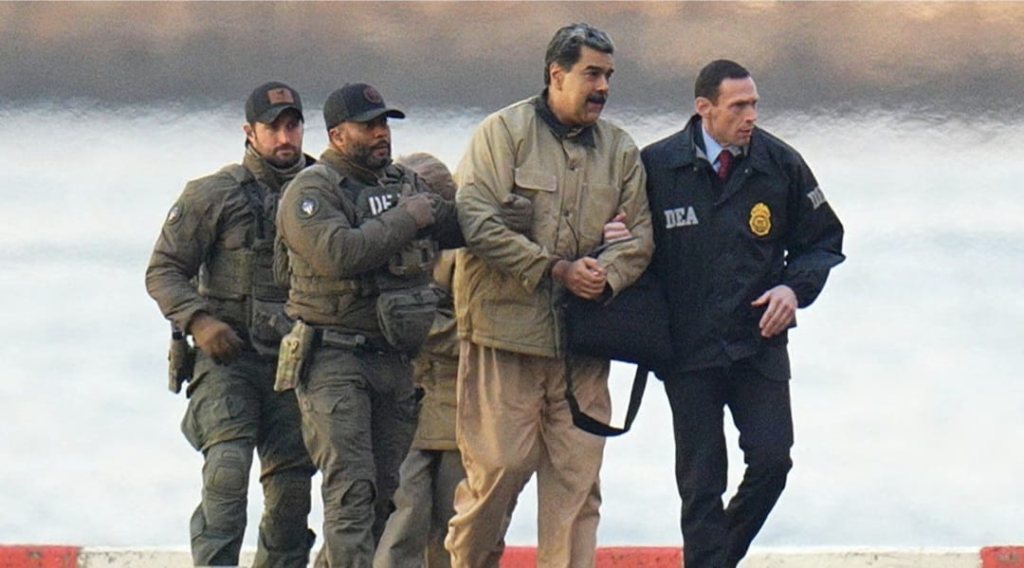
The recent “arrest” of Venezuelan President Maduro by the U.S. military, carefully framed as an arrest rather than an act of war, feels like a major turning point on the world stage. Countries across the globe – whether allies or not – are closely watching to see what happens next, but this is not just another headline or isolated incident. For those who observe politics closely, this is the beginning of the end. Of the old International Order, the one we have grown accustomed to.
As this international system enters a phase of transformation, it is characterised by the dissolution of ethical norms that bind the world and historically constrain the exercise of state power. In the classical sense, especially in the Chinese tradition, it is identified as the collapse of ritual and music, ‘libeng yuehuai’ – a state wherein all formal structures of governance and diplomacy lose their moral coherence, leaving only the application of raw-brute power. This event will serve as the definitive marker of this systematic disintegration.
The Collapse of Ritual:
On 3 January 2026, the United States crossed a line that it had long bypassed through legal justification. Under the banner of Operation Absolute Resolve, Washington launched a military intervention unlike anything we have seen in the modern era—not sanctions, not diplomatic pressure, not another round of symbolic recognition of an opposition government, but the direct, kinetic seizure of a sitting head of state on his own soil.
This was not a regime change by proxy or paperwork. It was force, plain and simple. The legal justification was built around a sweeping indictment of Nicolás Maduro and his inner circle for narco-terrorism, large-scale cocaine trafficking, and weapons violations, including machine gun possession. These charges, in turn, were used to invoke the Alien Enemies Act—an obscure but powerful legal tool that effectively reframed a foreign president as a criminal subject to U.S. jurisdiction.
International law offers no true global enforcement mechanism. It depends on consensus, restraint, and mutual recognition. The United States, by contrast, does not suffer from that limitation. It has courts, indictments, and—most importantly—the military capacity to enforce its legal interpretations unilaterally. Operation Absolute Resolve made this imbalance impossible to ignore.
In the past, legal experts have focused their attention on the 1990 case of Panamanian leader Manuel Noriega as the primary precedent. Maduro, in his statement, argued that he is a ‘Prisoner of War’ (PoW) and that he has head-of-state immunity, a doctrine that typically protects leaders from prosecution in foreign courts. However, the US Government preempted this argument by refusing to recognise the Maduro regime following the disputed 2024 elections.
‘The Trumpian Corollary’:
The Trump administration breaks sharply from those that came before it—not because it is more aggressive, but because it is unapologetic. The message is blunt to the point of parody: ‘yeah, we’re taking the oil’. There is no effort to cloak power in the language of democracy, liberation, or human rights. And for Donald Trump, this approach is internally consistent. His objective is not regime transformation or nation-building; it is leverage—economic, political, and strategic—for making America “great again”, tariffs included. Preserving something close to the status quo works well as long as it can be exploited. Refreshing, perhaps, but also deeply revealing of how little regard is left for the norms that once constrained American power.
This is important because these norms were not accidentally adopted. Last year marked the 80th anniversary of the 1945 United Nations Charter, a document explicitly designed to prevent unilateral uses of force by placing the renunciation of war at the core of the international legal order. The Charter allowed only narrow exceptions, including one which many nations exploited under the garb of self-defense. As we know, the postwar system was imperfect from the start, but it established a critical principle, that force requires legal justification beyond raw power. War crimes tribunals at Nuremberg and Tokyo reinforced that idea by holding individuals and states accountable, at least in theory.
What the United States is now signaling is not merely disregard for that framework, but a willingness to hollow it out entirely. While Washington had multiple legal and diplomatic options available, the decision to forcibly remove a disfavoured government collapses the distinction between law enforcement and warfare. When a state with global reach treats regime changes as a prosecutorial act, it invites others to do the same; under their own laws, with their own definitions of criminality. The danger is not chaos overnight, but normalisation: a world in which sovereignty is conditional, legality is unilateral, and power, not law, once again becomes the final arbiter.
The View from Beijing: China’s Muted Observation?
China’s reaction to Washington’s actions in Venezuela has been in equal parts alarm and strategic calculation. On paper, Beijing has always championed sovereignty and non-interference. In practice, that principle has remained flexible at best, keeping in mind the South China Arbitration Case, which involved the sovereignty of the Philippines. Still, its response to this crisis has been noticeably awkward—almost hesitant. One may say that it may be driven by the scale of Chinese investments across Latin America, or by something bigger: Beijing’s growing ambition to present itself as the real guardian of international order, one reshaped and led through what it calls “Chinese characteristics.”
Since 2020, the idea of the “rule of law” has taken on renewed importance inside the Chinese Communist Party. Not the rule of law as commonly understood in liberal systems, but a Socialist Rule of Law with Chinese Characteristics. This framing gained traction during the Second, Third, and Fifth Plenary Sessions of the Nineteenth Central Committee, where “Xi Jinping’s Thought on the Rule of Law” became a central theme. National security—both at home and abroad—sat at the heart of those discussions.
That focus inevitably ties into questions of territorial unity and sovereignty. The unification of the “motherland” and the framework of “one country, two systems” loom large here, particularly as observers draw parallels with Taipei and with Beijing’s own Operation Justice Mission–2025. What’s interesting is how Beijing has been consistent in its legal positioning on Taiwan being an internal matter, a claim which is often reinforced through the One-China Policy and repeated relentlessly in international forums.
From Beijing’s perspective, the U.S. intervention in Venezuela opens a strategic window. It exposes the gap between Washington’s rhetoric about a rules-based order and its willingness to act unilaterally when it suits its interests. China sees an opportunity to exploit that contradiction and to weaken U.S. leadership, validate its own long-term investments in global institutions, and present itself as the steadier, more principled alternative; a claim that is gaining traction among nations observing this incident.
Of course, ideals are only part of the story. The real drivers are money, power, and structure. China has enormous financial stakes tied up in the current system, but it is also working aggressively to build alternatives alongside it—parallel systems of governance, finance, and influence that reduce its dependence on a U.S.-led order.
What Beijing is after isn’t just a seat at the table. It wants to redesign the table itself—and, just as importantly, to be seen as the power most capable of enforcing the new rules. In that sense, this isn’t unprecedented. The victors of World War II did something similar when they built the postwar order: creating institutions like the International Monetary Fund and the World Bank, anchoring the dollar on gold, and locking in a system that reflected their interests and values.
China is now writing its own version of that playbook. It is rolling out governance and development frameworks such as the Belt and Road Initiative (BRI), the Global Development Initiative (GDI), the Global Civilization Initiative (GCI), and the Global Security Initiative (GSI). These are reinforced by institutions like the Asian Infrastructure Investment Bank (AIIB) and the newly proposed International Organization for Mediation (IOMed), Cross-Border Interbank Payment System (CIPS) – focusing on building an alternative, better mechanism for trade settlements. Taken together, they amount to a serious, coordinated challenge to the U.S.-led system—not by open confrontation, but by steadily building a rival architecture in parallel.
Rewriting of Norms?
What we are witnessing, at this moment, is not simply an instance of American overreach or an opportunity for China, but a visible unraveling of a system that once relied on some restraint, civility, and legality to which everyone agreed to respect through International Law. The United States has demonstrated that law can be weaponised and enforced unilaterally, while China prepares to show the world that order can be rebuilt without liberal consent.
The arrest of Maduro will not be remembered for what it achieved in Venezuela, but for what it revealed globally, namely that the post-1945 international order no longer governs the behaviour of states. What will replace it will not be decided by Charters or courts, but by those capable of operating, enforcing, and enduring an international regime under which legitimacy follows power, and not the other way around.

Add comment