


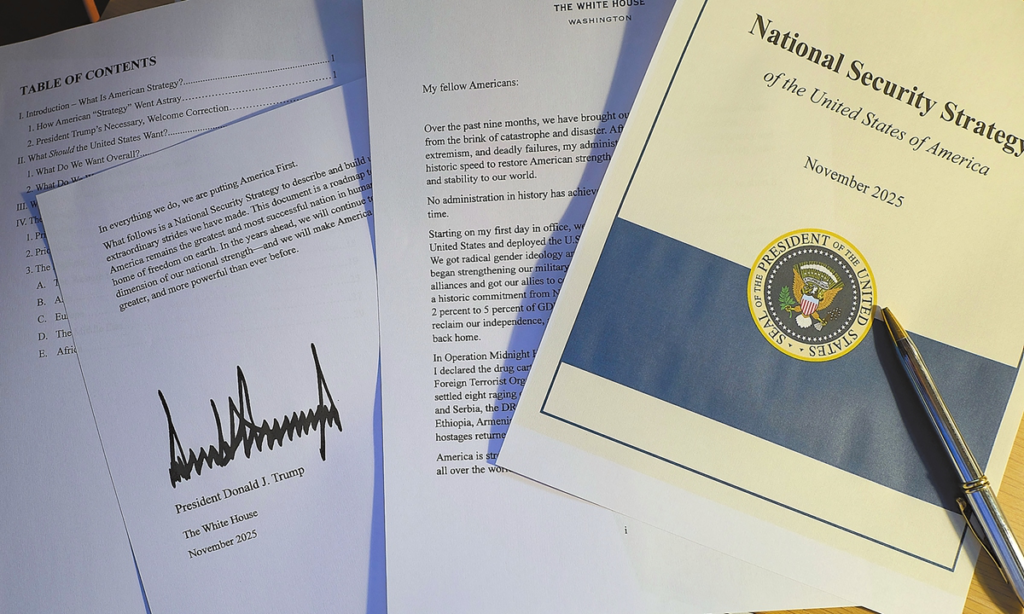
The 2025 National Security Strategy (NSS) emerges at a delicate juncture in the strategic history of the United States and, more broadly, in the evolution of the international order. After the three decades following the end of the Cold War — marked by a phase of apparent American unipolarity — the global system is now traversed by the rise of multiple centers of power: China, Russia, India, the expanded BRICS group, and new regional actors in the Near and Middle East, Africa, and Latin America. In this environment, Washington’s ability to unilaterally set the rules of the game can no longer be taken for granted.
The NSS 2025 is born precisely within this tension: on the one hand, it firmly reaffirms the objective of preserving the United States’ central role; on the other, it reflects the awareness that such centrality is increasingly contested and weakened by long-term geopolitical, economic, and technological processes. The strategy explicitly rejects the idea of a fully cooperative polycentric order and instead aims to reorganize the international architecture in hierarchical form, with Washington at the apex and a set of subordinate poles acting as local guarantors of a system still driven by U.S. power.
This approach can be described as “reactive unipolarism”: no longer the triumphant unipolarity of the 1990s, but rather the attempt to prolong hegemony under less favorable structural conditions, through more selective, more defensive, and at times openly coercive tools.
CONTINUITIES AND BREAKS WITH PREVIOUS STRATEGIES
Structural continuities
Despite its innovations, the 2025 National Security Strategy fits within a line of continuity with the main strategies developed since 2001. Several core pillars remain unchanged.
First, the objective of preventing the emergence of hostile regional hegemons remains central. The United States continues to regard it as vital to prevent any rival power from dominating Europe, East Asia, or the Near and Middle East. This objective underpins the maintenance of an advanced U.S. military presence in Europe (through NATO) and in Asia (through the system of bilateral alliances with Japan, South Korea, and Australia, as well as the strategic partnership with India).
Second, the strategy reaffirms the logic of “peace through strength.” The strengthening of military power—both conventional and nuclear—remains a cornerstone of U.S. security policy. Deterrence is still perceived as the primary instrument for preventing great-power conflict and for maintaining favorable balances of power.
Third, the centrality of the Indo-Pacific and of technological competition with China is further consolidated. Supremacy in areas such as artificial intelligence, quantum computing, advanced telecommunications, energy, and biotechnology is regarded as an integral component of national security, rather than merely an economic or industrial objective.
Finally, the system of alliances and partnerships continues to be viewed as a force multiplier. The United States intends to rely on Europe, Japan, India, Australia, and other partners to distribute the burdens and responsibilities associated with managing the international order.
Discontinuities: Sovereignism, Protectionism, and the end of Globalism
Alongside these continuities, significant breaks clearly emerge.
The first concerns the rejection of globalization. The strategy explicitly criticizes three decades of free trade, offshoring, indiscriminate market opening, and reliance on international institutions perceived as vehicles for the erosion of U.S. economic sovereignty. The declared objective is no longer to “lead the liberal order,” but rather to defend U.S. interests as a priority, even at the cost of undermining rules and practices established in the post–World War II period.
The second major discontinuity is the centrality attributed to migration. Immigration is no longer treated primarily as a social or economic issue, but as a core threat to internal cohesion and, therefore, to national security. Border protection is defined as the first line of defense of the state, and the strategy explicitly proclaims the “end of the era of mass migration.” This represents a profound shift from earlier phases in which the principal threats were identified as terrorism or nuclear proliferation.
The third break concerns the abandonment of the rhetoric of “democracy promotion.” The 2025 NSS no longer seeks to transform other political systems from the outside by invoking human rights and democratic norms. On the contrary, it asserts the legitimacy of cooperating with non-democratic regimes when doing so serves U.S. interests. This marks a clear departure from the interventionist doctrines of the 1990s and 2000s.
The fourth rupture lies in the transformation of alliances into conditional contractual relationships. Alliances are no longer framed as communities of shared values, but as mechanisms through which Washington demands higher defense spending, arms purchases, and technological and geoeconomic alignment from its allies in exchange for security guarantees.
Finally, the strategy embraces a form of “strategic mercantilism.” Reindustrialization, protectionism, the political use of tariffs, and the rejection of the “Net Zero” paradigm become integral components of the security doctrine, rather than mere elements of domestic economic policy.
Security as the Defense of Internal Order
One of the most innovative aspects of the 2025 National Security Strategy is the close linkage it establishes between internal security and the capacity for external power projection.
Reindustrialization and Economic Sovereignty
The erosion of the industrial base is identified as a threat to national security. Reindustrialization is presented as a necessary condition for sustaining military capability, reducing dependence on vulnerable global supply chains, rebalancing economic relations with China, and shielding American society from the social and political consequences of deindustrialization.
This approach overturns the paradigm of the recent past: it is no longer trade openness that guarantees power, but rather control over critical productive, energy, and technological infrastructures. National security is thus anchored to industrial sovereignty.
Migration, Society, and Internal Vulnerability
The strategy emphasizes the threat posed by irregular migration, drug trafficking (particularly fentanyl), and the growing perception of social insecurity. Large-scale migratory flows are associated with the risk of identity fragmentation and internal political crisis. Border security is therefore elevated to a central pillar of national security.
This shift has significant implications: threats no longer stem solely from hostile state actors, but also from transnational processes—migration, criminal networks, and social instability—that directly affect the cohesion of the American political community.
The Crisis of Globalism and Selective De-globalization
Criticism of globalism translates into a form of selective de-globalization. The United States does not abandon globalization altogether but instead seeks to manage its effects in order to preserve its primacy. On the one hand, access to strategic sectors—such as advanced technologies, critical value chains, and digital infrastructures—is restricted or filtered; on the other, the role of the dollar and U.S. financial markets as the core of the international economic system is maintained and reinforced.
(This article constitutes part one of two part article examining the 2025 National Security Strategy.)




Add comment