


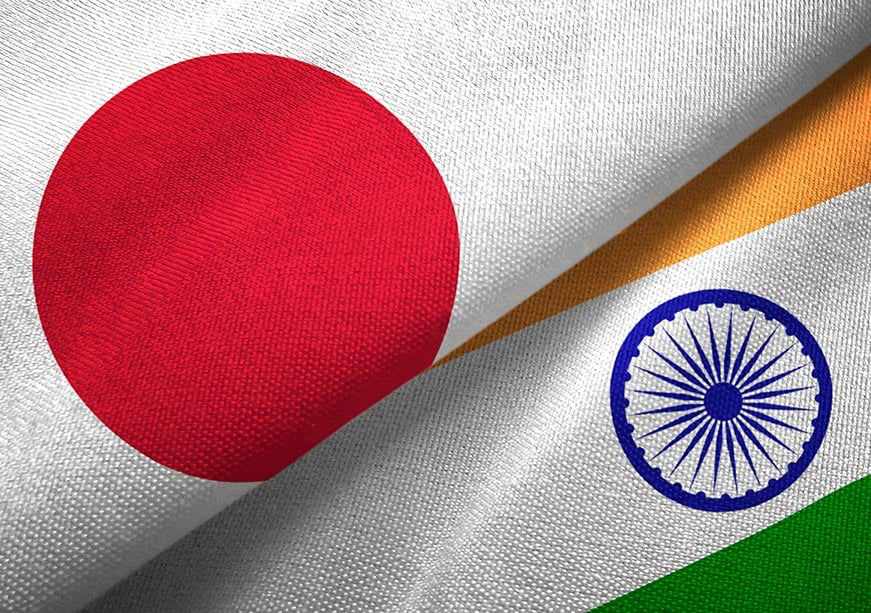
The Indo-Pacific has become a geopolitical theatre of great power rivalry. The rapid naval build-up and military modernisation of the great powers, overlapping territorial claims, and disputed maritime boundaries in the waters of Indo-Pacific add to the instability in the region. Against this backdrop, the Indo-Japanese strategic partnership stands out for its depth, institutional density, and expanding scope. The partnership was elevated to a Special Strategic and Global Partnership in 2014 during Prime Minister Modi’s visit to Tokyo, and consequently, the last decade has witnessed a structural convergence of strategic interests of both countries that very few other bilateral relationships can boast of in the Indo-Pacific.
India and Japan are dealing with the same strategic challenge in the Indo-Pacific – the rapid and assertive rise of Chinese power across both continental and maritime domains, and therefore, New Delhi and Tokyo have been collaborating to promote a multipolar Indo-Pacific order, an order that prevents any single country from dominating the region. This strategic congruence between New Delhi and Tokyo is evident across multiple interlinked domains. India and Japan conduct the annual JAIMEX bilateral naval exercise. Both countries are also together in the expanded Malabar naval exercise, reflecting growing interoperability and a shared concern about the stability of the Indo-Pacific. Since 2019, the 2+2 Foreign and Defence Ministerial Dialogue has provided a regular high-level institutional mechanism to coordinate on regional security. The Acquisition and Cross-Servicing Agreement (ACSA), signed in 2020, has further deepened this cooperation by enabling the two sides to provide each other with logistical support during operations and exercises.
On the economic front, the bilateral trade between India and Japan has touched $25 billion in 2025. Japan remains India’s largest bilateral Official Development Assistance (ODA) partner. Moreover, the Mumbai-Ahmedabad High-Speed Rail project, supported by a Japanese soft loan of approximately $15 billion, is the iconic example of economic cooperation, as it is not merely a connectivity or infrastructure project, but is also the single largest bilateral infrastructure joint project between the two countries, reflecting long-term Japanese stakes in India’s growth story.
The bilateral partnership is also rapidly transcending the traditional domains. Cooperation between the Japan Aerospace Exploration Agency (JAXA) and ISRO in the space sector is increasing, with activities spanning satellite-based applications and the potential for joint missions. Cybersecurity has become a new key pillar in bilateral cooperation. Both countries are also working on supply chain diversification to reduce dependencies on China. Thus, the India-Japan partnership has come a long way from the post-Cold War era and has now evolved into more structured, multi-dimensional cooperation, strategically built on shared interests, with a shared vision for a more balanced and multipolar Indo-Pacific.
There are three specific dimensions of India-Japan cooperation in the Indo-Pacific:
a). the defence of a rules-based maritime order
b). the management of regional flashpoints, and
c). the strengthening of international institutions for dispute resolution.
Rules-Based International Order and Freedom of Navigation
The international order established after World War II was founded on a set of common rules and norms that included multilateral treaties, the principle of sovereign equality and a codified system of rules governing the seas. The maritime rules are based on the United Nations Convention on the Law of the Sea (UNCLOS), adopted in 1982. It provides the basic legal framework for the governance of the oceans: territorial waters, exclusive economic zones (EEZs) and the principle of freedom of navigation. Yet, in the Indo-Pacific, this framework is facing increasing pressure from China, especially in the South China Sea
India’s vision of Mutual and Holistic Advancement for Security and Growth Across Regions (MAHASAGAR) offers a cooperative and inclusive vision for the Indian Ocean, in which security and growth are pursued for all regional stakeholders. Japan’s Free and Open Indo-Pacific (FOIP) strategy also places an extraordinary emphasis on the rule of law at sea and protection of a rules-based maritime order. The convergence between MAHASAGAR and FOIP is not simply a rhetorical alignment, it is operationalised through a set of concrete institutional mechanisms.
The strategic convergence between New Delhi and Tokyo for the protection of rules-based international order and freedom of navigation in the Indo-Pacific is also driven by economic compulsions, because over the equivalent of $5.3 trillion in annual trade transits through the Strait of Malacca. More than 80% of Japan’s energy imports pass through the chokepoint, as does the bulk of India’s trade with Southeast and East Asia. For both countries, the protection of freedom of navigation is not a vague legal concept, but an existential national imperative with direct implications for their energy security, trade flows, and long-term economic stability.
Potential Flashpoints and the Imperative for Deeper Cooperation
There are several flashpoints and unresolved disputes across the Indo-Pacific that pose very serious security threats to both India and Japan. The first such flashpoint is the Taiwan Strait. Any Chinese military operation on Taiwan (which is part of China according to international law) would not only severely damage the global semiconductor supply chains, but would also carry a high risk of escalating into a full-scale conflict between China the United States, and might destabilise the wider Western Pacific. Japan’s southwestern islands would also be well inside the operational theatre of such a crisis, and India, even not militarily involved, would almost certainly be impacted economically by such a crisis in the Taiwan strait.
The second flashpoint is the Senkaku/Diaoyu Islands, where the regular incursions of Chinese coast guard vessels into the surrounding waters since 2012 have directly contested Japan’s administrative control and turned the East China Sea into a zone of latent conflict. The third flashpoint is the India-China Line of Actual Control (LAC) where the June 2020 Galwan Valley clashes violated the post-1993 understanding between India and China that the border would be managed without lethal force. The fourth flashpoint is the South China Sea, where China’s massive island-building and construction of military and naval facilities on reclaimed features have shifted the regional military balance and increased the challenges of maintaining freedom of navigation.
China’s military and naval modernisation, along with its overall hard power accumulation, connects all these four flashpoints into a single strategic problem for India and Japan. The regional balance of power in the Indo-Pacific is tilting to Beijing’s advantage, and neither New Delhi nor Tokyo can on its own fully offset that power shift. That makes the deeper cooperation between the two nations more of a structural necessity. Through joint naval exercises, intelligence sharing and maritime domain awareness, New Delhi and Tokyo can share the burdens of deterrence, limit their individual vulnerabilities, and collectively help forge a more stable, genuinely multipolar Indo-Pacific order. The Quadrilateral Security Dialogue (Quad), comprising the United States, India, Japan, and Australia, is intended as an important multilateral force multiplier in Indo-Pacific but, in Trump’s era such groupings have taken a backseat, and thus the India-Japan partnership becomes much more important to overcome challenges in the region.
International Institutions and Dispute Resolution
International institutions are supposed to provide a rules-based approach to managing and resolving disputes. In the Indo-Pacific region, ASEAN-led bodies, such as the East Asia Summit, the ASEAN Regional Forum, and the ADMM-Plus, have been useful for dialogue and confidence-building, but they have not actually resolved any territorial disputes, and negotiations on a South China Sea Code of Conduct have dragged on for over two decades without producing a binding agreement. However, India and Japan have a strong shared interest in reinforcing, rather than abandoning, these international institutions.
Conclusion
India-Japan cooperation in the Indo-Pacific stretches across three reinforcing dimensions. The defence of maritime law and freedom of navigation provides the normative foundation. Shared exposure to regional flashpoints and Chinese military and naval modernisation generates the strategic imperative. Institutional engagement supplies the mechanism through which both states can translate bilateral alignment into regional stability. Together, these three strands weave a coherent strategic architecture.
In the future, the development of this partnership requires deliberate deepening. First, India and Japan should accelerate defence technology co-production. Second, both countries should formalise a bilateral supply-chain resilience pact targeting semiconductors, rare earth minerals, and pharmaceutical inputs – sectors where Chinese dominance creates vulnerability for both of them. Third, India and Japan should cooperate more on infrastructure financing in Southeast Asia and the Pacific Islands through a more integrated JICA-Exim Bank framework that could offer a transparent and sustainable alternative for infrastructure financing for countries in the Indo-Pacific.
The India-Japan partnership is no longer a partnership for developing potential; it is a partnership of strategic necessity, and its future significance will depend less on the summit communiques and more on the actual institutional interaction, instrumental interoperability, and economic integration that the two sides can achieve in coming years.

Add comment