


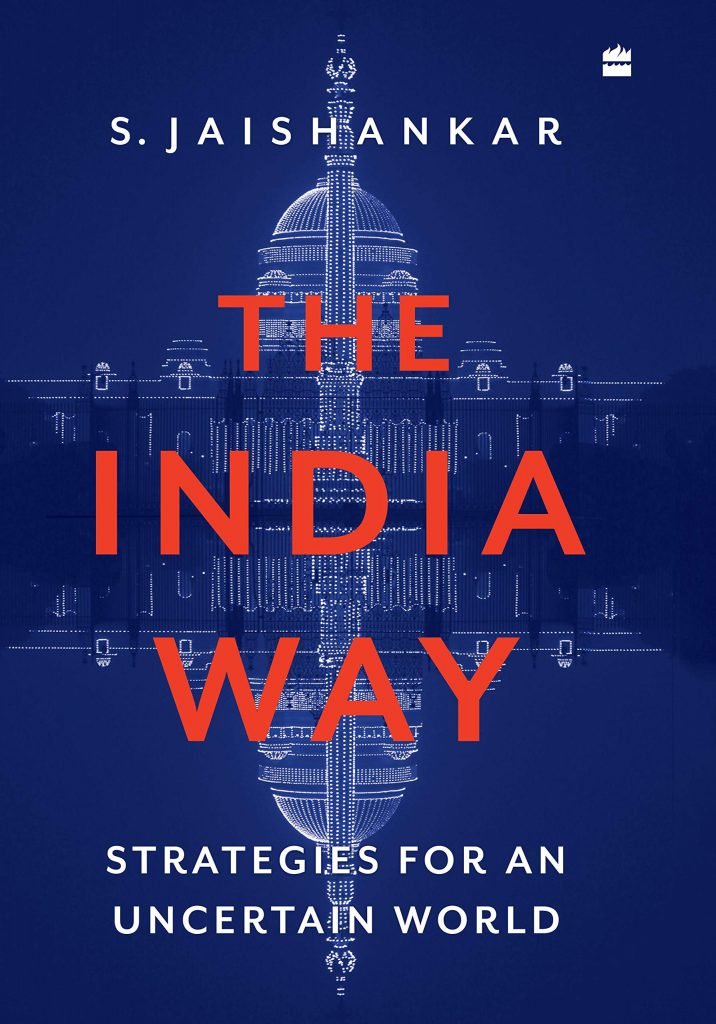
Capturing the foreign policy vision, direction and action of a 1.3 billion people-strong country like India in just around 200 pages is an astoundingly difficult task that Dr Jaishankar, India’s current Foreign Minister accomplishes with considerable aplomb. The illustrious son of an equally, if not more, illustrious father – one of India’s doyens of strategic thought – K Subrahmanyam, Dr Jaishankar deploys his vast diplomatic experience, profound strategic knowledge and meticulous narrative skills, probably inherited from his father, to seamlessly lead the reader through the expansive landscape of India’s foreign policy objectives in a fast changing 21st century world geo-political order.
Dr Jaishankar deploys his vast diplomatic experience, profound strategic knowledge and meticulous narrative skills to seamlessly lead the reader through the expansive landscape of India’s foreign policy objectives in a fast changing 21st century world geo-political order.
Yes, I am talking about his recent book “The India Way”, which was released earlier this month. The India Way is about India’s contemporary thinking about its relationship with other countries in the world, its priorities and vision. Given over seven decades of diplomacy and foreign relations history during which period India has reached many significant milestones, it is a yeomanly task to narrate it in relation to the thinking of the current dispensation. Volumes have been written about each single relationship that India has had with other states, whether it is China, the United States, Japan or Pakistan. But Jaishankar tries to pack all of it into eight crisp chapters. He doesn’t dwell at length on the diplomatic history, nor does he attempt to draw references from the leaders in the past. He rather analyses developments in the most objective and academic way and flavours his account with the current thinking and future vision.
Lord Palmerston, then the British Prime Minister, in his famous address to the House of Commons on March 1, 1848, had said: “We have no eternal allies, and we have no permanent enemies. Our interests are eternal and perpetual, and those interests it is our duty to follow”. This became a mantra for nations in their foreign policy in subsequent times and continues to dominate strategic thinking even to this day. Palmerston defined diplomacy as a dynamic subject. Countries have to perpetually update and upgrade their foreign policy. Jaishankar underscores that important understanding in the very first paragraph when he, rather poignantly, says that ‘many of the assumptions on which we had operated were now being called into question’. Highlighting the challenge for the practitioners of foreign policy, the author makes a profound observation: “If the pressure of political correctness is one challenge, the weight of accumulated dogma is no less. An equally difficult reconciliation is that between an adequate awareness of the global context, and yet viewing it from a hard-headed national perspective”.
While the entire book is incredibly engaging, two chapters standout – the ones on China and Japan. Jaishankar used his experience as an ambassador in those countries to give the reader a first-hand perspective.
Jaishankar’s experience in foreign policy, firstly as a diplomat for over four decades and currently as India’s External Affairs Minister in the last year-and-a-half, oozes out in every single page and in innumerable quotable statements through the pages of the book. Let me illustrate some of them: ‘It is only a multipolar Asia that can lead to a multipolar world’; ‘Will the world continue to define India, or will India now define itself?’; ‘International relations is an exercise of both forging convergences and managing divergences’. ‘Power, especially as it grows, must be debated, projected and applied judiciously’; ‘Most strategists fight the last war, not the next’. Readers will come across many such profound statements in different chapters of the book.
Another good thing about this book is that Jaishankar minces no words in making some important admissions about certain omissions and commissions of yesteryears. He repeatedly decries the dogmatic approach to foreign policy in the past and emphasises the pragmatism that has replaced it of late. He calls the partition of India, delayed economic reforms and prolonged exercise of the nuclear option as the ‘three major blunders’ that the country’s foreign policy carries from the past. He insists that the past shouldn’t be the ‘determinant of our future’ and warns that we should refrain from ‘passing off timidity as strategy or indecision as wisdom’. He admits that performance-wise, while we have not done ‘too badly’, ‘some competitors have done better’. He believes that the real obstacle to the rise of India is ‘not anymore the barriers of the world, but the dogmas of Delhi’. “It is only recently that a stronger realpolitik has overcome a complacency based on entrenched dogma”, he writes.
The India Ways is a must-read book for all the diplomats – especially the younger ones – and other foreign policy enthusiasts. It is a commendable and courageous effort by the writer as it is not easy for a serving foreign minister to articulate the nuances of foreign policy so openly.
The India Way highlights almost all the important facets of India’s foreign policy through eight uniquely titled chapters. ‘The Lessons of Avadh’, ‘Krishna’s Choice’, ‘The Nimzo-Indian Defence’ – these are some of those titles. While the entire book is incredibly engaging, two chapters standout – the ones on China and Japan. Jaishankar used his experience as an ambassador in those countries to give the reader a first-hand perspective. The chapter on China sees Jaishankar putting the blame largely on that country for the difficulties India experiences with Beijing while the chapter on Japan (and the ASEAN) largely puts the onus on India. Jaishankar sums up The India Way as ‘many friends, few foes, great goodwill, more influence’. “The India Way, especially now, would be more of a shaper or decider rather than just be an abstainer”, he concludes.
The India Ways is a must-read book for all the diplomats – especially the younger ones – and other foreign policy enthusiasts. It is a commendable and courageous effort by the writer as it is not easy for a serving foreign minister to articulate the nuances of foreign policy so openly. Jaishankar of course deploys his diplomatic language throughout – that makes some parts less comprehensible to readers unfamiliar with the profession. Also, the pedagogic style used by the author calls for attentive reading. In spite of these minor challenges the book makes a great addition to the resources available on the dimensions of India’s foreign policy doctrine and priorities.


Excellent review which compels one to crave to read the book.
A compelling read. Commendable honest effort to capture the ‘ Indian ‘ diplomacy graph covering diverse aspects of it on a comprehensive canvas. An equally honest review.
Hi ..sir…Johar I’m from Jharkhand…..main aap main sadev……apne desh ka bhavi PM or…. Genius dekhta ….hu…meri aapse milne ki bahut ichha hai…pls….aap jab bhi Delhi aaye….sanyog bane…sir kindly request hai aapse….pls mujhe milne….ka mauka de….ham jese chote karyakrta ko……bhaut kuch sikhne ko milega….aap sadev mere prerna sort hai…….🙏🙏🙏🙏
From the review as detailed here and the articulation of his thoughts on foreign policy by the author in some of his recent interviews raise the interest of readers like us and the follower of recently changing nuances of foreign policy from timidity towards pragmatism based on national interest. For long India’s foreign policy was held hostage to the perception by others particularly the left liberal western narrative rather than our own. It is good to see it come out of that shackle and trying to redefine the image of new India rooted in its civilizational ethos. However, a far more proactive foreign policy based on real politik with a strong economic thrust on futuristic trajectory of the world is the need of hour rather than the pure academic exercise only to be politically correct but ineffective at regional and global levels.
Like this book a lot. A good stuff .A clear and comfort Indian position.
Excellent book and excellent review. It is precisely the ‘headlines’ which summarise the doctrinal inferences that an inquisitive mind may have in the worldview that the emerging Indian thought processes in the field of statcraft may espouse.
“This is a time to engage America, manage China, cultivate Europe, reassure Russia, bring Japan into play,” the author must be bringing his deep perspective as Ambassadors to both Beijing and Washington into the power play and how the complexities of their relationship forges the larger world. The book is quite enchanting to a foreign policy student and the detailed book review here is one of the most authoritative and quite narrative and highlighted by the reviewer as “He rather analyses developments in the most objective and academic way and flavours his account with the current thinking and future vision”. Very good review.