


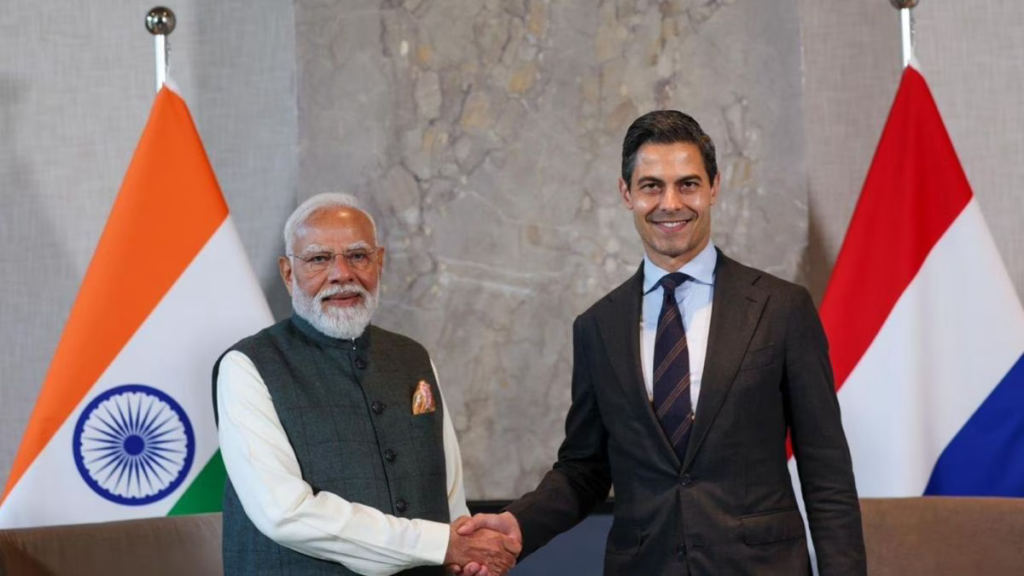
Few bilateral visits in recent Indian diplomatic endeavours have combined the range of technology, energy, and security interests that converged when Prime Minister Narendra Modi arrived in Amsterdam on the morning of 16 May 2026. It was his second visit to the Netherlands, and the agenda was crowded. PM Modi was hosted for a bilateral meeting and luncheon by King Willem-Alexander and Queen Maxima at the Royal Palace Huis ten Bosch before sitting down with Prime Minister Rob Jetten for restricted and delegation-level talks that evening.[i] The visit, part of a four-nation European tour, culminated in the formal elevation of India-Netherlands ties to a “Strategic Partnership.[ii]
The bilateral meeting between PM Modi and Jetten produced an agreement list that reads less like a diplomatic checklist and more like a geoeconomic positioning paper. The sectors covered, among them semiconductors, green hydrogen, critical minerals, defence manufacturing, space, artificial intelligence, quantum computing, water management, dairy, health, and migration, reflecting how substantially the India-Netherlands relationship has moved beyond its earlier character as a predominantly commercial arrangement. The Netherlands is already one of India’s largest trading partners in Europe, with bilateral trade reaching USD 27.8 billion in 2024-25.[iii] but the question is no longer merely about trade volumes. It is about technology access, supply-chain positioning, and geopolitical alignment.
The ASML Agreement
The centrepiece of the agreements was an MoU between Tata Electronics and ASML, the Dutch company that holds an effective monopoly over the lithography machines without which advanced semiconductor fabrication is impossible.[iv]Signed as both heads of government looked on, the deal commits ASML to supporting Tata Electronics’ upcoming 300-millimetre semiconductor fabrication plant in Dholera, Gujarat, India’s first commercial front-end chip fab.[v]
The significance of this particular partnership is inseparable from its geopolitical context. For years, Washington has been pressuring the Netherlands to restrict ASML’s technology exports to China. Those restrictions have progressively tightened, and the proposed MATCH Act in the US Congress seeks to further degrade Chinese semiconductor capability by barring ASML from servicing already-installed machines on Chinese soil.[vi] In this environment, India’s access to ASML’s Deep Ultraviolet immersion lithography systems, the very machines that Beijing is actively being denied, represents a substantial strategic gain. The Dholera fab will target chips in the 28nm to 110nm range, relevant to artificial intelligence, automotive, and consumer electronics applications.[vii]
Accompanying the Tata-ASML MoU was a semiconductor “Brain Bridge” initiative, comprising partnerships between the universities of Eindhoven and Twente and six Indian Institutes of Technology to develop the human capital that a serious chip manufacturing ecosystem demands.[viii] A migration and mobility pact, simultaneously signed, is expected to ease pathways for Indian semiconductor professionals to work in the Netherlands and vice versa. The two agreements together address both the hardware and the talent dimensions of India’s semiconductor ambition.[ix]
Energy, Water, and the Digital Cooperation
Beyond semiconductors, the visit produced a dedicated roadmap on green hydrogen cooperation, pairing production technologies, storage, transport, and industrial decarbonisation with India’s National Green Hydrogen Mission.[x] A joint statement of intent was signed between NITI Aayog and the Netherlands for collaboration on energy transition projects, and a joint working group was established under a renewed MoU on renewable energy cooperation. The Netherlands also formally joined India’s Global Biofuel Alliance, launched during India’s G20 presidency in 2023, and both sides co-chair the Mission Innovation Programme on Biorefineries.[xi]
The water cooperation thread running through the visit also deserves attention. A Letter of Intent was signed between India’s Ministry of Jal Shakti and the Dutch Ministry of Infrastructure and Water Management for technical cooperation on the Kalpasar Project in Gujarat, a long-proposed scheme to create a large freshwater reservoir across the Gulf of Khambhat.[xii] The Netherlands, with its globally recognised expertise in water engineering, is a logical partner for such an undertaking.
Less prominently discussed in early coverage but notable in the joint statement was a Letter of Intent on cyberspace collaboration, building on the 8th session of the bilateral online cyber school and committing both sides to closer coordination in multilateral forums and joint efforts on countering cyber threats.[xiii] On public health, a separate MoU was signed between India’s ICMR and the Dutch National Institute for Public Health and the Environment (RIVM), covering infectious diseases, vector-borne diseases, One Health, and disease surveillance, with a first joint working group meeting to be convened before the end of 2026.[xiv]
Geopolitics in the Room
The joint statement released after the Modi-Jetten meeting was notably candid on contested geopolitical terrain. Both leaders called for a free, open, and peaceful Indo-Pacific “based on respect for international law, sovereignty and territorial integrity, freedom of navigation, and absence of coercion and conflicts.”[xv] The reference to coercion, without naming China, was widely read as a pointed comment on Beijing’s increasingly assertive posture in the region.
West Asia was also on the agenda. The two leaders expressed concern over energy supply disruptions and immense human suffering stemming from the regional situation, and jointly called for freedom of navigation through the Strait of Hormuz, opposing any restrictive measures. They welcomed the ceasefire announced on 8 April 2026 and called for sustained de-escalation, dialogue, and diplomacy.[xvi] Both India and the Netherlands are significant energy importers with exposure to Gulf shipping lanes, making the convergence on this point practical rather than merely rhetorical.
On terrorism, Prime Minister Jetten’s condemned the Pahalgam attack of April 2025. The joint statement called explicitly for holding the perpetrators accountable and expressed the Netherlands’ support for India’s fight against terrorism, including cross-border terrorism.[xvii] The call for a “zero tolerance” approach to terrorism, rejecting double standards in combating the threat, carried implications that both parties understood well.
Trade Architecture and the FTA
The visit came months after India and the European Union concluded negotiations on a Free Trade Agreement in January 2026, a development that altered the commercial calculus for EU member states in their dealings with New Delhi.[xviii]PM Modi and Jetten explicitly flagged opportunities arising from the India-EU FTA for bilateral trade growth. The Netherlands, with its world-class logistics infrastructure and the Port of Rotterdam serving as a strategic gateway to Europe for Indian exporters, stands to gain from expanded Indian market access.[xix]
On multilateral reform, PM Modi secured Jetten’s continued endorsement of India’s bid for a permanent seat on a reformed UN Security Council.[xx]
Conclusion
The Netherlands visit is perhaps best understood as a calibrated meeting of interests across several areas simultaneously. On technology, it represents India’s most consequential entry into the global semiconductor supply chain, and on energy, it locks in a European partner for two of India’s largest industrial transitions: green hydrogen and critical minerals.
The 2026-2030 Strategic Partnership Roadmap does reflect the aspirations of both nations. Whether the Dholera fab delivers on schedule, whether the green hydrogen cooperation produces usable industrial output, and whether the defence manufacturing roadmap survives the long gestation of joint ventures: all of these remain open questions.[xxi] What the visit accomplished is the formalisation of a partnership that is now anchored in specific projects rather than in diplomatic goodwill alone.
[i]PIB / PM India, Joint Statement, ibid. The statement confirms this was Modi’s second visit to the Netherlands and records the royal audience at Huis ten Bosch on the morning of May 16.
[ii]The Statesman, “PM Modi’s Europe Visit: India, Netherlands Elevate Ties to Strategic Partnership, Ink 17 Pacts,” May 17, 2026, https://www.thestatesman.com/world/pm-modis-europe-visit-india-netherlands-elevate-ties-to-strategic-partnership-ink-17-pacts-1503594817.html
[iii]The Statesman, ibid. Bilateral trade figures sourced from PTI as cited in the report.
[iv]Al Jazeera, “India’s Tata and Dutch Giant ASML Sign Semiconductor Deal During Modi Visit,” May 17, 2026, https://www.aljazeera.com/news/2026/5/17/indias-tata-and-dutch-giant-asml-sign-semiconductor-deal-during-modi-visit
[v]Beats in Brief, “While China Gets Blocked, India Gets the Deal: Inside the Tata-ASML Semiconductor Pact,” May 18, 2026, https://beatsinbrief.com/2026/05/18/tata-asml-mou-dholera-semiconductor-india-china-chip-race-2026/
[vi]Beats in Brief, ibid. The article provides a detailed analysis of the geopolitical significance of restricting ASML’s DUV technology exports to China.
[viii]Legacy IAS, “Prime Minister’s Visit to the Netherlands (May 2026),” May 18, 2026, https://www.legacyias.com/prime-ministers-visit-to-the-netherlands-may-2026/
[ix]The Tribune, ibid.
[xi]Channel IAM English, “India-Netherlands Strategic Upgrade,” May 18, 2026, https://en.channeliam.com/2026/05/18/india-netherlands-strategic-partnership-agreements/
[xiii]PIB / PM India, Joint Statement, ibid. The statement records the signing of a Letter of Intent on cyberspace collaboration and notes the holding of the 8th session of the bilateral online cyber school.
[xiv]PIB / PM India, Joint Statement, ibid. The ceasefire in West Asia was announced on 8 April 2026. The statement also records the signing of an MoU between ICMR and the Dutch RIVM covering infectious diseases, vector-borne diseases, One Health and disease surveillance.
[xv]Government of the Netherlands, “Joint Statement by India and the Netherlands,” May 16, 2026, https://www.government.nl/documents/2026/05/16/joint-statement-by-india-and-the-netherlands
[xvii]PIB / PM India, “India-Netherlands Joint Statement on the Visit of Prime Minister of India to Netherlands,” May 16, 2026, https://www.pib.gov.in/PressReleasePage.aspx?PRID=2261884. The joint statement named the Pahalgam attack and called for holding perpetrators accountable.
[xviii]Government of the Netherlands, Joint Statement, ibid. The statement references the conclusion of India-EU FTA negotiations in January 2026.
[xix]The Tribune, ibid. The joint statement described the Netherlands’ Port of Rotterdam as a strategic gateway to Europe for Indian exporters.
[xxi]The Tribune, “India and Netherlands Ink 17 Pacts, Elevate Ties to Strategic Partnership,” May 17, 2026, https://www.tribuneindia.com/news/india/india-and-netherlands-ink-17-pacts-elevate-ties-to-strategic-partnership/


Add comment