


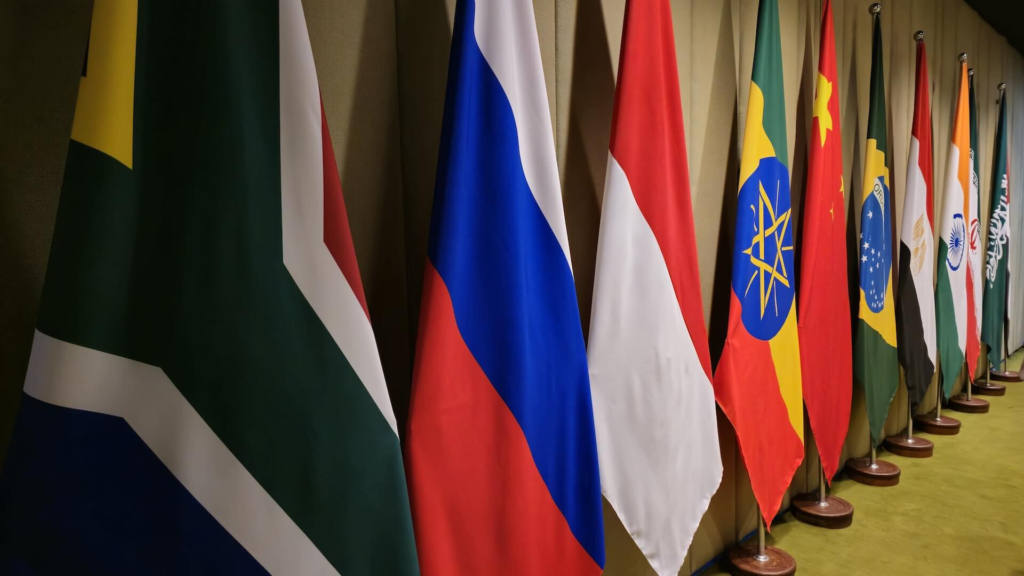
India takes the chair of BRICS for the fourth time on 1 January 2026. The official theme, “Building for Resilience, Innovation, Cooperation and Sustainability”, isn’t just branding. It is a direct echo of what Prime Minister Modi laid out in Rio last July: give BRICS a new form, centre it on the Global South, keep it oriented to people-first, and focus on practical cooperation. In today’s fragmenting world, that message lands differently. Great power competition is sharpening, supply chains are snapping, and the scramble for critical minerals has acquired strategic urgency. India’s presidency has a chance to turn this expanded platform into a bridge, not a barricade.
The global context feels raw. Amidst the threats due to sanctions, tariffs and conflicts, countries are looking for friend-shoring and de-risking. Supply chains that used to be seamless now look weak. BRICS+ has a lot of power because it controls about 72% of the world’s rare-earth resources, 75% of manganese, 50% of graphite, and big shares of lithium, cobalt, and nickel. The group already accounts for about 40% of the world’s GDP when adjusted for purchasing power, and it has more than 45% of the world’s population. Its growth is faster than that of the G7. Trade between BRICS countries is still going up, and deals in local currencies are becoming more common.
India has a lot at stake right now. We still rely on imports for all of our lithium, cobalt, and nickel. We get 80–90% of our rare-earth permanent magnets from one China, even though our own reserves are the third largest in the world, with 13.15 million tonnes of monazite holding 7.23 million tonnes of rare-earth oxides. The lesson hit home: having big dreams at home is possible, but you need partners to help you grow and diversify. We mean business at home with the National Critical Minerals Mission and the ₹7,280-crore plan for sintered rare-earth magnets. However working together with other countries is necessary. India should base the whole presidency on the four official pillars and focus on four specific goals that build on what we have been pushing for since the Johannesburg BRICS summit in 2023.
First, keep pushing for a new kind of multilateralism. We have been saying for years that problems in the 21st century can’t be solved with rules made in the 20th century. The 2026 summit must issue a strong, coordinated call for IMF quota reform and clear support for permanent African and Indian seats on a new UN Security Council. This is because BRICS+ now has a very large economic and demographic weight. This push should take place before the UN High-Level Week. Unilateral tariffs and sanctions are making people less trusting of the institutions that are already there. Instead of leaving the system, BRICS can raise a credible voice to call for fairness within it.
Second, turn counter-terrorism from joint statements into real cooperation. After the April 2025 Pahalgam attack, PM Modi was blunt in Rio: terrorism must be condemned as a matter of principle and in practice, not only for convenience. The declaration reflected that zero-tolerance line. Now the Counter-Terrorism Working Group should be expanded into something operational: real-time intelligence sharing on financing and radicalisation, plus a fresh joint push for the Comprehensive Convention on International Terrorism. This keeps faith with India’s consistent message while addressing the security worries of newer members.
Third, make critical minerals deliverable. PM Modi has already warned against weaponising mineral supply chains. The Rio declaration acknowledged their central role in energy transitions. BRICS controls dominant shares of the key resources, yet processing remains heavily concentrated elsewhere. India should champion a dedicated ‘BRICS Critical Minerals Cooperation Mechanism’. Create a shared geological data platform for joint exploration. Set up technology-sharing protocols for sustainable mining, processing and recycling. Push ethical upstream, mutually beneficial guidelines so that resource-rich African and Latin American partners move beyond raw materials exports into advanced processing. Also, add coordinated stockpiling norms and early-warning systems for supply shocks. This is de-risking without decoupling. It complements Western initiatives such as the Minerals Security Partnership by stressing South-South diversification and sovereignty. Think of it as neighbours finally agreeing to pool tools instead of fighting over the last spare part in the shed.
Fourth, lock in supply-chain resilience. The pandemic and the wars in Ukraine and Iran have exposed the perils: Red Sea rerouting, sudden export bans, major assets “unhooked” from conflict zones overnight. India floated the issue of resilience in Rio; now it must help deliver the mechanism. India can propose an initiative on supply chain resilience to address vulnerabilities across the domains of semiconductors, renewables, pharmaceuticals and other essential items. There is also a pressing need to map alternative logistics corridors and harmonise trade standards. This is a low-hanging fruit. Pursuing them eschews more controversial and divisive endeavours and gives every member something tangible.
Financial resilience deserves the same practical focus. India has wisely avoided loud de-dollarisation rhetoric. Instead, quietly expand local-currency lending through the New Development Bank, link digital payment systems drawing on our UPI success, and build guardrails against unilateral tariff shocks. The NDB has already proved it can finance infrastructure and green projects on which traditional lenders move more slowly. Plan ti open a dedicated “BRICS Resilience Fund” window inside the bank for supply-chain and minerals projects.
Innovation, digital public infrastructure and the people-centric approach must be prioritised in all the proposed initiatives. India should champion interoperability of digital systems, ethical AI governance that gives the Global South fair access, and green finance that respects national priorities. Expand youth scholarships, launch a startup knowledge hub, and create tracks for women-led businesses. Make BRICS feel like a platform for people, not just governments.
To make the presidency matter, India should copy what worked in the 2023 G20. It should maintain the Troika with Brazil and South Africa and continue the structured outreach to partner countries and Global South observers, host ministerial tracks on critical minerals, supply chains and digital economy with clear deliverables attached, focus ruthlessly on measurable outcomes through support pilot projects with deadlines, a Critical Minerals Knowledge Hub, one or two joint processing ventures, supply-chain stress tests. Avoid the trap of thick declarations that gather dust.
Some of the challenges are real. The processing dominance of one BRICS-member creates asymmetry within the Grouping. National strategies often trump collective interests in minerals mining and procurements, and fellow member countries chase separate diversification deals. Views on sanctions differ sharply. Expansion brings more voices but also more complexity. Yet India’s multi-alignment posture gives us the credibility to manage these tensions. We do not have to choose camps; we can choose outcomes that address shared vulnerabilities.
Lessons from India’s G20 Presidency are simple: success comes from inclusivity, consensus-building and walking out with deliverables that have names, timelines and budgets attached. The 2026 BRICS presidency is not just another rotation. It is India’s strategic moment to prove that multipolarity can mean pragmatic cooperation rather than endless confrontation. By prioritising supply-chain resilience and critical-minerals cooperation within a broader vision of reformed multilateralism, India can help reform the global economic order for the sake of greater equity and stability.
The stage is set in India. The instruments, like an expanding membership, the New Development Bank, several working groups are ready. BRICS controls enormous resource reserves and represents nearly half the world’s population. Let us use both these assets wisely. Focus on shared problems, convert rhetoric into mechanisms that work, and keep the agenda focused on tangible pilot projects. India did this with the G20. The 2026 BRICS Summit offers the same opportunity. The question is whether the members, under Indian leadership, will seize it to build something effective and lasting.

Add comment