


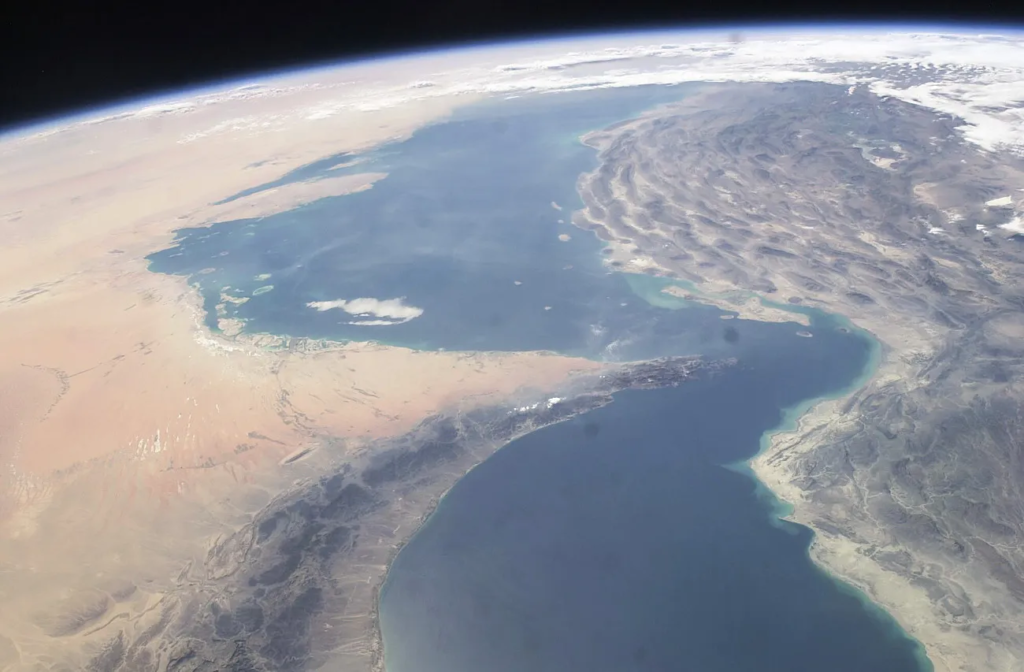
Hormuz (Persian: ﻫﺮﻣﺰ, Hormoz) derives from Ohrmazd, rooted in Ahura Mazda, the Zoroastrian “Lord of Wisdom.” Much like India’s civilisational ideal of dharma, it signifies balance, order, and righteous conduct, an apt metaphor for a strait that today stands at the fault line between global stability and disruption.
What was once merely geography has now become destiny.
The fiction of the Strait of Hormuz as a neutral global commons is over. What exists today is something far more consequential: a controlled maritime corridor, where access is no longer guaranteed by international law, but negotiated through power, perception and political alignment. Iran has not shut Hormuz, it has selectively operationalised it, allowing passage to “friendly nations” while signalling costs, risks, or denial to adversaries. This is not disruption. It is doctrine.
If this doctrine holds, Hormuz will become the template for a world where chokepoints, from the Red Sea to the South China Sea, are governed not by rules, but by regional gatekeepers. The question is no longer whether the strait will open. The question is: who decides the terms of its opening?
No region is insulated from disruption. Europe faces energy shocks, Asia confronts supply insecurity, while Africa and the Global South bear disproportionate inflationary pain. Hormuz has become the point where geopolitics translates directly into human cost.
India’s engagement with this region is not recent, nor merely transactional. For millennia, Indian traders and seafarers moved across the Arabian Sea, linking the subcontinent with Persia through exchange and coexistence, not domination. This civilisational memory offers a different grammar of power: pluralism over polarity, dialogue over diktat, continuity over confrontation. It is precisely this depth that allows India to think beyond the binaries paralysing global diplomacy today.
Let us be candid: the Western-led order that once underwrote maritime security is no longer seen as neutral, nor universally legitimate. Rules are applied selectively, sanctions are weaponised and security guarantees are politicised. Hormuz exposes this erosion starkly. The so-called “global commons” is now subject to strategic gatekeeping. The result is not order, but fragmentation.
Any attempt to “reopen” Hormuz through a U.S.-led naval coalition will fail strategically, even if it succeeds tactically. It would reinforces Iran’s core narrative that maritime access is being weaponised by hostile powers. It risks escalation, invites asymmetric retaliation, fragments shipping into rival blocs, and forces neutral countries to choose sides, an outcome most of the world seeks to avoid.
This is India’s moment, not as a balancer, but as an architect.
India has spent two decades perfecting multi-alignment. That phase is over. Hormuz demands something more ambitious: India must transition from a balancing power to a rule-shaping power. This is not about mediation. It is about designing the operating system of access.
India is uniquely positioned. It is trusted by Iran without being a subordinate; it interacts with the West without being dependent; engaged with Russia and China without being constrained; and critically, it is a principal stakeholder with its own energy security at risk. No other country combines credibility, capability, and consequence in the same way.
The only viable path forward is not a military alliance, but a Coalition of the Non-Hostile, states that Iran does not regard as adversarial and therefore cannot easily exclude. This coalition should include India as convener, alongside China, Russia, key Gulf states, and major Asian importers. The objective is not to challenge Iran, but to box in unilateralism by making selective access economically and politically untenable. If Iran privileges “friendly nations”, then those nations must collectively define the terms of passage.
The hard truth is that Iran will set conditions. The question is whether those terms are fragmented and coercive, or structured and stabilising, and that is where India must intervene.
Iran will seek de facto recognition of its security primacy. India must accept operational realities without conceding legal principles, ensuring that coordination does not become endorsement. Iran will attempt to segment shipping according tp political identity. India must uphold a principle of cargo neutrality where, once cleared, all commercial vessels move under uniform protocols. Iran will monetise passage through tolls and controls; India must convert this into a transparent, multilateral mechanism to prevent rent-seeking. Pre-clearance and surveillance demands can be institutionalised into joint verification frameworks, diluting unilateral control. At the strategic level, Iran will link access to sanctions and isolation; India must work to decouple maritime access from broader geopolitical disputes, while quietly enabling limited economic flexibility.
However credibility will not come from articulation, it will come from action.
India must announce a Hormuz Stabilisation Initiative, not as mediation, but as a framework-setting exercise. It should deploy a neutral naval presence to escort and monitor shipping without provocation. It must convene a quiet compact with Iran and Oman, where real negotiations occur. It must bring China and Russia into the tent as co-stakeholders, not rivals. And it must draw a clear, calibrated red line by spelling out that arbitrary disruption of energy flows will invite coordinated economic and diplomatic consequences.
All of this unfolds under the shadow of the US+Israel – Iran confrontation, India cannot resolve this conflict, but it can, and must, ensure that its spillover does not hold global trade hostage.
This is where India must step forward, not just as a nation, but as the voice of the Global South, the region most affected, yet least represented. For the Global South, Hormuz is not about strategy; it is about survival. Energy shocks translate into food inflation, debt stress, and stalled development. India must assert that access to Hormuz is not a privilege, but a global necessity, and that its disruption is not a tactical move, but a systemic shock.
The future will not be defined by blocs, but by issue-based coalitions. Hormuz offers the first real opportunity to shape such an order, functional, inclusive and equitable. India is uniquely positioned to anchor this transition, not as a hegemon, but as a custodian of equilibrium.
Moments of systemic disruption are rare and unforgiving. Hormuz presents India with a stark choice: remain a participant in a crumbling order, or emerge as an architect of a new one.
Because if the “friendly nation” status becomes the new currency for access, then India must ensure that friendship is not transactional, but institutional, enforceable, and anchored in shared stability.
Hormuz, named for the “Lord of Wisdom,” now demands wisdom in action. In a world where power is exercised through restrictions, India must demonstrate that influence can be exercised through restoration, restoring access, restoring balance, restoring trust.
The true test of leadership is not the ability to control a chokepoint, but the ability to open it for all.

Add comment