


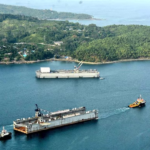
With the ₹72000 crore Great Nicobar Island project moving into high gear in early 2026, India is playing its most powerful maritime card since independence. By securing necessary regulatory clearance, especially the highly significant National Green Tribunal (NGT) verdict passed on February 16, 2026, the Indian Government is making it abundantly clear that “strategic necessity” is fast becoming the primary paradigm for viewing island regions. This megaproject is the birth of a military economic bastion at a global chokepoint, located merely 40 nautical miles from the mouth of the Strait of Malacca, the Great Nicobar is the perfect sentinel of the Six Degree Channel, one of the busiest maritime straits in the world with roughly 35% of global maritime traffic passing through it, and around 80% of China’s crude oil imports. By creating an operational base there, India acquires an effective “veto power” over the energy flows, offering a counterweight to the “Malacca Dilemma” of extra regional powers.
A Dual Use Doctrine
What makes this project a strategic masterpiece is its “Dual Use” Doctrine. A key element of the project is the International Container Transshipment Terminal (ICTT), based in Galathea Bay which possesses a capability of up to 20 meter depth draft. While economically, the project seeks to attract part of business currently done in other ports like Colombo and Singapore, the military potential of the project is incomparable, allowing India to host its capital ships such as INS Vikrant and INS Vikramaditya, which will result in replenishment of assets of the Indian navy in the area without the necessity of returning to mainland bases, complemented on land by the Greenfield International Airport, featuring a 3,500-meter hardened runway. Recent 2026 estimates confirm the runway can accommodate C-17 Globemaster heavy transports to P-81 Poseidon maritime patrol aircraft, together making an ideal “force multiplier”.
The “Unsinkable Aircraft Carrier”
The project weaves a dense Maritime Domain Awareness (MDA) umbrella over the region which consists of advanced coastal radar chains, ELINT ( Electronic Intelligence) and SIGINT (Signals Intelligence) stations in order for the Indian armed forces to track surface vessels and subsurface threats with surgical precision across the Eastern Indian Ocean. This strategy serves as a direct check to China’s military upgrades on Myanmar’s Coco Islands. India is stepping up from being a “gatekeeper” traditionally to “Net Security Provider” for the QUAD and ASEAN by fortifying the southern tip of the island chain, ensuring Freedom of Navigation (FONOP) in the Indo Pacific region.
The Chief of Defence Staff (CDS), General Anil Chauhan, stressed the significance of the project in his operational assessment made in April 2026:
“The Great Nicobar development is a strategic imperative that provides the Indian Armed Forces with the necessary reach to safeguard our interests. It acts as a springboard for our maritime strategy, ensuring the Andaman and Nicobar Islands remain the central pillar of our ‘Act East’ policy and our ability to maintain a secure and stable Indian Ocean Region.”
The above assertion also brings out the significance of the project by referring to it as an “unsinkable aircraft carrier,” a term used by strategists to refer to land based installations that can conduct military engagements continuously unlike an aircraft carrier that operates from a ship.The Great Nicobar project offers a 450 MVA hybrid power plant and self-contained logistics, making high intensity operations sustainable for months.
A2/AD
By the late 2020s, The Great Nicobar is set to evolve into a launchpad for long range missile batteries and underwater acoustic listening posts. Under the Integrated Theatre Command strategy, the territory would evolve as the launching grounds for hypersonic missiles and Brahmos-ER cruise missiles, creating thereby an A2/AD zone across the Bay of Bengal. The ultimate result is the Military Superiority that no adversarial naval formation could pose a threat to Indian maritime interests as India gains the capability to interdict and neutralise adversarial naval formations at the very moment they exit the Indonesian straits.
Securing the “Southern Anchor”
The Great Nicobar Island is being utilised as a secure landing zone for high speed under sea fiber optic cables, thus ensuring that India’s strategic communication does not come into jeopardy in case of war. In addition to this, the “effective occupation” of the island by around 150,000 people including a significant military garrison makes sure that India has established a populated, digitised ecosystem that facilitates sustained and sovereign military control.
CONCLUSION
The ₹72,000 crore Great Nicobar Project is the ultimate response to the evolving security architecture of the 21st century. It represents the long overdue reclamation of the Indian Ocean Region (IOR). The combination of commercial port activity and the military presence on the other hand will mean that India can continue to be the “Southern Pivot” that ensures the stability of this region. The message is very clear: India’s maritime sovereignty is the cornerstone of its national rise.
References & Strategic Data Sources
• [PIB Delhi: Holistic Development of Great Nicobar Island – Strategic Overview]
• [NITI Aayog: Great Nicobar Island Development – Technical Infrastructure Blueprint]
• [Maritime India Vision 2030: Ministry of Ports, Shipping and Waterways Policy]
• [Ministry of External Affairs: India’s Act East Policy and Indo-Pacific Security Doctrine]
• [Indian Navy: Ensuring Secure Seas – Indian Maritime Security Strategy]
• [Ministry of Finance: National Infrastructure Pipeline (NIP) – Port and Defence Integration]
• [PIB: CDS General Anil Chauhan Reviews ANC Operational Readiness (April 2026)]
• [Ministry of Environment, Forest and Climate Change: Wildlife and Forest Clearances]
• [Andaman & Nicobar Administration: Official Gazette on Galathea Bay ICTT Development]




Add comment