


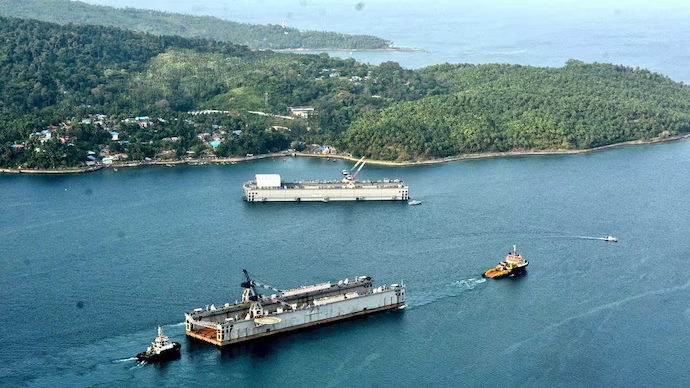
The Great Nicobar Island Project (GNIP) which has been projected to cost INR 72,000 crore, is a revolutionary megainfrastructure project initiated by the Government of India with the objective of changing India’s geo-strategic positioning. The project is also a marker of a shift in approach from mainland centrism to adopting a more proactive maritime stance in the Indo-Pacific by developing a state of the art logistics and strategic complex in the country’s southernmost border region.
The GNIP proposes to build an International Container Transhipment Terminal (ICTT) at Galathea Bay. It is set to achieve the ultimate capacity of 14.2 million TEUs, challenging the supremacy of global logistics centers such as Singapore and Colombo. It ultimately aims to capitalize on the large cargo traffic which circumvents Indian waters. The Great Nicobar Island is located at just 40 nautical miles from the East West corridor that acts as the main pathway through which 35% of the world’s international trade passes. It not only acts as a passageway for commercial purposes but also acts as a major bottleneck through which international energy supplies and commodities transit. This means that India’s position in such a scenario should not be judged solely on economic grounds but should rather be interpreted in light of the changing equations of geopolitics in the Indo Pacific region.
Economically, the ICTT at Galathea Bay is a strike against “transshipment leakage”. As a result of shipping Indian cargo through other ports that are not in India, there are additional expenses incurred by the nation’s exporters, with costs estimated at $200 to $220 per container. By virtue of offering these services on local soil, the GNIP initiative forms an integral part of the “Amritkaal” policy, promoting the development of a thriving blue economy.
The building of a new greenfield international airport is at the heart of this “dual purpose” policy aimed at accommodating 4,000 passengers per hour. The dual nature of the project does not only lie in its aim to boost tourism in the region but also in its aim to augment the operational capability of the Andaman and Nicobar Command. The authorities have decided to eschew the use of diesel powered electricity for this purpose and use a combined gas and solar plant of 450 MVA capacity.
The logistics aspect of the GNIP is also supported by the formation of the integrated township covering a total land area of about 149 sq. km that will act as a residential city having a capacity to accommodate 3.5 lakh people in its final stages. This township will not only be responsible for providing the manpower needed for functioning of the port and airport but also assist in the economic development of the region by developing tourism, information technology, and marine industries. To ensure smooth execution of the entire process, the project has been divided into several stages beginning from the first stage covering a land area of about 72.12 sq. km.
In order to tackle the ecological impacts, the government has deployed an exceptionally sophisticated conservation model. The total forest diversion as a consequence of the construction of this terminal is 130.75 sq. km, which represents only 1.82% of the total forest cover in Andaman and Nicobar Islands. In order to limit its environmental impact, there has been an introduction of a stringent policy on phased diversion in which cutting down only 7.11 lakh trees is permissible. However, to compensate for such ecological damage, massive afforestation programs have been undertaken in an area spanning 97.30 sq. km in the state of Haryana. Simultaneously, the Zoological Survey of India undertook the successful relocation of approximately 15000 coral colonies to ensure the bay’s diversity remained intact.
Equally critical is the social dimension. Under a strict “Zero Displacement Policy” towards indigenous Shompen and Nicobarese tribes; Shompen, who are among the Particularly Vulnerable Tribal Groups (PVTGs), the government has made sure that they continue to live in their own habitat with an effective ‘No Contact’ buffer zone around them, which protects their hunting-gathering way of life. Moreover, to provide better protection to the indigenous tribes, the government has extended the notional Tribal Reserve by 77 square kilometers.
The Great Nicobar project is an instrument of India’s “Neighbourhood First” and “SAGAR” policies. With the creation of the exclusive port city in the Malacca Strait region, India can interact with ASEAN countries and the other countries of Southeast Asia by working together on infrastructure projects and economics. The GNIP has the potential of becoming a strong pillar of India’s Act East policy in the coming years, taking it from its diplomatic nature to the construction of the strategic corridor. In doing so, India also continues to strengthen its position in the Indo-Pacific region, which is currently the most dynamic region of the world.
In conclusion, the holistic development plan of Great Nicobar Island is an excellent example of India’s commitment towards creating world-class infrastructure, taking into account all the complexities associated with strategy and the environment. However, the success of the project will serve as a global gold standard proving that ambitious economic sovereignty and preservation of natural and cultural heritage can thrive in a harmonious, symbiotic system.
Footnotes and Government References
1. Theloadstar.com indian transshipment leakage
2. NITI Aayog Strategic Papers: Vision for Sustainable Development in Island Territories.
3. Ministry of Ports, Shipping and Waterways
4. MoEFCC Portal: Environmental Impact Assessment and Forest Clearance Report (2021-2026).
5. Ministry of Tribal Affairs: Status of Tribal Reserves and Indigenous Protection in Great Nicobar.
6. Andaman and Nicobar Administration: Regional Master Plan for GNI Township and Logistics Hub.
7. Forest Survey of India: State of Forest Report – Analysis of Island Cover.
8. Zoological Survey of India: Coral Translocation and Marine Monitoring Report.
9. Ministry of External Affairs: SAGAR Initiative and India’s Maritime Strategy.
10. Ministry of Power: Renewable Energy Integration in Island Territories.
11. PIB Delhi (May 2026): Strategic Dimensions of the GNI Holistic Development Project



Add comment