


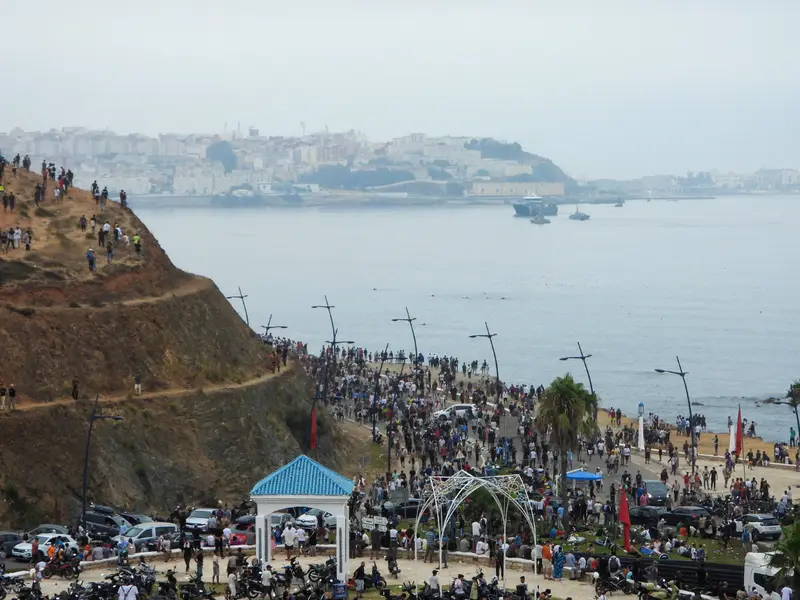
In the last week of July 2026, tens of thousands of migrants crossed from Morocco into Ceuta, the small Spanish territory on the North African coast.[1] Spanish authorities said that between 50,000 and 60,000 people attempted the crossing in a single week, making it the largest surge of irregular arrivals ever recorded on EU territory in such a short span.[2] The confirmed death toll rose in stages as bodies were recovered over several days: 18 on 30 July, 57 by the following evening, 67 by 1 August, and 72 by 2 August, with Spanish authorities and the news agency EFE saying more were still being identified.[3]Many drowned near the breakwater. Others were crushed in the crowd at the border fence.
This is not new. Ceuta has experienced this before. A Pattern, Not an Accident. In January 2017, around 800 migrants stormed the fence, injuring dozens of police officers.[4] In May 2021, between 8,000 and 10,000 people entered over two days, many by swimming around the sea barrier, an event widely read as Morocco loosening its border controls to pressure Madrid over the Western Sahara dispute.[5] The 2026 crisis dwarfs both. The chart below places the three episodes side by side.
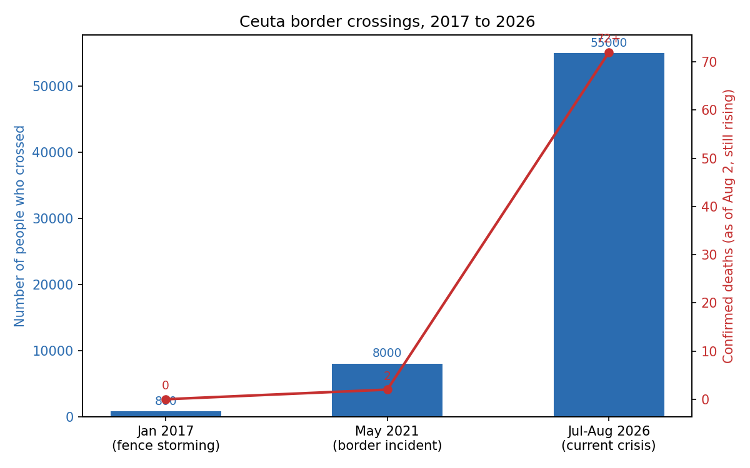
Figure: Comparing scale of crossings and deaths across three Ceuta incidents, 2017 to 2026.[6]
What Triggered This Round
The underlying arrangement has remained unchanged for over three decades. Spain and Morocco signed a bilateral readmission agreement in 1992, under which Morocco is obliged, in certain conditions, to take back third-country nationals who entered Spain irregularly through its territory.[7] Morocco has periodically used its control over that border as leverage, tightening or loosening it depending on the state of its relationship with Madrid.[8]
Two things came together this time. First, in April 2026, Spain announced a mass regularisation scheme for migrants already living in the country without papers, which attracted around 1.2 million applications.[9] Twenty-two EU member states later wrote to European Commission President Ursula von der Leyen, European Council President António Costa, and Irish Prime Minister Micheál Martin, describing the scheme as a “pull factor” behind the Ceuta surge and calling for an urgent meeting of interior ministers.[10] Second, on 29 June 2026, Spain’s Supreme Court ruled that migrants intercepted at sea while attempting to reach Ceuta or Melilla could no longer be summarily returned to Morocco under the old “hot return” procedure and would instead need to go through the ordinary immigration process.[11] Spanish leaders, including Prime Minister Pedro Sánchez, said human trafficking networks twisted this ruling into a rumour that Spain’s doors were now open and used it to push people towards the border.[12]
How Governments Responded
Spain deployed army units to support the Guardia Civil at the border, and by Friday evening, most of those who had crossed had been sent back to Morocco, many voluntarily after finding no food or shelter.[13] Sánchez publicly criticised what he described as the “selfish” response of some EU states.[14]
Italy’s Prime Minister Giorgia Meloni was among the sharpest critics of Spain’s handling of the situation. Italy suspended the Schengen Area’s free travel arrangement with Spain, and Italian Foreign Minister Antonio Tajani called for Spain to be suspended from the Schengen Area altogether, prompting Madrid to summon Italy’s ambassador.[15] Meloni wrote on social media that her government would “not yield an inch” on illegal immigration and would continue to defend borders, stop traffickers, and enforce repatriations.[16] This builds on a position she has held since 2023, when she pushed for a Mediterranean naval blockade and clashed publicly with Germany over funding for migrant-rescue charities.[17]
Denmark, Finland, Sweden, and Austria supported the call to consider suspending Schengen cooperation with Spain.[18] German Chancellor Friedrich Merz called for the immediate enforcement of the EU’s Return Regulation and separately demanded that Morocco take back the migrants without delay.[19]France’s Jordan Bardella asked the European Parliament to hold an urgent debate on what he described as the EU’s failure in migration policy.[20] On the other side, Spanish and European left-wing politicians called this reaction opportunistic, arguing that it was being used to paint migrants as a threat rather than to address the humanitarian emergency at hand.[21]
France, for its part, noted that Ceuta sits on the African continent and is not part of the Schengen free movement zone, and that no unusual movement had been detected in mainland Europe, thereby distancing the incident from a broader EU-wide crisis, at least for now.[22]
A Policy Failure, Not a One-Off
Ceuta is not really a story about one difficult week at one border. It is a story about a policy failure the European Union has never fixed: national migration decisions keep producing shocks that spread across the bloc, and the bloc keeps responding with more national decisions rather than a shared system.
This has happened before, on a much larger scale. In 2015, Germany suspended the EU’s Dublin Regulation for Syrian asylum seekers, and its chancellor pledged that the country could manage the consequences alone.[23] First-time asylum applications in Germany rose from 441,800 in 2015 to 722,300 in 2016, according to Eurostat.[24] Rather than build a joint response, member states acted unilaterally: Germany, Austria, France, Norway, Sweden, and Denmark reintroduced checks at their national borders that year, and the European Parliament’s research service notes that all six still have them in place a decade later.[25] Brussels produced only a shared tool, the deal with Turkey that closed the Balkan route, after the unilateral response was already locked in.[26]
Ceuta is the same failure, just on a smaller scale. A national regularisation scheme and a national court ruling produced a shock. Until a mechanism exists, the country’s name attached to the crisis will keep changing while the failure recurs.
[1]NPR, “At least 18 die after breach of border between Morocco and Spanish territory of Ceuta,” 31 July 2026.
[2]CNN, “The Supreme Court ruling at the center of Spain’s Ceuta migrant crisis,” 1 August 2026.
[3]Al Jazeera, “Migrant deaths in Ceuta rise to 72 after border surge from Morocco,” 2 August 2026, citing Spanish government representative Miguel Angel Perez and the Spanish news agency EFE; earlier tallies of 18, 57, and 67 reported respectively by NPR (31 July), Al Jazeera (31 July), and Euronews (1 August) as bodies were recovered over successive days.
[4]GlobalSecurity.org, “Ceuta,” citing the 1 January 2017 fence storming incident.
[5]Al Jazeera, “At least 18 die as thousands cross from Morocco into enclave of Ceuta,” 30 July 2026; CNN, “Spanish leader slams ‘selfish’ EU response as death toll from Ceuta crossings climbs,” 31 July 2026, both citing the May 2021 precedent of roughly 8,000 to 10,000 crossings over two days.
[6]Figures compiled from footnotes 3, 4, and 5; 2026 crossing figure taken as the midpoint of the 50,000 to 60,000 range reported by CNN.
[7]CNN, “The Supreme Court ruling at the center of Spain’s Ceuta migrant crisis,” 1 August 2026.
[8]Reuters, “Spain accuses Morocco of ‘blackmail’ over Ceuta migrant surge,” on Morocco loosening border controls after Spain hosted a Western Sahara independence leader; Forbes, “Most Migrants Who Crossed Into Ceuta Have Returned To Morocco — As Death Toll Rises To 34,” 31 July 2026, on the pattern of Morocco relaxing controls during diplomatic disputes.
[9]France 24, “Almost 1.2 million of Spain’s undocumented migrants apply for regularisation,” 2 July 2026; Al Jazeera, “Spain immigration scheme sees 1.2 million apply for legal status,” 2 July 2026, both citing Spain’s Secretary of State for Migration Pilar Cancela and the official count of 1,174,978 applications.
[10]Euronews, “22 EU leaders call for emergency talks over Ceuta migrant crisis,” 1 August 2026.
[11]CNN, “The Supreme Court ruling at the center of Spain’s Ceuta migrant crisis,” 1 August 2026; Al Jazeera, “At least 18 die as thousands cross from Morocco into enclave of Ceuta,” 30 July 2026.
[12]CNN, “The Supreme Court ruling at the center of Spain’s Ceuta migrant crisis,” 1 August 2026.
[13]CNN, “Spanish leader slams ‘selfish’ EU response as death toll from Ceuta crossings climbs,” 31 July 2026.
[14]Ibid.
[15]Morocco World News, “Italy’s Meloni Urges Stronger EU Border Action After Ceuta Mass Migration,” 1 August 2026.
[16]Euronews, “Ceuta migrant crisis sparks strong reactions from all over Europe,” 1 August 2026.
[17]Fox News, “Italy’s call for naval blockade may be only way to stem Europe’s migrant crisis, expert says,” 21 September 2023; Fox News, “Conservative world leader torches Germany over migrant charities amid calls for naval blockade,” 27 September 2023.
[18]Euronews, “Ceuta migrant crisis sparks strong reactions from all over Europe,” 1 August 2026; Il Foglio, “Europe is divided over Ceuta,” 31 July 2026, on Sweden’s and Austria’s positions.
[19]Euronews, “Ceuta migrant crisis sparks strong reactions from all over Europe,” 1 August 2026; Channels Television (AFP), “Migrant Crisis: Denmark Urges EU To Consider Suspending Spain From Schengen,” 31 July 2026.
[20]Ibid.
[21]Ibid.
[22]Ibid.
[23]InfoMigrants, “The ‘refugee summer’ of 2015: Key moments that shaped Germany,” 2025 retrospective; Emerald Publishing, “Understanding Germany’s response to the 2015 refugee crisis,” Review of Economics and Political Science, on the 25 August 2015 suspension of Dublin for Syrian nationals and the 31 August “Wir schaffen das” statement.
[24]Eurostat, “Asylum in the EU Member States,” news release 44/2016, 4 March 2016 (441,800 first time applicants in Germany in 2015); Eurostat, “1.2 million first time asylum seekers registered in 2016,” news release, March 2017 (722,300 first time applicants in Germany in 2016).
[25]European Parliament Research Service, “State of the Schengen Area,” EPRS Briefing, updated 2025, on the six Schengen states that reintroduced internal border checks in 2015 and have kept them in place since.
[26]Stiftung Wissenschaft und Politik (German Institute for International and Security Affairs), “The Future of Schengen,” on the closure of the Balkan route and the EU-Turkey agreement of spring 2016.



Add comment