


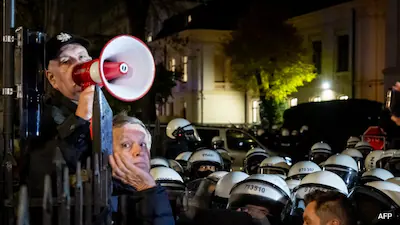
Polish Prime Minister Donald Tusk’s attempted coup on the night of October 30, 2026, aborted by the unexpected arrival of President Karol Nawrocki at the Constitutional Tribunal (TK) that was being taken over by pro-Brussels judges, is currently in a stalemate. The putschists have not been arrested so far. However, the spontaneous uprising against the coup, including leaders of opposition parties and military veterans, is spreading to the cities, and it seems unlikely that the elected President can now be deposed.
The incident has ignited simmering resentment across Europe against the growing stranglehold of the European Union (EU) and European Commission (EC) on member countries. The twin policies of austerity for native populations, and rampant immigration, increasingly seen as an attempt at changing the ethnic composition of European countries are triggering a popular revolt. A so-called (pro-globalist, pro-Brussels) Colour Revolution is therefore increasingly unlikely.
The crux of the issue is whether Poland will be governed by its national interests or subordinated to the goals of Brussels and Berlin, which include an actual war with Russia, a prospect with which part of the Polish government is reconciled.
During Poland’s National Security Council meeting on November 3, 2026, President Nawrocki reprimanded Prime Minister Tusk, saying that Friday’s actions created “a major constitutional crisis.” The Tusk government had tried to capture the Constitutional Tribunal, taking advantage of the President’s absence from the country, and the people’s preoccupation with the All Saints’ Day ceremonies. Addressing Tusk, who was in the meeting, Nawrocki said Tusk bore full responsibility for misusing police and State Protection Service officers for his nefarious design. He urged Tusk to repent before the National Independence Day celebrations on November 11, to repair what has been done and return Poland’s affairs to the Poles.
On October 30, some judges entered the Constitutional Tribunal in Warsaw, escorted by State Protection Service officers. There, Judge Anna Korwin-Piotrowska, announced the one-month suspension of Tribunal President Bogdan Święczkowski and Vice-President Bartłomiej Sochański, effectively seizing control of the institution. This was rejected as unlawful by the existing Tribunal leadership; the Police cordoned off the building as protesters gathered outside. Nawrocki, alerted by loyalists, curtailed his visit to Senegal, and arrived at the Tribunal in the wee hours of October 31, where he confronted Korwin-Piotrowska and other judges over the abuse of their powers.
Why the coup?
Donald Tusk was President of the European Council in Brussels, and returned to Poland in 2021 to take over his old party, Civic Platform. In the October 2023 general election, the Law and Justice Party (PiS) emerged as the single largest party, but Tusk cobbled a coalition of Civic Coalition with the Third Way Party, and the Left. His priority was to subordinate Poland to the EU agenda.
Tusk needed to control the Constitutional Court to change the constitution. Presently, the national currency, the zloty, is enshrined in the constitution as a fundamental instrument of sovereignty. A new constitution could take Poland into the eurozone. Poland’s gold reserve (the largest in Europe) might then be moved to the European Central Bank in Frankfut, and be used to fund the war in Ukraine, to which Poland has already heavily contributed.
The proposed new constitution would allow the judiciary to impose a war decision via parliament, where Tusk had control. It would recognise the supremacy of European law over national law. Now, however, Poland has decided to send the Army to the borders with Germany and Lithuania and stop illegal migrants from crossing into Poland.
When Nawrocki arrived at the Constitutional Tribunal, judges Anna Korwin-Piotrowska and Maciej Berek tried to block him, but quickly succumbed because the President was escorted by members of the Polish army. Journalist Stanisław Janecki reported plans to prevent the presidential plane from landing, but these were rebuffed by army officers in charge of the military section of the airport. President Nawrocki had been elected in 2025 with 51% of the people’s vote.
To control the Constitutional Tribunal, Tusk wanted to appoint eight judges. As he was legally allowed to appoint three, President Nawrocki administered the oath of office only to three judges. Tusk then organized a parallel swearing-in for the other five by administering the oath to them himself, though only the President is constitutionally empowered to do so.
One illegally sworn-in judge ordered the removal of Bogdan Święczkowski, President of the Court. On returning to Warsaw, Nawrocki removed the five judges illegally sworn in by Tusk and granted Bogdan Święczkowski access to his office as President of the Supreme Court.
Later, in a direct message to Ursula von der Leyen, President Nawrocki said, “Madam President, Poland will not accept any measures from European institutions aimed at relocating illegal migrants to Poland.”
Observers noted that the police officers who blocked access to the Constitutional Court on October 30, 2026, did not have identification numbers on their helmets and did not understand the questions posed in Polish. They are believed to be German. The renowned German economist, Professor Richard A. Werner, said the coup was backed by the “dictatorial EU Commissars, [and] was carried out in part using German military and German police.”
The role of Germany needs an explanation. After the destruction of Nord Stream, the German industry began to collapse due to the loss of cheaper Russian gas. Poland hosts the last two functioning pipelines from Russia to Germany, viz., Yamal and Druzhba. Germany could easily pay for this gas, but seems to have decided that it must instead control Poland to save its industry. This is simply naked colonialism, reminiscent of Adolf Hitler’s annexations.
Russian Telegram channels state that the intelligence service SVR warned President Nawrocki of the possibility of a coup. The coup failed because the military, specifically the Army, remained loyal. Soldiers surrounded the residences of some police chiefs and arrested them. The police organisation announced the surrender of its heavy weapons and withdrew from the coup.
Mateusz Morawiecki, former Prime Minister and Member of the Sejm (parliament) filed a motion on October 31 itself, to oust Tusk and appoint a new prime minister who could restore order in cooperation with the president.
The Confederation party leaders, Krzysztof Bosak and Sławomir Mentzen, urged President Nawrocki to shorten the Sejm’s term and order fresh elections, to bring an end to the Tusk government as soon as possible. They pointed out that the Tusk regime has illegally seized Poland’s leading news channel, the TVP, the National Prosecutor’s Office, and tried to take over the Constitutional Tribunal.
Former Polish President Andrzej Duda condemned the coup and warned that “Tusk and his men, who are burdening us with debts and who are lamentably incompetent on the economic front, have shown themselves today to be a gang of thugs, perpetrating a brutal attack against a constitutional organ of the state.”
Poland’s leading lawyers, Zbigniew Kapiński, First President of the Supreme Court; Jacek Chlebny, President of the Supreme Administrative Court; and Bogdan Święczkowski, President of the Constitutional Tribunal, all opine that Tusk’s actions constitute a coup d’état. The head of the National Bar Council, Przemysław Rosati, has challenged the actions of the usurper Korwin-Piotrowska in the Constitutional Tribunal.
Grzegorz Braun, the Polish member of the European Parliament, denounced the EU and Donald Tusk, and asserted that “The only way out of this deadlock of the rule of law… is to exit the EU.” Braun called on all Polish officers and soldiers to stay loyal to their oaths and “regain Independence.”
As several veterans joined the protesters, Polish police officers began to ignore orders from the Tusk government. Indeed, a police union accused the Tusk government of using the police for political ends. Several Polish envoys resigned in protest against Tusk’s unlawful attempt to take over the Constitutional Tribunal.
Europe in Flames
Protests against austerity and the rising costs of living, and demands for decent education, healthcare, and housing, are engulfing Germany, France, Spain, Belgium, the Netherlands, Greece, Italy, Ireland and even Switzerland. Australians have also marched in protest against illegal immigration.
In a surprise move, Hungary’s Prime Minister Péter Magyar rejected the EU Migration Pact, asserting, “Hungary will not accept any pact. In fact, I’m going to reinforce the border fence even more.”
Latvia is also opposing the EU Migrant Relocation Plan and the alternative fee, whereby it is expected to contribute around 20,000 euros per person.
In Denmark, the far-right anti-immigration party, the Danish People’s Party (DF), tripled its number of seats and its electoral score in the elections.
In Bulgaria, Yliana Yotova beat the pro-EU Andrei Ghiurov with 58% votes against 38%, and is set to become the country’s first female president. In her campaign, Yotova opposed further military assistance to Ukraine, advocated dialogue with Russia, and supported a negotiated settlement to the war.
Questions about the EU
The anti-democratic nature of the European Union is coming under popular scrutiny. On May 29, 2005, France voted against the European Constitution by a decisive 55 per cent. Yet, three years later, the Lisbon Treaty, which incorporated much of the European Constitution, was ratified by Parliament, without a new referendum. The European Constitution was thus imposed on the French people by unelected technocrats in Brussels.
More pertinently, the European Union began as a trade pact, and by a sleight of hand became a government for governments, with the right to bring the constitutions of individual member countries into compliance with its policies and rules. It is currently imposing mandatory migrant relocation quotas and fines on countries that refuse to accept them.
The growing sentiment among the Visegrád countries (Poland, the Czech Republic, Slovakia, and Hungary) is that they should start negotiating an exit from the EU, and establish a strong Central European union, which could be joined by Austria, Slovenia, and others.
The failed Polish coup could well be the prelude to major changes in Europe.


Add comment