


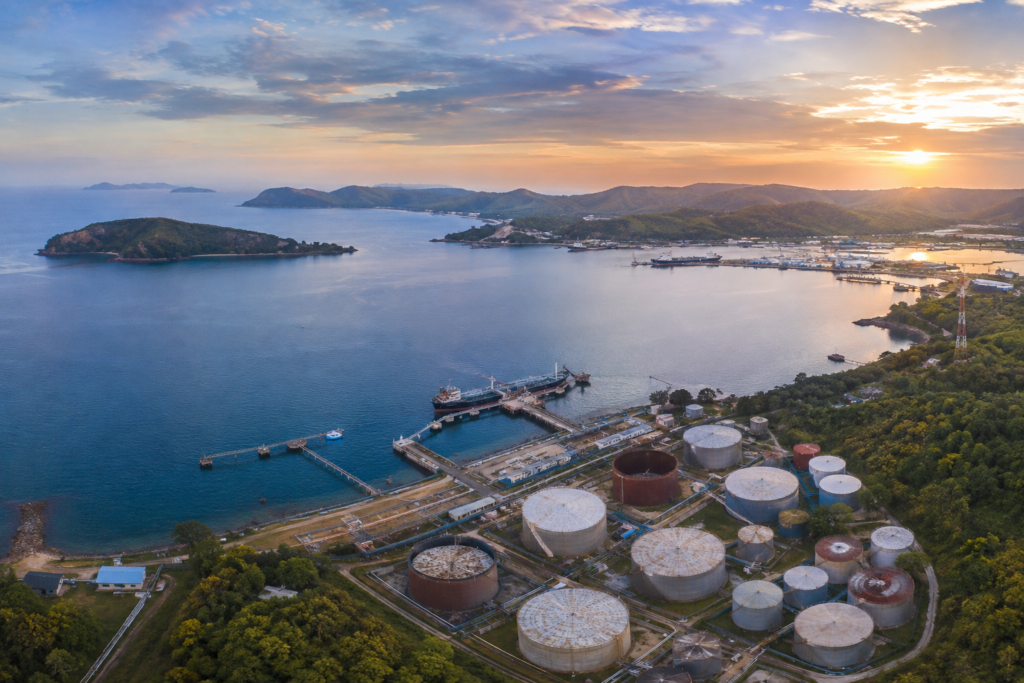
For over two centuries, Trincomalee has held a unique place in the strategic imagination of great powers. Former British Prime Minister William Pitt the Younger called Trincomalee “the most valuable colonial possession on the globe” because it gave Britain’s Indian Empire security “it had not enjoyed since the Empire’s establishment.” When the British took over Trincomalee from the Dutch in 1796, Napoleon remarked: “He who controls Trincomalee controls the Indian Ocean.”
Located on Sri Lanka’s eastern coast, Trincomalee is the world’s fourth-largest natural deep-water harbour. Its location facilitates greater control over the Bay of Bengal region. Historically, the port has served as a vital asset for colonial powers seeking to expand their maritime trade and dominance. The British built the port in the 1930s to supply fuel to Royal Navy ships during the Second World War. During the Cold War, when successive Sri Lankan governments explored proposals with Western companies to modernise the oil storage complex, India strongly objected to commercial investment, citing the harbour’s immense military value and fearing that external powers, particularly the United States, could establish a strategic foothold only a few hundred kilometres from India’s southern coastline. As a result, India viewed Trincomalee more as a strategic than an economic asset.
For nearly 80 years, the massive oil storage tanks at Trincomalee have stood as silent reminders of one of independent Sri Lanka’s greatest unrealised strategic assets. Nevertheless, Sri Lanka has shown interest in developing Trincomalee Port, and in the aftermath of its economic crisis, it urgently needs to boost economic activity and create new growth prospects to rebuild its economy.
Each of the 99 existing tanks can hold 12,000 tonnes of fuel. With a total capacity of over 1.2 million tonnes, the oil farm has the potential to turn Sri Lanka into a petroleum hub in South Asia. In January 2022, India and Sri Lanka signed an agreement to develop the Trincomalee Oil Tank Farm. It was reported that the two countries agreed to jointly develop 61 of the 99 tanks. The Trinco Petroleum Terminal (Private) Limited was established for the joint venture, with 51 per cent of the stake held by the Ceylon Petroleum Corporation (CPC) and 49 per cent by the Lanka Indian Oil Corporation Ltd (LIOC). Of the remaining 38 tanks, LIOC would continue to use 14, and the CPC would operate 24.
Trincomalee has now been identified as a nodal point for cooperation between India and Sri Lanka in the field of energy security. Sri Lanka has also expressed interest in developing the region into an energy hub and in investing in its socio-economic infrastructure. The following projects are currently underway:
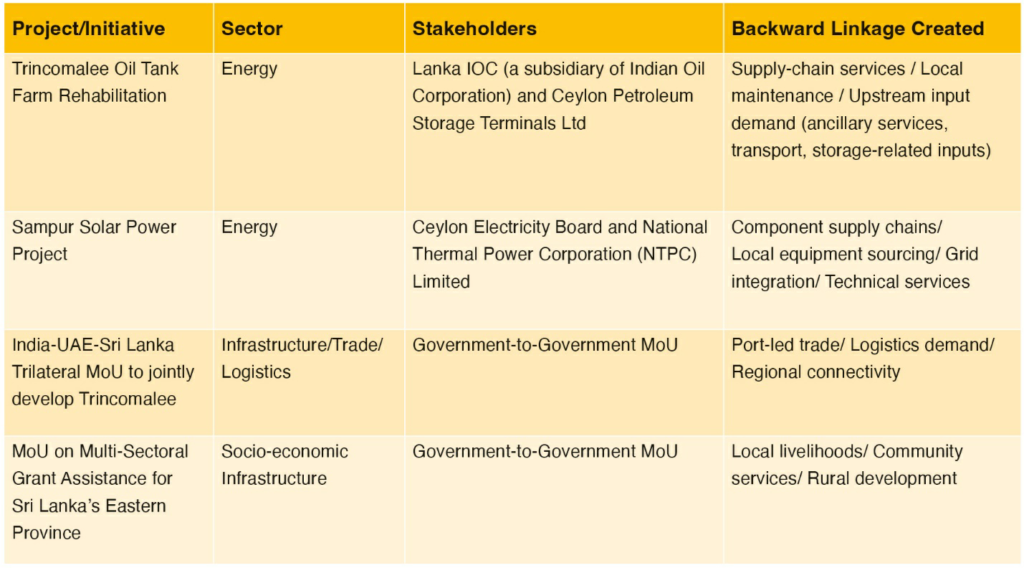
Source: Aditya Gowdara Shivamurthy and Uditi Lunawat, “From Geopolitics to Geoeconomics: Trincomalee’s Transition and India–Sri Lanka Relations,” Observer Research Foundation (ORF), 9 December 2025
Last year, during the three-day official state visit to Sri Lanka in April 2025, PM Narendra Modi, speaking on the occasion, said, “The Sampur Solar Power Plant will help in Sri Lanka’s energy security. All the people of Sri Lanka will benefit from the agreements signed for building a multi-product pipeline and developing Trincomalee as an energy hub.” Another major step forward was the electricity grid interconnectivity agreement, which will enable power trade between the two countries and potentially allow Sri Lanka to export electricity in the future. Parallel to this, Sri Lanka’s Foreign Minister Vijitha Herath also emphasised the significance of the Trincomalee project, calling it a “permanent solution to the energy crisis in India’s neighbourhood”.
For Sri Lanka, developing the Trincomalee oil tank farm can reduce its dependence on other countries for crude oil. Sri Lanka’s Sapugaskanda oil refinery meets 30% of the country’s domestic demand, with the remaining 70% supplied by imports of petroleum products. This agreement therefore provides future energy security for Sri Lanka. To further ensure energy security, the Sri Lankan cabinet accepted an expression of interest in February 2025 to increase the capacity of its Sapugaskanda oil refinery to 100,000 barrels per day under a Build-Operate-Transfer (BOT) model, which Sri Lanka hopes will attract investors from the Middle East, the United States, China, Japan, and India.
By securing the agreement in Trincomalee, which is expected to be significantly smaller than China’s investments in Hambantota, India can at least ensure that no other country uses the harbour for military purposes. Amid stiff competition from China, trilateral partnerships provide India with a cost-effective way to rebuild trust. As a leader in infrastructure investment, the UAE, the largest trading partner in the Middle East, is the best-suited partner.
Today, Trincomalee is far more than a strategically located port or a geopolitical asset. It has emerged as a pivotal node in the evolving India–Sri Lanka partnership and the broader strategic architecture of the Indian Ocean Region. At a time when extra-regional powers are attempting to recalibrate their influence in South Asia, India’s consistent and constructive engagement with its neighbours offers a model of partnership rooted in mutual respect and shared prosperity.

Add comment