


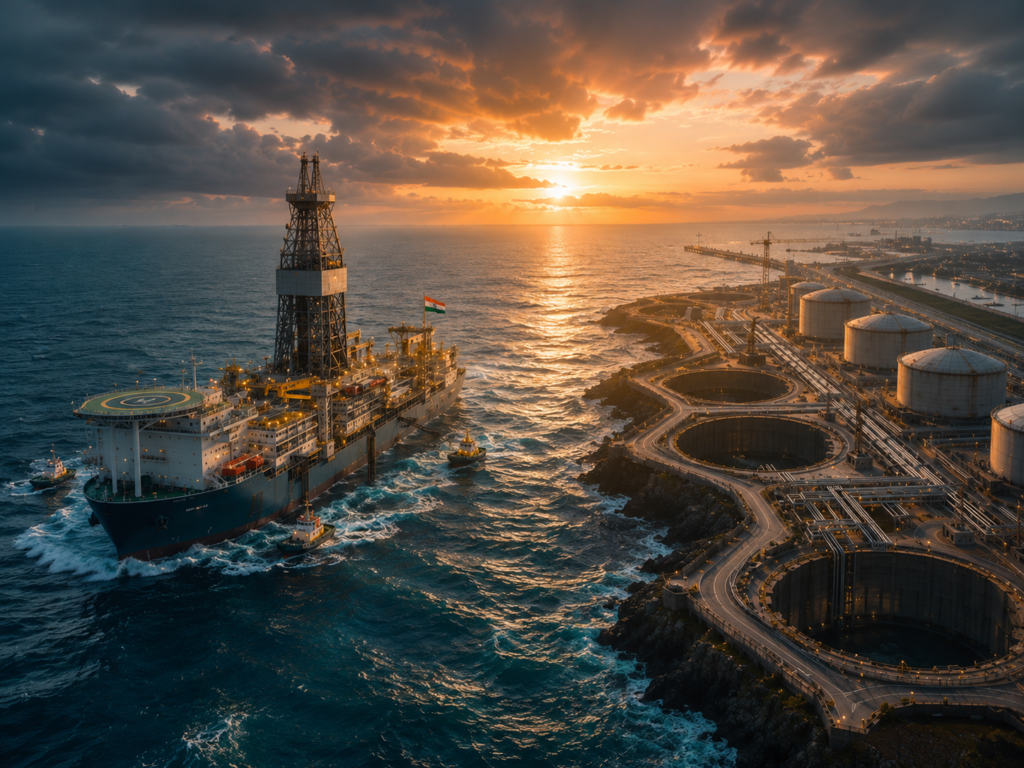
India spends nearly ₹13 lakh crore a year just buying crude oil from abroad. It is the kind of number that is easy to skim past in a news brief, and much harder to sit with once you picture what it actually means: a nation of 140 crore people, growing faster than almost anywhere else on earth, writing a cheque of that size every year just to keep its lights on and its factories running. That is the backdrop against which I read the Cabinet’s approval of “Samudra Manthan”, the National Offshore Exploration Scheme, backed by ₹84,084 crore through FY 2030-31.
The name is well chosen. As per the Mahabharata, Samudra Manthan, which involved churning of the ocean, was the patient, collective effort through which the gods and demons drew out the treasures hidden in the sea. Something is fitting about reaching for that image now, because what India is attempting is exactly that: a deliberate churning of its own waters to bring up the energy security that has eluded it for decades.
India now imports close to 90% of the crude oil it consumes. That dependence has, if anything, been quietly widening: domestic crude output slipped from 28.7 million tonnes in FY25 to about 28 million tonnes in FY26. At the same time, natural gas production fell from 36,113 to 34,776 million standard cubic metres over the same year. It is a reminder of why the timing of this scheme feels less like ambition and more like necessity, arriving just as the war in West Asia and the recurring threat of disruption at the Strait of Hormuz have shown, once again, how quickly energy security can turn into energy anxiety.
A decade of groundwork, now coming to fruition
Since 2014, the government has steadily cleared the ground that kept India’s waters out of reach. It opened up over 99% of the old “No-Go” areas, which once locked up more than a million square kilometres of India’s Exclusive Economic Zone. Production Sharing Contracts gave way to simpler Revenue Sharing Contracts. The 2025 Oilfields Act amendment modernised the legal architecture, and operators were given a predictable playing field regardless of contract vintage. Samudra Manthan is the natural next chapter in a reform journey that has unfolded patiently for over a decade, and that sequencing of reform before capital is a mature way to build policy. That sequencing matters because India has been here before: many international oil companies entered during the early rounds of the New Exploration Licensing Policy only to exit later, discouraged by regulatory delays and thin fiscal incentives. Read against that history, Samudra Manthan looks less like a fresh gamble and more like a considered answer to it, an attempt to rebuild exactly the kind of investor confidence those earlier rounds struggled to earn.
Sharing the risk, so India can be bold
A single exploratory well in frontier basins such as Krishna-Godavari, Cauvery, Mahanadi or Andaman can cost ₹1200-1400 crore with no guarantee of what lies beneath. This is the primary reason why so much of India’s deepwater potential has remained untouched. Under this scheme, the government will provide a support of up to 50% of the cost of drilling a deepwater exploration well, capped at ₹675 crore per well, across a planned 60 wells. By sharing that risk, and pairing it with ₹28,534 crore for modern seismic data and AI-assisted reprocessing, the government is investing in seeing clearly before betting big. The most striking feature about this design is the emphasis on shared infrastructure. By spreading the cost of evacuation and processing facilities across multiple fields rather than burdening a single find with the entire bill, the scheme could make discoveries commercially viable that would otherwise have been written off as too marginal to develop alone.
The churning has already begun
The institutions responsible for delivering on Samudra Manthan are not waiting around. ONGC set up a dedicated Deepwater Exploration Mission Centre in Mumbai at the start of this year. Within weeks, it had spudded a frontier well in the Andaman basin, nearly 270 nautical miles from the islands. It also began a new deepwater well in the Mahanadi basin, building on its earlier Utkal and Konark discoveries. Oil India, working an Andaman block awarded years ago, has reported early testing results showing the presence of natural gas. None of this guarantees commercial success at scale; that will take years of patient appraisal. But it shows that the mission has already left the harbour. Once better geological data is available and a few commercial discoveries have been made, international operators with deepwater expertise could be brought in.
A journey other nations have made before us
India is not the first country to bet its energy future on the deep sea. Brazil spent decades investing patiently in its offshore basins before pre-salt discoveries turned it into one of the world’s top ten oil producers. India now has the chance to write its own version of that story with the added advantage of decades of global deepwater experience, from Brazil to the Gulf of Mexico to West Africa, to draw upon. Guyana offers an even more recent version of the same lesson: a stable fiscal regime and a run of major discoveries turned it, within a few years, into one of the world’s most closely watched frontier destinations. India is not there yet, and greater exploration success is still needed before it can compete with either benchmark on those terms. But Samudra Manthan’s attention to infrastructure gaps and project timelines, and not financial support alone, is what should set India apart from many other frontier regions chasing the same capital.
A few further reforms could sharpen this advantage. Treating exploration-related imports more like research and development, with relief from customs duty and GST, would ease the cost of frontier drilling. So would revisiting India’s ring-fencing rules, which currently treat each block in isolation for cost recovery; allowing losses from an unsuccessful well to be offset against profits from a successful one elsewhere.
What this scheme could mean for India
The scheme targets to lift domestic oil and gas production from around 62 to 80 MMTOE a year, grow the hydrocarbon resource base from 1.6 to 2.2 billion TOE, catalyse reserve accretion of over 600 MTOE, and potentially trim the crude import bill by close to ₹1 lakh crore annually.
If India wins this bet, it is bound to become a nation that is genuinely energy secure, with a domestic industrial base to match and far less exposed to a world that has grown less predictable.



Add comment