


When strategic thought is discussed in Europe and among Western audiences, Carl von Clausewitz (1730-1831), a Prussian army officer and military theorist, is often cited. His unfinished work, ‘On War,’ published after his death, remains widely studied for its insights into military strategy, politics, and the philosophy of combat, as well as for its contemporary relevance.
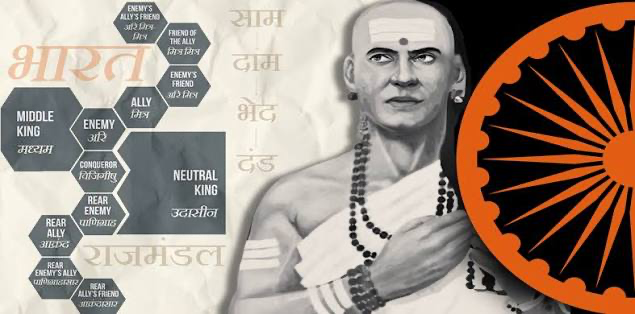
However, about two millennia before Clausewitz, Asia produced two of the finest strategic minds whose ideas remain relevant today—Sun Tzu in China and Kautilya in Bharat—contemporaries operating in distinct geographies. Sun Tzu lived during China’s Warring States period, when military victory was central to the survival of competing states. His Art of War consequently focused primarily on warfare and the means of achieving victory. Kautilya, on the other hand, was a strategist whose ideas went beyond the battlefield and into the realm of statecraft. For him, war was but one of the means to preserve the power of the state. His seminal work, The Arthashastra, delves into the means of acquiring power, preserving security, managing rivals, building alliances, strengthening the economy and achievingpolitical objectives. For Kautilya, war was an instrument of statecraft—not its purpose.
Kautilya’s Ṣāḍguṇyam—the sixfold framework of foreign policy and interstate statecraft—rests on six measures: Sandhi (peace, treaty and alliances), Vigraha (war and hostilities), Yāna (expeditions and mobilisation), Asana (strategic pause), Samśraya (seeking alliances and shelter), and Dvaidhibhava (dual policy), as well as on their contemporary relevance and utility. While these concepts retain contemporary relevance, Yāna, in particular, warrants revisiting. Often translated as “going to war”, the concept has deeper strategic significance. It concerns mobilising and projecting power to influence an adversary’s choices and create uncertainty in his mind. The objective is not necessarily to fight but to create conditions in which an adversary concludes that accommodation is preferable to confrontation. The greatest victory is not necessarily the destruction of the enemy. It is achieving the desired political outcome without having to fight. This aligns with Sun Tzu’s concept of winning without fighting and with what Clausewitz propounded—that “War is merely the continuation of policy by other means.” In the Kautilyan context, Yāna can be described as deterrence through visible preparedness and purposeful mobilisation—the space between diplomacy and war.
Modern deterrence operates similarly. While Kautilya’s world no longer exists, the logic of power, then and now, remains unchanged. The earlier land battle now extends to the sea, air, cyberspace, outer space, the electromagnetic spectrum, financial systems, supply chains, critical technologies, information and the cognitive domain. Today, competition does not begin when armies cross borders. It is a continuum, with states using cyber operations, economic coercion, disinformation, proxy forces, technology restrictions, maritime pressure and other grey-zone tools to advance their interests while remaining below the threshold of conventional war. As the battlespace has become multi-domain, the modern Yāna or Neo-Yāna must likewise be multi-domain.
Can Kautilya’s ancient concept of Yāna provide a relevant framework for Bharat to mobilise and integrate all instruments of national power? Military readiness, of course, remains at the core, including resilient logistics, secure supply chains, integrated air and missile defence, maritime surveillance, and forward deployment. Alongside this, space capabilities must provide secure communications, persistent surveillance, and resilience against counter-space threats. Cyber capabilities must protect critical infrastructure and offer credible options for responding to hostile activity, while information power must counter disinformation and shape strategic narratives.
But with military mobilisation, we also need national mobilisation. Today, economic resilience requires energy security, access to critical minerals, diversified supply chains, and financial stability. Technological resilience requires national capabilities in semiconductors, artificial intelligence, quantum technologies, drones, and advanced defence systems. Neo-Yāna can offer a useful framework for thinking about modern deterrence, which requires capability, credibility, and communication. Capability implies the power to impose unacceptable costs. Credibility means convincing the adversary that this power will be used if necessary. Communication means ensuring that the adversary understands both the capability and the resolve behind it. Yāna brings the three together, converting preparedness into strategic signalling.
Bharat’s strategic environment makes this approach particularly relevant. An assertive China on its northern frontier, a troublesome Pakistan to its West, and a contested Indian Ocean make for a challenging security environment. At the same time, cyber threats, disinformation, grey-zone operations and vulnerabilities in critical infrastructure are multiplying. India’s response must therefore integrate military power, diplomacy, intelligence, technology, economics, industry and strategic communication.
Many of India’s current initiatives already reflect aspects of this approach. Sustained naval deployments have led to forward presence across the Indian Ocean, while border infrastructure development has improved mobilisation and logistics. Defence partnerships and logistics arrangements with countries such as the United States, France, Japan, Australia and Singapore have expanded India’s operational reach, while military exercises have strengthened interoperability. Bharat’s space programme and defence modernisation have added to capability, strengthening deterrence. That is Yāna in practice. A Neo-Yāna could hence be conceptualised on the following six principles:
- Persistent multi-domain readiness. Preparedness must be continuous, not episodic. India must be ready to respond across military and non-military domains.
- Forward presence. Strategic deployments, logistics networks, border infrastructure and maritime access must create the ability to act before a crisis escalates.
- Integrated deterrence. Diplomacy, military power, intelligence, technology, economics and strategic communication must work together rather than in separate silos.
- Networked partnerships. Partnerships should expand India’s strategic options without compromising its autonomy.
- National resilience. Supply chains, energy systems, digital networks, critical infrastructure and defence-industrial capabilities must be protected against disruption.
- Escalation management. Power must be used intelligently. The objective is not maximum escalation, but maximum strategic advantage at minimum cost.
Yāna, therefore, is not a doctrine of perpetual war but a method for shaping the strategic environment before war becomes necessary. It holds that power is most valuable when it need not be used, with the ultimate objective of maintaining peace. Together, these six principles transform an ancient strategic concept into a contemporary national security doctrine.
The international system is slowly but surely moving away from a unipolar world towards an increasingly multipolar one. Consequently, countries may cooperate in one area while competing in another, and economic interdependence can coexist with strategic rivalry. In such a scenario, rigid alliances are not always the most effective instrument of statecraft. Bharat’s preference for strategic autonomy and flexible partnerships aligns naturally with the logic of Yāna, with overlapping networks of partnerships based on national interests—defence with one partner, technology with another, energy with a third, and maritime cooperation with several others. However, to maintain strategic autonomy, Bharat must be able to defend its interests, absorb economic shocks, secure its critical infrastructure, and project influence beyond its borders. This is where Neo-Yāna becomes relevant. It offers Bharat a framework for an integrated national strategy—one that combines military preparedness, technological innovation, economic resilience, diplomatic engagement and information dominance into a coherent whole.
Today, the most consequential contests may not be decided on the battlefield. A state that integrates all elements of national power will possess strategic choice—an advantage that extends beyond military strength and enables the preservation of peace on favourable terms. Neo-Yāna offers such a framework for Bharat, integrating hard and soft power, diplomacy and deterrence, technology and resilience, and partnerships and strategic autonomy. Kautilya’s wisdom, therefore, is not merely a subject for historical study. It can serve as a guide to the future.
This article is drawn from a talk delivered by the author at a National Security Dialogue convened by Bharat Ki Soch on the Ṣāḍguṇyam Doctrine, held on 5-6 August at the India International Centre.


Add comment