


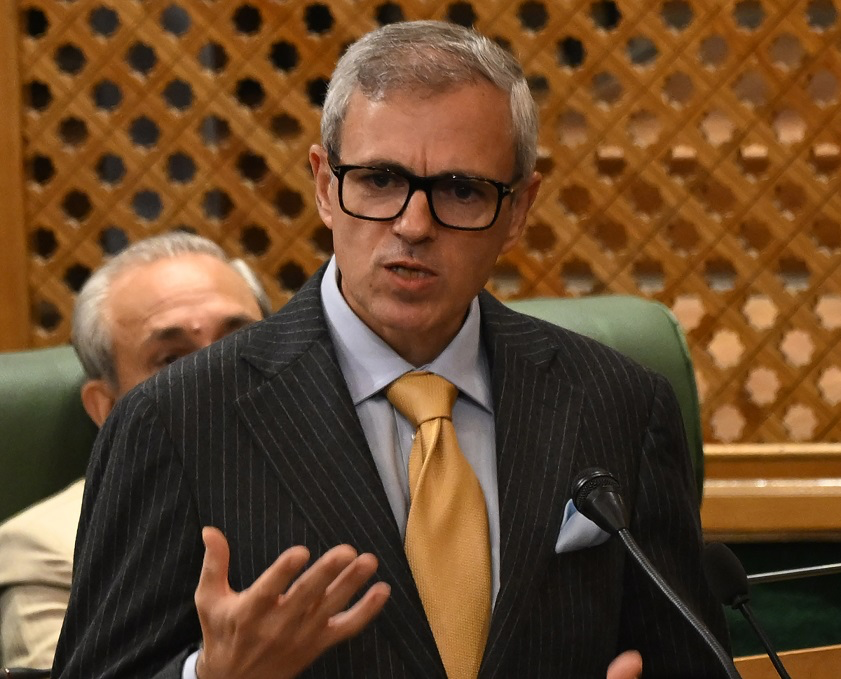
Speaking to reporters on the sidelines of the inauguration of the fifth edition of the J&K Open 2026 at the Royal Springs Golf Course (RSGC) in Srinagar, chief minister Omar Abdullah said: “The people who are responsible for keeping the security here, they are expected not to let such attacks happen.”
Whom does the Chief Minister intend to implicate while absolving himself? He clearly alludes to the Lieutenant Governor, who heads the Union Territory of Jammu and Kashmir. Who appoints the chief minister after he wins the majority’s support in the assembly? It is the Lt Governor. When the chief minister indirectly implicates the Lt Governor, it implies a lack of trust on the part of the chief minister.
Hence, everything boils down to trust deficit. If it were not the case, the Government of India would not have excluded the portfolios of Law & Order and Security from the jurisdiction of the Chief Minister.
The real issue is not who is responsible forfighting terrorism; the real issue is the trust deficit which surfaced owing to the crisis that overtook the State from early 1980. The erosion of trust actually began in 1953 when Sheikh Abdullah changed his stance on accession, leading to his dismissal and arrest. During his long estrangement, his lieutenant Afzal Baig carried forward the separatist agenda under the label of the Plebiscite Front, which erased any semblance of trust between Srinagar and New Delhi. Subsequently, the Plebiscite Front continued to nurture its separatist agenda under one name or the other.
With the death of Sheikh Abdullah in 1982, intense dynastic rivalry for power between the Sheikh’s son, (Dr Farooq) and his daughter (Khalida), personalised Kashmir politics. Each party accused New Delhi of pursuing the game of divide and rule. Bringing all accusations to the doorstep of the Union government was the best strategy for winning mass support. They broadcast a message to the local population that the Government of India was applying colonial norms in its dealings with Kashmir.
Personal aggrandizement and factional rivalry within the political structure did not spare even the Hindu minority of Kashmir from the repression of power-hungry postulants in 1986. The brazen attack led by Jama’at-e-Islami assailants, drawn from almost all anti-India and anti-Hindu political groups in South Kashmir, vandalised Hindu temples and shrines and torched many Hindu houses. The vandals created a fear psychosis among their victims, compelling many Hindu families to abandon their homes to save their lives and honour. Reports of the 1986 attack on the Hindus in South Kashmir were blacked out and no regional or national paper printed a word about it. This laid bare the communal propensity of the state government. No inquiry, no compensation, not even a word of sympathy was uttered. Undoubtedly, the trust was broken.
Where in the Constitution of India is it written that in a Union Territory where the legislative assembly is in place, and an elected chief minister and his council of ministers are in power, they are absolved of responsibility for the security and maintenance of Law and Order in the state? Restructuring the jurisdiction of the administration should not lead to dereliction of responsibility. Collective responsibility is the essence of a democratic dispensation. It allows for a reassignment of powers in times of need.
Let us show how the State government spasmodically undermined the significance and importance of trust and left the state to bear the brunt of terrorism. Its ambivalence about accession brought untold hardships to the people of Kashmir.
A responsible chief minister, who goes and joins the agitatotws of Cockroach Janta Party at Jantar Mantar, and becomes an acolyte of the mobsters hurling abuse at the prime minister, is least qualified to adjudicate responsibility for eliminating terrorism in the state. Agent-provocateurs are not reliable caretakers of the people.
Accused of hunting with the hounds and running with the hare, back in Srinagar from the Jantar Mantar protest, the Chief Minister laconically stated that his people were not the ones who indulged in violence and vandalism at Jantar Mantar. He meant that Kashmiris are a non-violent people. If that is a fact, what makes him state that responsible authorities should forestall terrorism? Abusing the Prime Minister is tantamount to abusing the very process and institution that brought Omar Abdullah to power as Chief Minister.
The statement of the chief minister is out of place. He should have said that the authorities ought to expose the elements whose declared mission is to destabilise the elected government in J&K and obstruct peace and progress in the state; yet he will never say it because he knows that the finger of suspicion will point to political leadership of the state, including his own party.
The whole world knows who sponsored armed insurgency in Kashmir in the early 1980s; who provided overt and covert logistical support to externally sponsored and internally abetted armed infiltrators. Who helped brainwash and arm jihadists in training camps set up by our adversary across the border? The story of the rise of Kashmir armed insurgency and the role of local political structures has been vividly and accurately told by Jagmohan, the former StateGovernor in his monumental work My Frozen Turbulence in Kashmir. It contains a monumental analysis of the methods used for radicalising and militarising a people in the guise of upholding democracy.
Who allowed Jama’at-e Islami (JeI) of Kashmir to spread its tentacles in darsghs (its seminaries) in the hamlets, villages, and towns of Kashmir during the decades of 1970s and 80s? Who allowed it to grab awqaf (endowments), nazool (Escheat, crown land), khalisa sarkar, banjar, and kahcharai lands and raise mosques and madarsas on them?
Who indoctrinated labourers, artisans, masons, carpenters, electricians, sanitary technicians, and other workers to build those institutions without accepting wages? Who were the teachers of these seminaries or the Imams of the mosques who spat venom in their sermons against India and hatred against the Hindus? Who converted thousands of these seminaries into government schools and allowed the pupils to receive government stipends and teachers their salaries while campaigning against India. Most of the Kashmiri terrorists who have been killed or arrested in encounters with the security forces were the product of these darasgahs. And who were the patrons of these radical institutions? They were mostly ministers, top bureaucrats, and elected members of the legislature. All this was the creation of the elected governments, and now the chief minister expects the LG to clean the Augean stables.
Who grabbed hundreds of thousands of kanals of forest land and sold it away to relatives, friends, and influential persons for a tuppence and thereby caused huge losses to the State exchequer? Who tried to legalise this colossal fraud by managing to pass the notorious Roshni Act? Was the state government creating an egalitarian society as described in the document Naya Kashmir, or was it building a safe haven for terrorists?
Who were the members of the judiciary who either cleared or bailed out local gun-wielding outlaws who confessed to killing numerous innocent persons, particularly Kashmiri Pandits, at the behest of their leaders? They have been released on bail and cases against them are collecting dust. How come not a single criminal has been brought to book in the last 36 years? How is it that no government — NC/PDP/Congress — set up a court of inquiry to investigate the rise of the armed insurgency, the massacre of Pandits, leading to de facto ethnic cleansing in Kashmir.
The story of the Kashmiri leadership’s blackmail of the Indian nation is not as surprising as its blackmail of its own people. Pakistan has not been frugal in distributing the opium of religion to Kashmiris. NC Chairman Dr Farooq Abdullah harps on the theme of India talking to Pakistan, but does not utter a word on the suppression of the people of PoJK who have fought hard to wriggle out of Pakistan’s control. In 1964, Sheikh Abdullah visited Pakistani President General Ayub Khan in Karachi to offer him the plan for a Confederation. His son, Dr. Farooq Abdullah, should disclose the General’s reaction to that plan.
In the final analysis, Chief Minister Omar Abdullah wants India to take care of the consequences of what his party and its leadership have done for decades in Kashmir.

Add comment