


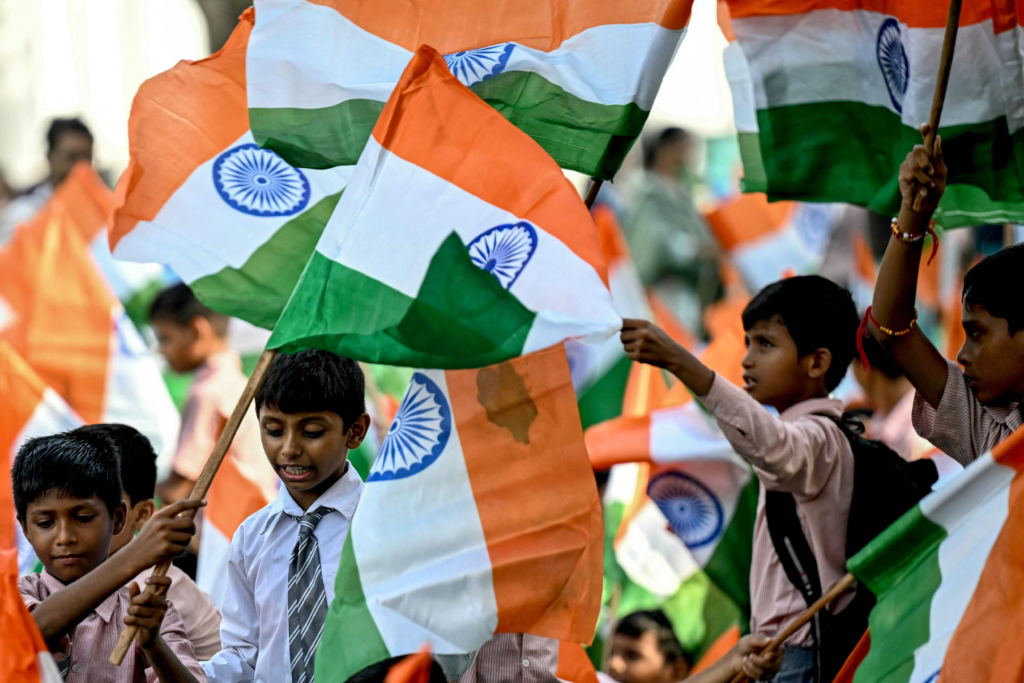
Today, Bharat completes 79 years of independence. As we step into the 80th year of our freedom and reflect on the year gone by, we have indeed made great progress towards the goal of becoming Viksit Bharat by 2047. But is it enough?
The economy is on track. We remain the fastest-growing major economy, with real GDP growth estimated at 7.7 per cent in FY 2025–26. We have reached a historic high of USD 860 billion in exports, supported by the continued expansion of services and growing exports of electronics, engineering goods and pharmaceuticals. Major trade agreements have been concluded, including those with the European Union, and India’s leadership of BRICS has strengthened its position as an important economic and diplomatic power.
In technology, Bharat’s semiconductor ecosystem is taking shape, though we still have a long way to go. Digital infrastructure remains a success story, with UPI in particular evolving into the world’s most successful payment system. This demonstrates how technology developed in Bharat can operate at extraordinary scale and increasingly serve as a model for other countries. The Space and Deep Tech sectors have also seen significant progress. ISRO completed a crucial hot test of the Power Head Test Article of its 175-tonne-thrust semi-cryogenic engine for future heavy rockets; and on 18 July 2026, Skyroot Aerospace’s Vikram-1 made it the first privately developed Indian rocket to successfully reach orbit from Indian soil. India has also begun building indigenous quantum-computing capabilities, with the first open-access quantum computing testbeds becoming operational in Andhra Pradesh.
The experience of Operation Sindoor, together with the rise in indigenous defence production, has reinvigorated the defence sector. Three advanced indigenously designed and built naval vessels (INS Dunagiri, Sanshodhak, Agray) were inducted simultaneously, strengthening Bharat’s maritime combat capability, maritime domain awareness and coastal anti-submarine warfare capability. Defence production reached an all-time high of ₹1.78 lakh crore, underscoring Bharat’s ability to develop and deploy sophisticated weapon systems. In infrastructure and energy, the country has made rapid progress in renewable energy, approaching a milestone of 300 GW of non-fossil-fuel installed capacity.
Internally, decisive progress has been made in combating Left-Wing Extremism, with the geographical footprint of Naxal violence reduced dramatically. In Jammu and Kashmir, while the security challenge remains, the Union Territory has witnessed a substantial decline in terrorist violence. Taken together, these achievements point to a broader transformation: With growth across economic, technological, military, space, and diplomatic domains, and a secure internal environment, Bharat is on track to shape its own strategic environment—and, increasingly, the wider international order.
But even beyond measurable indicators, a visible shift in mindset is evident in the protests by Bharat’s youth over paper leaks in key examinations. While the immediate trigger was the leaks that jeopardised young people’s career prospects, the movement also reflected a wider demand for accountability. If harnessed correctly, the student movement can be the catalyst that propels Bharat towards the cherished goal of ‘Viksit’ by 2047. Accountability is the key across all sectors, whether in providing basic civic services, fixing the education system, reforming governance structures, improving justice delivery mechanisms or imposing high levels of probity in public life.
This is also where the challenge and danger lie. In an age when algorithms shape perceptions, fissiparous tendencies can be exacerbated by hostile forces seeking to slow Bharat’s growth. Bharat’s extraordinary digital penetration, especially among its youth, has created an unprecedented new battlespace. Algorithms increasingly determine what young people see, how long they see it, and potentially what they believe. Engagement-driven platforms can create echo chambers, amplify outrage, normalise extreme or harmful content, and exploit psychological vulnerabilities. The battlefront is now the cognitive domain. It is more than a battle to control the information environment. It is a battle to control attention, perception, and behaviour. We have seen shades of this in the protests at Jantar Mantar. A genuine student movement can be overtaken by hostile forces.
A troubling aspect is the framing of protests in US linguistic terms. Gen Z, Gen Alpha, and similar terms are relevant to US and Western society, but they should not be uncritically imported as Indian youth do not share the same formative experiences as their American counterparts. These labels emerged from specific economic, technological and social conditions. Baby Boomers (1946–64) were shaped by the post-WWII population boom and the economic and cultural transformation of post-war America. Gen X(1965–80) was associated with the post-Boomer generation, smaller families, changing family structures, television culture and the transition towards the digital age. Millennials (Gen Y – 1981–96) were shaped by the internet, globalisation, 9/11, the financial crisis and the transition from an analogue to a digital world. Gen Z (1997–2012) is generally regarded as the first generation to grow up with smartphones, social media and ubiquitous internet access. And the newest in the block, Gen Alpha (2013–extending into the mid 2020s), is associated with children growing up with tablets, algorithmic platforms, AI and highly immersive digital environments.
These were Western experiences applicable to the socio-economic and cultural milieus of those countries. Their appropriation by people in Bharat signals intellectual and cultural bankruptcy. This is troubling. We need Indian terms for the Indian experience. The protests by Bharat’s youth were led by teenagers and young people in their Twenties and Thirties. We could therefore describe it as a T-3 (Teens, Twenties, and Thirties) movement, and that wording would have resonated better. Also, why not call those in their Forties and Fifties the F-2 Generation (F-2s)? They are in middle- and senior-level leadership today. Going further, we could call those in their Sixties and Seventies the S-2 Generation (S-2s). They have served and continue to serve their motherland in various capacities. And finally, we can have two more groups, the pre-T-3s and the post-S-2s. Such terminology is more relevant to Indian society and our way of life. Mindset changes are required; along with Make in India, we need indigenous Thinking and Conceptualisation. Borrowed thoughts and ideas can only take us so far. To lead, we need our own vocabulary and to remain connected to our civilisational heritage and ethos.
India’s challenge at 80 is no longer simply about becoming Viksit. That goal is increasingly within our grasp. We need a shift in mindsets and a distinctly Bharatiya way of doing things, especially in the realm of ideas. In the coming years, we will have to manage the complexities of success, which will bring new vulnerabilities. The solutions have to be homegrown, born of the genius of our people. They must include shedding the colonial mindset, holding those in positions of authority accountable, and doing away with the culture of entitlement. The ‘Lal Battis’ have gone from the vehicles, but not the mindsets that make people hanker for them as symbols of status. That will be the test of leadership at all levels.
Let each individual also do their bit for the country. Together, we can make a difference.
Jai Bharat, Jai Hind.


Add comment