


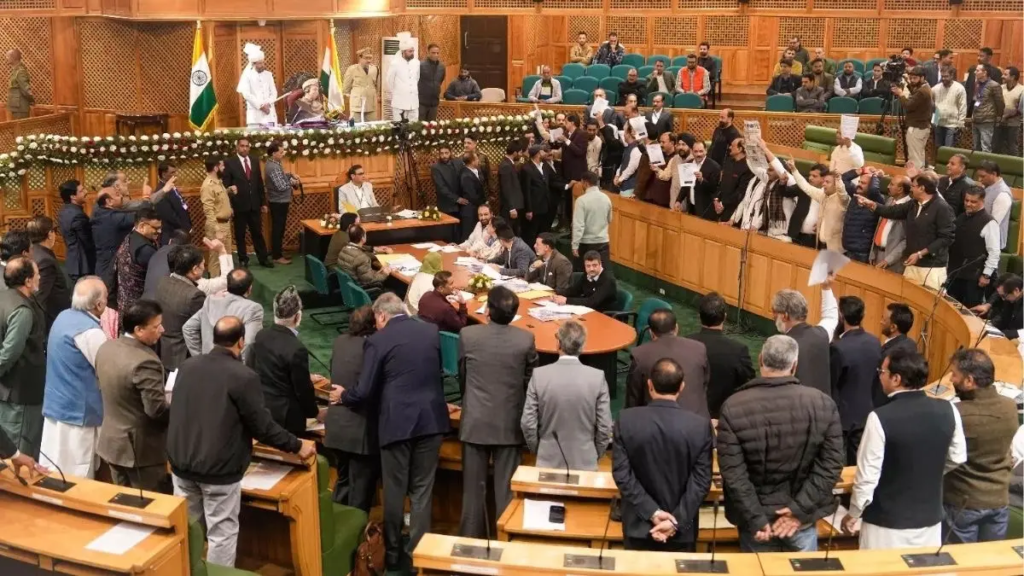
On the second day of its current session, the J&K Assembly witnessed an acrimonious debate. NC MLA Abdul Majid Larmi from Southern Kashmir demanded that the birth and death anniversaries of NC founder Sheikh Muhammad Abdullah be restored; alternatively, the holiday on Maharaja Hari Singh, falling on September 23, be cancelled. This equated the importance of the roles and contributions of the two prominent personalities of Jammu and Kashmir. This was an illogical comparison. We will come to that later; first, we deal with the theoretical and legal aspects of the issue.
A public holiday is a day established by law or government policy on which most public and private offices, schools, and businesses close, and workers are usually entitled to a day off. Section 25 of the Negotiable Instruments Act, 1881, sets out the legal basis for declaring public holidays, defines what constitutes a public holiday, and empowers the government to notify such days in the Official Gazette. The Central Government (and state governments through delegated authority) exercises administrative and executive discretion to declare national, regional, or festival holidays. Courts (including the Supreme Court) have repeatedly held that the declaration of public holidays is a policy matter. Citizens do not have a fundamental or legally enforceable right to compel the government to declare a specific day a public holiday.
On the legal aspects of declaring a specific day a public holiday, the Supreme Court of India’s judgment in a Public Interest Litigation (PIL) is instructive. In a PIL filed by a registered charitable and religious organisation, the petitioner sought directions for the Union of India and the States to frame uniform guidelines for declaring public or gazetted holidays in India. The petitioner contended that the current system for declaring public holidays lacks a statutory basis and is governed solely by executive instructions.
According to the petitioner, the absence of codified standards permits arbitrary and discriminatory exercise of executive discretion, thereby violating Article 14 of the Constitution. The petitioner sought specific directions declaring the birth anniversary (Prakash Parv) of Guru Gobind Singh Ji, the 10th Sikh Guru, a nationwide gazetted holiday. The petitioner argued that different governments adopt a “pick-and-choose” approach to declaring holidays, resulting in unequal treatment of occasions of national, historical, and cultural importance. The petitioner further emphasised Guru Gobind Singh Ji’s stature and contributions to the country’s spiritual, moral, and national fabric, and submitted that his birth anniversary deserved recognition as a nationwide gazetted holiday, particularly in a pluralistic and secular society such as India.
The Bench of Vikram Nath and Sandeep Mehta, JJ., declined to issue directions, holding that the relief sought was not justiciable under Article 32 because declaring a nationwide gazetted holiday or framing a uniform policy for public holidays falls within the executive policy domain. At the outset, the Court expressed deep respect for the legacy of Guru Gobind Singh Ji and observed that his life embodied courage, discipline and commitment to duty. The Court noted that Sikh teachings emphasise honest labour and selfless service, and that remembrance of these ideals is best honoured by the performance of duties rather than by symbolic gestures.
While considering whether it could direct the executive to declare a public holiday or to frame a uniform policy, the Court held that the declaration of holidays is a matter of policy involving administrative, economic and governance considerations, including the continuity of essential services and the accommodation of diverse socio-cultural practices. Such decisions fall within the executive’s domain and are not ordinarily subject to judicial direction.
The Court observed that India’s calendar already includes numerous national, regional and religious holidays reflecting the country’s pluralism, and that an indiscriminate expansion of gazetted holidays would adversely affect governance and productivity. The Court also noted that, in a federal structure, States may legitimately adopt different approaches based on regional and administrative considerations, and that such variation does not, by itself, constitute discrimination.
The Court rejected the Article 14 argument, holding that absolute uniformity is not required in policy matters, and that classifying holidays into gazetted and restricted categories reflects a calibrated administrative approach. In the absence of manifest arbitrariness or mala fides, the Court held that it cannot interfere with policy choices regarding holidays.
The Court also held that Article 25 guarantees freedom to profess, practise and propagate religion, but does not confer a right to demand State recognition of a religious occasion as a compulsory public holiday. Finally, the Court observed that granting such relief would open the floodgates to similar claims from other communities and would require continuous evaluation of socio-cultural priorities, a task best left to the executive.
The Court declined to issue directions either to declare the birth anniversary of Guru Gobind Singh Ji a nationwide gazetted holiday or to frame uniform guidelines for declaring holidays, holding that the relief sought was not justiciable under Article 32 and that the declaration of public holidays is a policy matter within the executive
In J&K, the decision to declare or withdraw the public holiday associated with a prominent personality is the sole prerogative of the administrative authority. In the UT of J&K, the Lt Governor is the Chief Executive Authority. From a legal point of view, withdrawing the public holidays marking Sheikh Abdullah’s birth and death anniversaries is legally sound. While Sheikh Muhammad Abdullah rendered meritorious service to his people, we have to remember that he worked through collective leadership. In his struggle to free the state from monarchical rule, he was not the only activist. A row of NC leaders shares the contribution which the Sheikh later claimed for himself. For example, Bakhshi Ghulam Muhammad is usually considered the architect of modern Kashmir. When the Sheikh was engaging with the Chinese and the Americans for his cherished Kashmir Sultanate, the Bakhshi was building the state brick by brick and driving away the demon of hunger and famine, the gifts of the “olav bub” to the Kashmiri nation.
The NC MLA who equates the Sheikh with Maharaja Hari Singh appears ill-informed about how the brave Dogras of Duggar Desh forged the State of Jammu and Kashmir. The cliffs and crags, the rocks and ravines, and the peaks and precipices of the treacherous Himalayas still echo with the blood and sweat of valiant Dogra soldiers, shed under the command of the Maharaja’s forefathers. Ultimately, his signing of the Instrument of Accession and accession to India in 1947 prevented the state from falling to invaders. Otherwise, the fate of the Kashmiris would have been reduced to mere hewers of wood and drawers of water, much like their unfortunate brethren in Occupied Kashmir. Today, all citizens of the Union Territory are enjoying the fruits of Indian democracy. That is Maharaja Hari Singh’s contribution. By contrast, the policies enunciated by Sheikh Abdullah led to the ethnic cleansing and genocide of the minority Kashmiri Hindu population. The difference is stark and real.

Add comment