


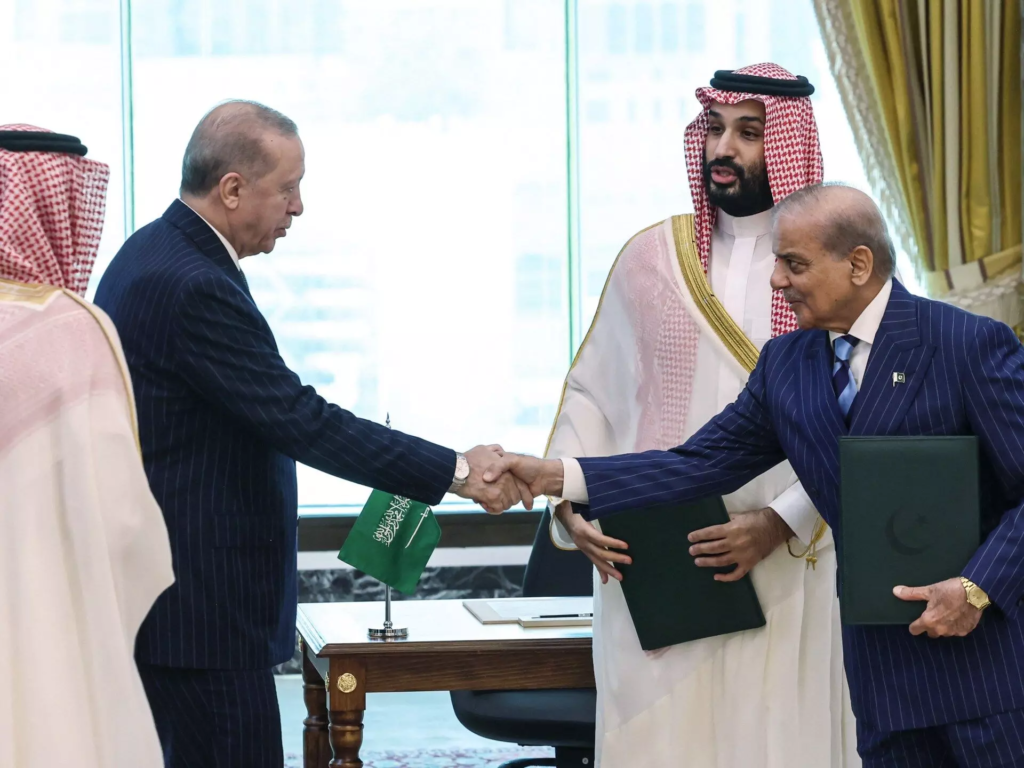
The startling gains by Yemen’s Ansar Allah fighters in the strategic Bab el Mandeb Strait have effectively immobilised the Mecca Joint Defence Agreement (August 7, 2026) between Riyadh, Ankara, and Islamabad.[1] Saudi sources reported that missiles and drones struck civilian and economic targets in four southern cities, damaging energy facilities and utility infrastructure. Ansar Allah (known as the Houthis after their leader Sayyid Abdul-Malik Badr al-Din al-Houthi) also launched coordinated ballistic missile and drone attacks on Saudi Aramco facilities in Abha, Jizan, and Najran, as well as on the King Khalid Air Base in Khamis Mushait. Abha is the administrative centre of Asir province; Jizan hosts Riyadh’s largest refinery and port; Najran is near the Yemeni border; and Khamis Mushait is a vital military hub.
The escalating attacks on 10-11 September and thereafter have created a delicate situation for the parties to the Mecca Agreement. While the accord’s text has not been officially released, its publicly stated goal implied that an armed attack on any signatory would be treated as an attack on all. However, there was no automatic trigger, and therein lies the rub. Both Islamabad and Ankara condemned the attack, affirmed support for Saudi Arabia’s sovereignty and territorial integrity, but refrained from providing military aid in response to the strikes. The lack of an operational joint command or standing response mechanism in the initial Mecca text is what allowed Pakistan and Türkiye to express solidarity without committing combat forces.
In fairness, the timing of the Houthi attack is awkward, as the military integration and decision-making mechanisms required to respond to aggression have not yet been established. The Pact was driven by shifting regional security dynamics, US policy shifts, and concerns about the security umbrella.[2] Despite close military ties with Riyadh, Islamabad sought cordial relations with Iran, possibly because of growing unrest in Balochistan. During the fiercest Baloch insurgency of 1973-77, Pakistan prevailed only because of substantial military and financial aid from the then Shah of Iran, Mohammad Reza Pahlavi. Moreover, Pakistan has a large Shia population (25 to 40 million) and fears domestic tensions if it joins the military conflict in Yemen. Ankara, too, is keen to avoid an anti-Iran alignment or entanglement in a prolonged conflict.
Pakistan may prefer to offer specialists and additional personnel, while Türkiye may advance drone technology, electronic warfare capabilities, and munitions. Islamabad has hinted it may act when the “time comes”.[3] It has urged Iran to rein in the Yemeni rebels after the attacks on Saudi Arabia intensified.
Bab el Mandeb Strait
Ansar Allah has broken the maritime blockade on Yemen. Perim Island, which hosts an Emirati air base to which Israel has access, has fallen. It now controls the city of al-Mukha (Mocha), the Bab el-Mandeb Strait, and the entire Red Sea coast. The Saudi-backed Yemeni government has officially announced its withdrawal from Perim Island and the Bab el-Mandeb Strait. Maj. Gen. Tareq Saleh, commander of Yemen’s Special Security Forces, has fled to Eritrea. Yemen may eventually be ruled by the Iran-aligned Ansar Allah, which is expected to push into the interior until it achieves full control over the country.
Ships can now safely arrive and berth at Yemeni-controlled ports via Bab el-Mandeb. Ansar Allah’s military spokesperson, Yahya Saree, said the waterway is safe for all shipping except Saudi vessels; commercial and commodity carriers continue daily transits. Ansar Allah’s Political Council member Mohammed al-Bukhaiti declared that the current conflict is not against the Saudi people but is aimed at the “Zionist Gang” (those siding with Washington and Tel Aviv).
As ten per cent of the world’s oil flows through this waterway, the turmoil has spiked US oil prices and, in an election year, driven up the cost of food, fuel and other goods. Iran (Strait of Hormuz) and AnsarAllah (Bab el-Mandeb Strait) now control the movement of one-third of global oil trade.
East-West line
The strike on the Abqaiq-to-Yanbu pipeline (East-West pipeline), which Saudi Arabia relied on to transport oil from its eastern region to the Red Sea, bypassing the Strait of Hormuz, forced the kingdom to halt oil exports entirely. This has worsened its economic woes, prompting it to seek around US $8 billion in loans from various banks.
The pipeline in the Riyadh and Medina regions was attacked by drones based in Iraq’s Maysan province.[4] The 1,200-km pipeline enabled Riyadh to ship around 5 million barrels of oil daily, accounting for 4% to 5% of global supply. The Iraqi commander responsible for the strike was promptly dismissed by the Iraqi government, and Riyadh refrained from retaliation at the request of the Iraqi prime minister.
US reluctance
US President Donald Trump declined to commit US forces to direct military action against Ansar Allah, despite two phone calls from Saudi Crown Prince Mohammed bin Salman on 10 September 2026. Instead, Washington offered intelligence sharing and targeting, Axios reported.[5] However, Admiral Brad Cooper, commander of US Central Command, rushed to Riyadh for talks.
CNN sources said the US has sent around 200 advisers to Saudi Arabia to provide intelligence and targeting support against the Yemeni fighters.[6] It may be recalled that under President Trump’s second administration, the US launched a campaign against the rebels, which ended in an abrupt ceasefire after Gen. Dan Caine, Chairman of the Joint Chiefs, felt there was no clear exit strategy. After more than six months of fighting in Iran, US forces are stretched thin and wary of being dragged into a fresh fight against Ansar Allah.
Former US counterterrorism chief Joe Kent observed that the rapid advance of Ansar Allah marks “the beginning of the blowback effects we are now going to face as a result of our counterproductive policies in the Middle East and because of this senseless war in Iran”. He noted that Ansar Allah’s ability to capture key terrain and strategic ports along the Red Sea coast demonstrated its military capabilities and capacity to gain support from tribes far from the traditional Ansar Allah strongholds in northern Yemen. Kent said this is significant, as these tribes are predominantly Sunni, while Ansar Allah are Zaydi Shias. This will doubtless help when they move to unite the country under their leadership.
Kent anticipates problems for the US in Iraq, Lebanon and Bahrain in the days ahead. Hung Cao, the US acting Navy secretary, has admitted that the Iranian military “blew the hell” out of the US naval base in Bahrain.[7] Speaking to Ryan Morgan of The Epoch Times, Cao said Iran’s attack left American forces unable to “pull in” the aircraft carrier USS Abraham Lincoln, with troops suffering from low morale caused by prolonged deployment and poor conditions.
Trita Parsi of the Quincy Institute observed that the Iranians continue to inflict significant strategic damage with their missiles, and that the media narrative that Tehran is failing contradicts Tehran’s capabilities. Hung Cao suggested that the US is unlikely to return to its base in Bahrain. Furthermore, Iranian strikes on the Muwaffaq Salti Air Base in Jordan have damaged several US military aircraft, according to CBS News.
Dollar and Oil
After adjusting to the uncertainty caused by the near-closure of the Strait of Hormuz, the new development in the Red Sea is certain to trigger a surge in global oil prices and a global energy crisis. These developments will affect the US dollar as Washington’s control over the oil-rich Gulf is rapidly eroding. A surge in gold prices is also inevitable.
References
1] Saudi Arabia’s ‘Muslim NATO’ faces its first trial by fire, Farhad Ibragimov, RT, September 10, 2026
2] The Mecca Pact’s Credibility Gap, War On The Rocks, September 9, 2026.
3] Pakistan says no military response discussed under Mecca pact over Houthi attacks on Saudi Arabia, Reuters, September 10, 2026
4] Saudis shut down oil pipeline as Houthis tighten grip on Red Sea shipping, The Daily Star, September 12, 2026.
5] Saudi crown prince sought U.S. military help from Trump with Houthis, sources say, Reuters, September 11, 2026.
6] EXCLUSIVE: US expands intel, targeting support for Saudi campaign against Iranian ally, CNN, September 11, 2026.
7] Navy Secretary Casually Admits Iran “Blew the Hell” out of U.S. Base, The New Republic, September 11, 2026.

Add comment