


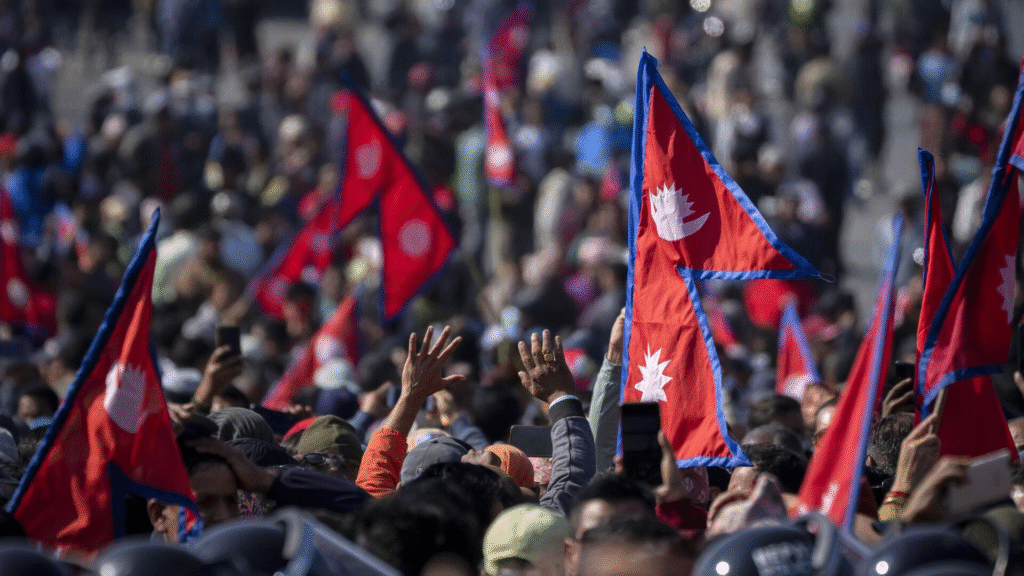
In September 2025, Nepal’s government collapsed not due to political manoeuvring or royal conspiracies, but because of a vibrant, youth-led uprising driven by hashtags that spread from university campuses and Discord servers into the busy streets of Kathmandu. After the cabinet’s ban on twenty-six social media platforms for failing to register, protests grew more intense. Government buildings were set on fire, Prime Minister K.P. Sharma Oli resigned, parliament was dissolved, and former Chief Justice Sushila Karki was appointed as the interim Prime Minister. The organisation and speed of mobilisation—mainly leaderless and coordinated online—transformed the country’s political landscape within weeks rather than years.
A right-of-centre perspective begins with fundamental principles: order must precede reform. Huntington’s dictum—that rapid mass mobilisation without institutional capacity leads to instability—aligns closely with this sequence. The ban, intended as a disciplinary action and a financial statement, had a deep impact as it clashed with a youthful electorate and established political groups. Meanwhile, the security forces failed in their duty to defend state symbols, fearing a bigger backlash. The outcome was a sharp loss of legitimacy, making the state look both oppressive and empty—an disastrous mix for any fragile democracy.
Neoclassical realism explains the core mechanisms. In this perspective, domestic gatekeepers—such as political parties, judicial bodies, military forces, and bureaucratic institutions—filter external influences and public opinion before they reach the highest decision-making levels. When these gatekeepers collapse, their impact is directly felt in high politics. In Kathmandu, longstanding perceptions of corruption and cartelised parties eroded the regime’s protections; the widespread platform ban exposed elite concerns and confirmed claims of impunity. The significant strength of the uprising was not due to a single leader but to the robust, horizontally organised youth networks that the traditional party system could neither co-opt nor dismantle. Observers of the movement have noted that this “leaderless” structure was, in fact, a deliberate strategy.
The information-cascade theory offers an alternative perspective. Timur Kuran’s idea—that private discontent turns public when coordination costs decrease—aligns well with Nepal’s situation. Hashtags lower costs; the “nepo-kid” meme, which highlights the advantages of political offspring, increased moral outrage; and Discord-based logistics enabled swift and efficient coordination. However, cascades cannot replace institutions. A month later, frustration grew as youth organisers observed few arrests and limited representation in the interim cabinet—an early sign that movements founded on negation (“remove them”) must quickly develop into institutional renewal or face disillusionment.
Four lessons strongly resonate with Indian policymakers and conservative thinkers.
Initially, establish regulations for the digital realm that embody due process, clarity, and sunset clauses. Broad or harsh bans could radicalise young individuals who may lack strong ideological beliefs, especially when their livelihoods—such as remittances, gig work, and connections to diaspora networks—depend on online platforms. Nepal’s September shutdown facilitated seamless coordination and turned a technical order into a decisive referendum on legitimacy; the streets perceived the ban as evidence of elite impunity and responded with passionate unity.
Secondly, prioritise renewing the party before external forces take control. The “nepo-kid” meme gained significant traction as it highlighted the clear barriers within meritocratic systems. Right-of-centre parties that focus on competence, embrace open primaries, and assess local performance will effectively oppose populist movements.
Conversely, if the right resembles just another cartel, it will attract the same scepticism currently directed at Nepal’s left-leaning establishment and its opponents. The importance of a communication strategy cannot be overstated: digital audiences react quickly to a lack of transparency; organisations that actively engage, share information, and correct issues maintain trust far more effectively than those that refuse to respond.
The design of the constitution is crucial. The debate over a directly elected executive in Nepal has gained renewed vigour. In a mountainous, federal, and ethnically diverse polity characterised by dispersed authority, fragmented coalitions can cause significant policy drift and require extra-institutional corrections. A carefully planned transition to a stronger, directly empowered executive—subject to oversight by courts and provinces—could boost accountability and reduce opportunistic party switching. India, with its unique blend of parliamentary and presidential practices, is well-placed to observe this discussion closely; the challenge is finding a balance between decisiveness and the risks of dominance.
Fourth, crises accumulate. In the wake of political upheaval, Nepal faced devastating landslides and floods, requiring decisive leadership and international support. Disaster relief, border management, and migration control need a level of continuity that street-assembled coalitions struggle to provide on a large scale. India’s swift provision of aid highlighted the importance of reliable partners nearby. It emphasised the significance of viewing neighbourhood stability as a collective benefit rather than just a transactional gesture. For conservatives, the message is clear: strong states must not only withstand shocks but also govern effectively in their aftermath.
This perspective from the right does not support authoritarian tendencies; instead, it advocates for thoughtful and principled conservative governance. Stability is not an obstacle to reform but its necessary foundation. The Nepali uprising shows that in interconnected struggles, the consequences of symbolic overreach are quick and unpredictable. Hashtags can challenge governments; only institutions can lead effectively afterwards. The key message for New Delhi and the wider South Asian right is to remove the causes of unrest: set clear regulations, adopt merit-based recruitment, manage social media to address issues rather than silence voices, and develop constitutional frameworks that prioritise accountability alongside maintaining order. By doing this well, the energy of youth can be channelled from destructive actions and anger into constructive governance and progress—the difference between a fleeting hashtag and a successful republic.




Add comment