


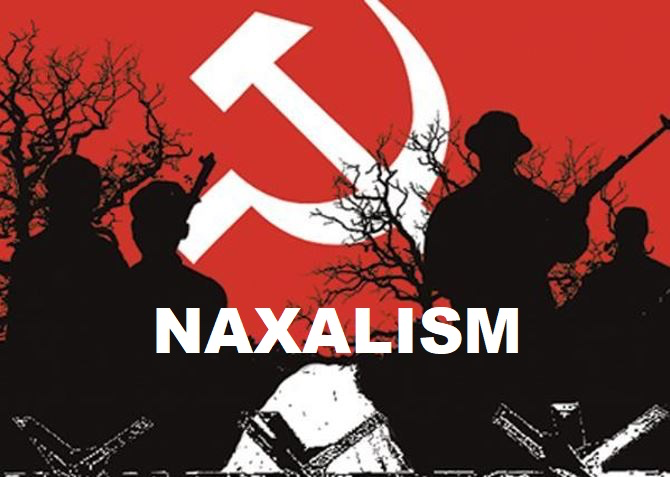
In 1967, a small village in northern Bengal saw sharecroppers rise against landlords after years of exploitation. This marked the start of one of the most violent and prolonged internal security and socio-political challenges the country has experienced. The movement quickly developed into a full-scale insurgency across the “Red Corridor” and has since influenced policy, security operations, and developmental priorities for decades. The overall trajectory of the Naxal movement in India, from its violent beginnings to its eventual decline, can be outlined in seven distinct phases—each characterised by distinct ideological shifts, organisational changes, geographical expansion, and state responses.
Phase 1: Ideological Birth and Armed Uprising (1967–1972)
The Naxal movement derives its name from its place of origin, the small town of Naxalbari in West Bengal. Led by prominent local figures such as Charu Majumdar, Kanu Sanyal, and Jangal Santhal, it wielded significant influence over the region’s peasantry. The movement, based on Mao Zedong’s revolutionary ideas, promoted armed conflict as the sole means to overthrow what it described as the “oppressive” state system and to establish what its leaders termed a “people’s government.”
In 1969, the rebellion emerged as an organised ideological group with the formation of the Communist Party of India (Marxist–Leninist) by Charu Majumdar. The use of guerrilla warfare, targeted violence against landlords, and even attempts to forcibly redistribute land marked this period. Throughout this phase, West Bengal and parts of Andhra Pradesh remained its centres. However, within three years, in 1973, the Indian state’s sustained counterinsurgency operations destroyed the main Naxal bases. Nonetheless, the underlying issues of poverty, inequality in land distribution, and alienation-particularly among tribals and Dalits—continued unmitigated and thus remained a source of inspiration for subsequent uprisings.
Phase 2: Decline, Confusion, and Fragmentation (1972–1980)
The death of Charu Majumdar in 1972 created an ideological vacuum and led to organisational disintegration. The movement fractured into several factions exploring different strategies, with some emphasising the need for continued armed struggle and others prioritising engagement in politics. Another development that significantly altered India’s political landscape was the National Emergency between 1975 and 1977, which also influenced the course of the Naxals. While the Emergency suppressed radical activities through strong crackdowns, it also heightened political awareness and dissent. Groups like the CPI(ML) Liberation eventually decided to participate in parliamentary politics, marking an early shift from militancy to democratic engagement within certain factions.
Phase 3: Resurgence and Organisational Consolidation (1980s–1990s)
The 1980s marked a resurgence of Naxal forces, represented by two dominant groups: the People’s War Group, based in Andhra Pradesh, and the Maoist Communist Centre, operating out of Bihar and neighbouring states. Their strategy was twofold: armed resistance and mass mobilisation. Their influence extended to the tribal-majority regions of central and eastern India, especially the Dandakaranya area. The Naxals established what is known as Janathana Sarkar (People’s Government), with adivasis and dalits serving as primary agents of change. The movement began to portray itself as the protector of tribals against exploitation by contractors, landlords, and state agencies. By aligning with grassroots socio-economic grievances, the movement managed to embed itself within tribal communities.
Phase 4: Rapid Expansion and the Red Corridor (1990s–2004)
The 1990s experienced a profound change as Naxalism expanded rapidly across central India, resulting in what became known as the Red Corridor—a continuous stretch from Jharkhand to Andhra Pradesh. The reasons for its growth included the alienation of tribal and Dalit communities, displacement caused by development projects, a weak administrative presence in remote forested areas, and increased organisational coordination among factions. This expansion peaked with the 2004 merger of PWG and MCC to form the Communist Party of India (Maoist), which significantly enhanced organisational capacity, operational coordination, and ideological unity, thereby establishing the foundation for the most violent phase of Naxalism.
Phase 5: Peak Strength and Violent Escalation, 2004–2010
The Maoist movement reached its peak of strength after 2004. According to sources, the Communist Party of India-Maoist established what it called “liberated zones” across large areas of Chhattisgarh, Jharkhand, Odisha, Maharashtra, Andhra Pradesh, and West Bengal. The creation of the People’s Liberation Guerrilla Army provided the insurgency with a structured military backbone. The PLGA, according to former ADG R. K. Vij, was a “three-tier pyramid structure” that enabled sophisticated operations-from ambushes and prison breaks to targeted assassinations. Major attacks during this period included: Koraput attack (2004), Jehanabad jailbreak (2005), R. Udayagiri attack (2006), killing of JMM MP Sunil Mahato (2007), several large-scale attacks in Chhattisgarh (2006–2007), Nayagarh armoury attack (2008). By the late 2000s, Naxalism had become, in the words of Prime Minister Dr. Manmohan Singh, “the single biggest internal security challenge ever faced by our country.”
Phase 6: Containment and Systematic Decline (2010–2020)
The year 2010 was characterised by an unprecedented level of Maoist violence. These include: the killing of 76 CRPF personnel in Dantewada in April 2010 and the massacre of villagers in Bihar’s Jamui district. In response, the Government of India launched intensified security operations combined with a renewed developmental effort. Key Maoist leaders like Cherukuri Rajkumar (Azad) were neutralised, thereby weakening the insurgent command structure. Crucially, the government adopted people-centred approaches that built trust with local populations. These included initiatives like: Amcho Bastar, Amcho Police (Chhattisgarh) and the Dadalora Khidki – Mava Hakka tha Khidki (Gadchiroli Police, Maharashtra). This assisted in dissolving the long-standing mistrust between tribal communities and the administration. Better access to healthcare, education, roads, and welfare schemes reduced the social space for Maoist recruitment. By the end of this phase, Naxal activity was confined to limited pockets in south Chhattisgarh, parts of Jharkhand, and Odisha.
Phase 7: Current Scenario and the Road to 2026 (2020–present)
The landscape of Naxalism today has changed significantly. Union Home Minister Amit Shah has repeatedly stated that India is on track to become Naxal-free by 31 March 2026. As he mentioned, the number of the most-affected districts has decreased dramatically—from 12 to just 6—a milestone in India’s counter-insurgency efforts. The current strategy relies on a dual pillar approach: security measures that maintain pressure against the remaining Maoist cadres and a focus on governance for development, addressing the roots of alienation such as poverty, lack of roads, unemployment, and the absence of state presence. The government now concentrates on creating a counter-narrative to Maoist propaganda through the effective delivery of welfare schemes, strengthening grassroots governance, and empowering tribal communities.
Uniqueness of Indian Naxalism and the Path Ahead
The Indian experience of Naxalism is unique in many ways – unlike numerous communist insurgencies that take place in urban areas, Indian Naxalism is mostly limited to tribal-dominated, mineral-rich regions of the country. The movement is also not solely ideological; it is rooted in feelings of deprivation, which also add a socio-economic dimension. These beliefs have helped the Naxals establish bases in forest-rich regions and create parallel governments to satisfy tribal and adivasi populations. The Indian Naxal movement has lasted about 55 years – its development reflects the complex interaction between ideology, socio-economic hardship, state capacity, and the aspirations of marginalised communities. From its fiery beginnings in Naxalbari to its peak as a multi-state insurgency and now its decline, the movement’s history offers a key lesson: lasting peace depends on both state presence and people’s trust. The aim is not only to eliminate the armed insurgency but also to address the deeper structural issues that allowed the problem to develop. The future for these regions depends on sustained development, inclusive governance, and a continued commitment to ensuring every citizen, especially the most vulnerable, feels heard, represented, and protected.
In recent years, the government has systematically implemented longstanding recommendations to combat Naxalism by addressing governance issues, strengthening security, and speeding up development across the BOJHCS region. Constitutional protections such as PESA and Fifth Schedule safeguards are being enforced more strictly, while justice delivery, grievance redressal, and grassroots planning systems have been reinforced to make democracy a credible and people-friendly alternative to Maoist ideology. Development has been realigned to meet local needs, with increased emphasis on rights-based approaches, improved literacy, decentralised administration, and measures to prevent corporate exploitation. At the same time, security capabilities have grown through better-trained state police units, specialised task forces, improved coordination with central forces, and targeted operations that have substantially weakened the PLGA. Ground audits, stricter oversight of NGOs, heightened awareness among frontline officials, stronger leadership in policing, and enhanced training infrastructure have further improved governance and limited the space for extremist influence. Diplomatic and informational efforts have also helped disrupt external links and counter pro-Maoist narratives.
As these developmental, ideological, and security interventions converge, violence has sharply decreased across affected districts. To resolve long-standing extremism, a multi-faceted approach is essential—one that is based on strong governance, equitable development, democratic empowerment, the restoration of tribal rights, reform of policing and administration, and precise, targeted security operations. No single intervention can succeed in isolation. Only the combined effort of development, democracy, and security can break the cycle of violence and establish the foundations for lasting peace in the region. With sustained focus and the momentum already evident, the government’s goal of eliminating Naxalism by 2026 seems not just achievable but increasingly attainable.



Add comment