


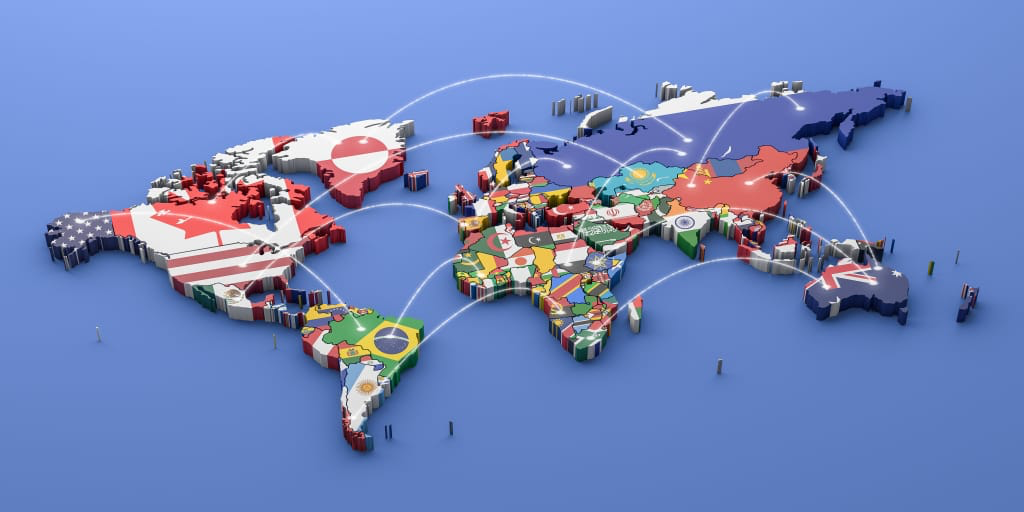
China believes that the world today is undergoing profound changes unseen in a century. In the near term, the world order formed since World War II is facing adjustments; in the long run, the multipolar model under the Westphalian system has become unsustainable.
Why does China oppose the “G2” concept? Because China has no desire to become another United States. China was once a victim of the U.S.-Soviet hegemonic rivalry. As early as 1974, Deng Xiaoping clearly stated at the Special Session of the Sixth UN General Assembly: If China becomes developed in the future and also seeks hegemony, the Chinese people and the people of the world will unite to defeat that hegemon! China’s cultural gene, as stated in the I Ching, is “a group of dragons without a leader,” rather than pursuing “leadership” or “dominance.” Furthermore, in the age of artificial intelligence, the U.S.-style “winner-takes-all” model is both unsustainable and unpopular; the true open-source model is the future direction of development.
I. What is the Equal and Orderly Multipolar World Order Advocated by China?
China advocates an equal and orderly multipolar world and inclusive economic globalisation. Among these, the core of an equal and orderly multipolar world is to acknowledge to the equality of all countries, big and small, oppose hegemonism and power politics, and effectively promote the democratisation of international relations.
To ensure that the multipolarisation process is generally stable and constructive, it is necessary to jointly uphold the purposes and principles of the UN Charter, collectively adhere to universally recognised basic norms of international relations, and practice true multilateralism. This is precisely China’s answer to the questions of the times.
Western scholars and officials often ask: What kind of multipolarisation does China want to promote? Is multipolarisation necessarily good? Based on their historical experience, multipolarisation may bring instability and even conflict. Peace is regarded as an interlude between wars, and multipolar balance is only a short-lived, occasional exception. China’s proposal to build an equal and orderly multipolar world stems precisely from the fact that the Western-dominated multipolarisation is neither egalitarian nor orderly. The historical multipolarisation was “unequal and disorderly” for three fundamental reasons:
First, theistic determinism and its Western-centric underpinning have shaped a self-centred and arrogant Western concept of international relations. The so-called universal values of the West are essentially a modern value deduction from Christian theism. Determinism has given rise to the Clash of Civilisations theory and the End of History theory, which uphold linear evolutionism and unilaterally advocate the “end of history.” This self-centred perspective means that international politics in the Western context is not truly world politics. Today, the Western-dominated global governance faces problems such as solidified first-mover advantages, rule lock-in, and path dependence, which have aroused widespread dissatisfaction among Global South countries. Western multilateralism is an order led by the United States and the West, based on alliance systems and characterised by value exclusivity. In recent years, it has further advocated a “rules-based international order,” attempting to make up for its insufficient strength with so-called “rules.” Josep Borrell, the High Representative of the European Union for Foreign Affairs and Security Policy, complained at the UN General Assembly last year that “the world is becoming more multipolar, but multilateralism is weakening.” His core appeal is that multipolarisation has enhanced China’s influence, squeezed Europe’s space, and failed to reflect the EU’s normative dominance.
Second, the axiomatic assumption of the inherent evil of human nature. The Christian doctrine of original sin, reflected at the human level, holds that human nature is inherently evil and that power is therefore inherently evil. Therefore, “checking power with power” has become the golden rule of the Western world. The selfishness of human nature is expressed as the exclusivity of national interests, the anarchy of the international community, and a self-help system. The European Renaissance and Enlightenment promoted the liberation of human nature from the divine, and the Thirty Years’ War released the national character, giving birth to modern international relations concepts—this is precisely the starting point of the realist international relations theory: human nature is inherently evil, so power is inherently evil; the assertion of human nature leads to the assertion of national character, which in turn triggers barbaric external expansion, plunder, and colonisation. Its basic logic is “pursuing security through power and interests through strength.” This self-centered thinking determines that the West prefers minilateralism or unipolar-dominated multilateralism. The EU’s advocacy of “unity in diversity” is seemingly similar to the “harmony in diversity” in traditional Chinese culture, but their connotations are fundamentally different.
Third, the West’s inability to adapt to civilisational transformation. Human civilization is moving from an industrial and commercial civilisation to a digital and ecological civilization, and the West has shown its obvious inability to adapt to this transformation process, which is also an important connotation of the profound changes the like of which have not been seen in a century. Therefore, China not only needs to respond to changes in the Western-dominated world pattern but also assume greater responsibility for leading the transformation of human civilisation—this is an inherent requirement of building a community with a shared future for mankind and a historical mission of creating a new form of international political civilization.
(This is the first of a two-part article.)


Add comment