


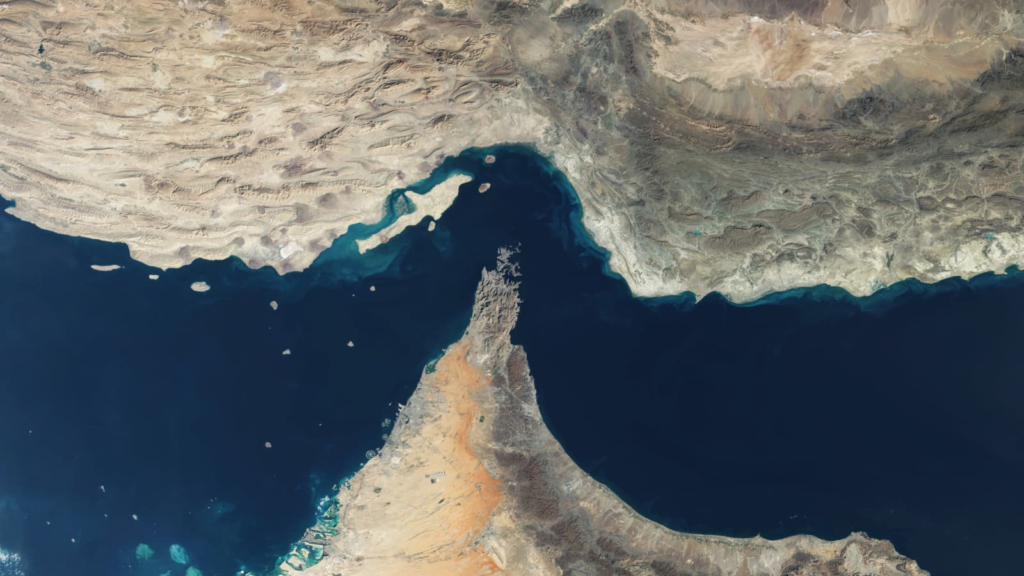
The current crisis in The Middle East precipitated by the US-Israeli military action against Iran has not only seen aerial attacks; it has escalated to maritime domains as well. The Strait of Hormuz, a maritime chokepoint for oil and gas supply has turned out to be the battlefield where not just naval ships are involved, but where there are also contestations from the perspective of International Law as well.
Considered one of the busiest waterways in the world, the Strait of Hormuz connects a gulf to a sea and serves as an important navigational route for shipping to and from the region. Approximately one-fifth of the global oil supply is routed through the Strait of Hormuz. As far as the maritime geography is concerned, there is no alternate sea route and therefore it can be referred to as the Transit Passage strait. However, Iran argues that the Strait is under its jurisdiction (territorial waters) and therefore applies the Innocent Passage rule (harmless passing). When it comes to US, it enforces Freedom of Navigation but reserves the right to impoe sanctions on any ship operating on behalf of nations with which it has a bone of contention.
Regional Conflict to Maritime Chokepoint Crisis
The disruption caused by the closure of the Strait of Hormuz is unprecedented in scale. Systemic shocks are being felt across the world, as Iran is using its leverage over the strategic chokepoint and turning it into a strategic equaliser.
Iran’s approach in the Strait of Hormuz blends hybrid maritime warfare with lawfare where military measures are coupled with administrative control and selective access. This effectively raises the risks and the costs of navigation through the strait rather than eliminating it. Indeed, some Iran-linked vessels have continued transiting under controlled conditions. This situation has created many dissentions and must be seen through the lens of International Law, particularly the United Nations Convention on the Law of the Sea (UNCLOS). This article will attempt to determine whether the closure of the Strait of Hormuz by Iran is a Violation of the UNCLOS.
The Legal Regime: UNCLOS and the Strait of Hormuz
The governing legal framework is the United Nations Convention on the Law of the Sea (UNCLOS), particularly Part III, which regulates straits used for international navigation. The Strait of Hormuz qualifies as an international strait because it connects two parts of the sea/EEZ and is used for global navigation. Although parts of the strait lie within the territorial seas of Iran and Oman, UNCLOS creates a special regime overriding full sovereignty. The major bones of contention in the entire debate are about the interpretation of the Innocent Passage and Transit Passage principles.
The 1958 Convention on the Territorial Sea and the Contiguous Zone (CTS) provides for the Innocent Passage regime. Article 14 of the CTS provides for Right of Innocent Passage to the ships passing through territorial water as long as it not prejudicial to the peace and security of the Coastal State. Article 16 of the CTS also provides for necessary steps to prevent any passage which is not innocent.
Next, the Transit Passage Regime comes into the picture through the UNCLOS. It refers to the freedom of navigation solely for the purposeof continuous and expeditious transit through the strait. This type of passage applies when the strait is the only navigational route; if the strait is an optional route, then the applicable regime is innocent passage. Article 38 of the UNCLOS provides for the right of transit passage which shall not be impeded.
Iran’s Closure and UNCLOS
From the US point of view, the closure of the Strait of Hormuz by Iran is a violation of International Law so far as the UNCLOS and customary International Law are concerned. It is argued that the Transit Passage regime of the UNCLOS has acquired the status of customary international law. Therefore the closure or even the levying of toll by Iran lacks legal validity and contravenes the Part III obligations under UNCLOS. Thus, under orthodox legal interpretation, Iran’s actions are unlawful.
However, Iran a multi-layered defence on its justification for closing the Strait of Hormuz. Iran asserts that the Strait lies within its territorial waters and thus falls under its regulatory authority. Further, and most importantly, Iran has signed but not ratified UNCLOS, arguing it is not strictly bound by its provisions. Likewise, the US is not a party to the Convention either. Iran frames the closure as a lawful countermeasure or act of self-defence in response to what it characterises (righfully) as an unlawful aggression. Moreover, Iran has declared that certain UNCLOS provisions reflect a quid pro quo and do not necessarily reflect customary international law.
Iran’s insistence on the applicability of innocent passage rule is a clever manoeuvre in terms of international law. Innocent Passage is now the customary rule in International Law and harder to challenge than the newer transit passage rules. Iran contends that the 1982 UNCLOS has not acquired customary status and that all the provisions of the Convention are not to be assumed to have a customary character, hence they are not binding, especially on non-signatory states. Even in its latest communication, Iran maintains the application of Innocent Passage regime (normal and non-hostile passage) in the Strait of Hormuz.
The disagreement on the applicable regime for the passage in the strait has led to a grey area in the governance of the Strait of Hormuz. As a consequence, from the viewpoint of UNCLOS and international law, Iran stands to benefit from the ambiguity and partial non-applicability of UNCLOS to navigation in the Strait of Hormuz.
Analysing the Maritime Vulnerability (and Closure)
The ongoing situation in the Strait of Hormuz has visibly affected the energy supply chains across the region, thereby triggering fuel price spikes and generating economic instability. The episode has triggered a debate about international law, and in particular with regard maritime geography, and will generate a discourse on the acceptable applicability of rules in the maritime order.
The closure of the Strait of Hormuz represents a paradigmatic crisis at the intersection of geopolitics, maritime strategy, and international law. The primary focus in this context is on the UNCLOS. While some parties contend that it has acquired the status of customary law, Iran claims that it is no so and applies the Innocent Passage rule to the Strait of Hormuz. The non-ratification of UNCLOS by Iran and its consistent assertion of the non-customary status of UNCLOS give Iran some room to contest the closure of the Strait, at least unfrt the International Law regime.
Conclusion
The Strait of Hormuz will play a role in defining and redefining the conditions under which a rule acquires customary status. The Strait today stands not merely as a conflict spot but also as a test case for numerous contestations in the maritime order. In essence, the current state of affairs in the Strait of Hormuz brings forth the paradoxical ambiguity of international law that is normatively authoritative but operationally contingent on the power to enforce or ignore it.



Add comment