


Over the past three decades, ghastly terrorist attacks have targeted India, including an attack on India’s Parliament and the dastardly Mumbai attacks of 2008. Yet, in India’s enduring struggle against terrorism, no terrorist act has seared the national conscience as the killing of 26 innocents in Baisaran meadow near Pahalgam, on this day, last year.
Today, we pause to honour those who fell. We remember them as victims of a brutal act of depravity that must never happen again. That moment also marked a significant shift in India’s anti-terrorism stance. An irrevocable threshold had been crossed. Henceforth, not only terrorists but their sponsors would be held accountable for such acts.
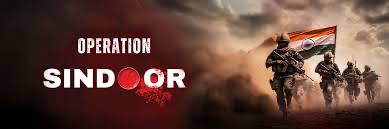
Two weeks after the Baisaran massacre, the launch of Operation Sindoor signalled the end of an era. For decades, India’s doctrine of “Strategic Restraint”, Pakistan’s nuclear threat, and India’s desire for regional stability had constrained action against these groups. But now, the sacrifice of 26 innocent souls demanded a more robust response.
Within 88 hours of the launch of Operation Sindoor, deterrence was redefined. The initial Indian strikes destroyed nine terrorist camps, including the headquarters of the Lashkar-e-Taiba and the Jaish-e-Mohammad. At each phase of the subsequent battles, India achieved escalation dominance, till the final moments when 11 air bases of Pakistan were struck, rendering them inoperational. Among these were the PAF Base Mushaf at Sargodha and PAF Base Nur Khan in Chaklala, Rawalpindi. This, coupled with a strike on the Kirana Hills, which reportedly housed Pakistan’s nuclear assets, unnerved the Pakistani state and prompted the Pakistani DGMO to request a ceasefire from his Indian counterpart.
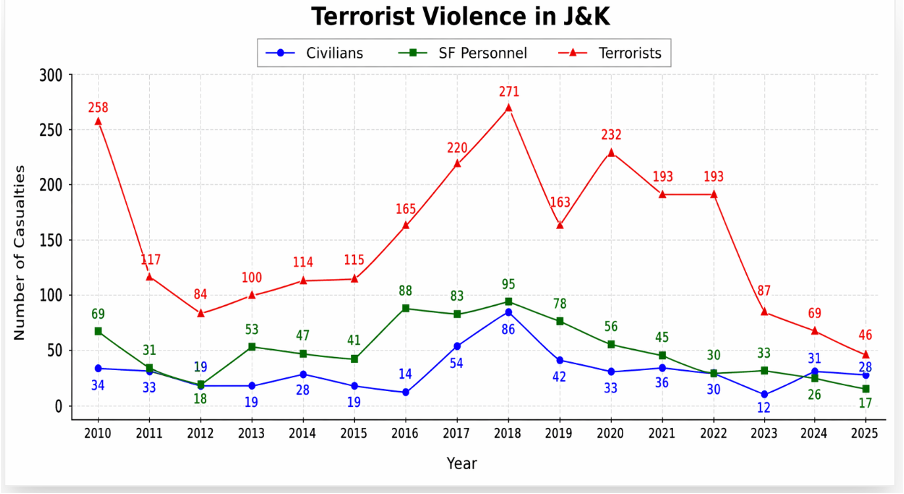
The period leading up to the terrorist attack in Baisaran was marked by a remarkable return to normality in Jammu and Kashmir. The repeal of Article 370 in 2019, together with development and security measures, has reshaped the security landscape in the Union Territory of Jammu and Kashmir (see the table below). This return to normality triggered the Baisaran attack. It was difficult for the terrorists and their sponsors to accept that civil society had largely rejected them. After the attack, the revulsion against the terrorists was so strong that The Resistance Front (TRF), an affiliate of Lashkar-e-Taiba, which initially claimed responsibility, swiftly issued a denial. Disenchantment with the Islamist terrorists, their sponsors in Pakistan, and the separatist elements within the Valley was a severe rebuke to all anti-India elements.
For India, a new normal has now been established. Henceforth, there would be zero tolerance for acts of terrorism. ‘Strategic Restraint’, long followed as a means of dealing with such acts, would no longer apply. There would now be serious consequences for terrorists and the Pakistani state that backed them.
Future responses will adopt a whole-of-India approach, using all instruments of state power. The holding in abeyance of the Indus Waters Treaty is a step in that direction. In addition to the use of military force, other measures will include political, economic, social and diplomatic means to compel a change in Pakistan’s use of terrorism as an instrument of its foreign policy. Blood and water can no longer flow together, as Prime Minister Modi so aptly stated.
The impact of Operation Sindoor and India’s new policy of zero tolerance towards terrorist attacks remains to be seen. While Pakistan is unlikely to close the terrorist organisations it has sponsored—The Lashkar-e-Taiba, Hizbul Mujahideen, Jaish-e-Mohammad, and others, India’s stated policy now calls for harsh deterrent action against the Pakistan military, which sponsors these groups. This shift in policy will make the cost of terrorism exorbitant and could eventually compel Pakistan to abjure the use of terrorism as an instrument of state policy. Till then, India will have to be alert and ready for any contingency.
As we reflect on the anniversary of the Baisaran attack, we do so with solemn clarity and resolve. The memory of the victims has forged a national consensus: never again will India succumb to nuclear blackmail or tolerate the “business as usual” approach to state-sponsored terrorism. Only the total eradication of terrorism from our soil can honour their memory.



Add comment