


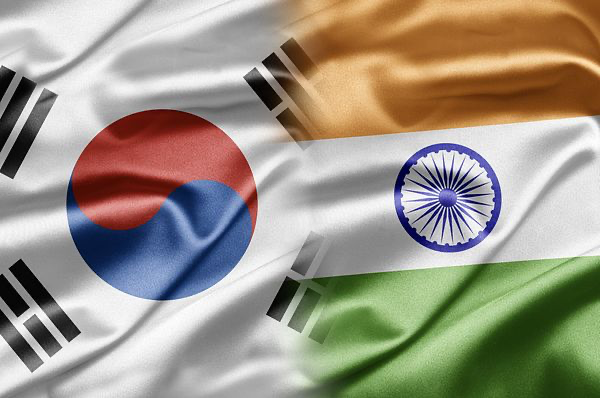
South Korean President Lee Jae-myung’s recent visit to New Delhi may not have generated the media spectacle that often accompanies high-profile summit diplomacy, but it could prove to be one of the more consequential strategic engagements in Asia this year. India and South Korea are increasingly recasting their relationship not merely for the needs of the present, but for the demands of the future.
For much of the past two decades, India–South Korea ties were defined largely by trade, investment, and the visible success of Korean consumer brands in the Indian market. Companies such as Samsung, Hyundai, LG and Kia became household names, helping establish South Korea as one of India’s most important economic partners in East Asia. Yet despite this strong commercial presence, the larger strategic relationship often appeared underdeveloped relative to its potential. That appears to be changing.
The centrepiece of President Lee’s visit was the unveiling of a five-year strategic roadmap for 2026–2030, alongside a series of agreements spanning technology, maritime cooperation, defence innovation, supply chains, clean energy and industrial development. These developments suggest that New Delhi and Seoul increasingly see each other as partners in navigating the economic and geopolitical turbulence of the next decade.
This shift is being driven by a changing international environment. Across Asia, countries are grappling with supply chain disruptions, intensifying great-power competition, technological fragmentation, and concerns over excessive dependence on China-based production networks. Both India and South Korea have strong reasons to diversify economic relationships and build greater strategic resilience.
For South Korea, India offers scale, growth, talent and an expanding market at a time when external demand conditions in traditional markets have become less certain. For India, South Korea brings world-class manufacturing capabilities, technological sophistication, capital, and deep experience in building globally competitive industrial ecosystems. The complementarity is increasingly obvious.
One of the clearest signs of this future-oriented convergence lies in the technological domain. The launch of the India-Korea Digital Bridge framework points to a more ambitious phase of cooperation in semiconductors, AI, data governance and advanced manufacturing. India’s growing strength in digital public infrastructure, software talent and AI capabilities can combine meaningfully with Korea’s excellence in electronics, precision engineering and hardware manufacturing.
At a time when semiconductors have become critical to economic competitiveness and national security, such cooperation is especially significant. If sustained, it could help both countries reduce vulnerabilities while creating new industrial opportunities.
Maritime cooperation is another major frontier. India’s growing economic ambitions require expanded shipbuilding capacity, stronger port infrastructure and modern logistical systems. South Korea, one of the world’s leading shipbuilding powers, is well placed to contribute to this endeavour. The new framework on shipbuilding, shipping and maritime logistics, including plans for a greenfield shipyard and dry dock in southern India, is therefore not just a commercial arrangement. It is a strategic investment in India’s long-term industrial and maritime capabilities.
The symbolism is important too. Partnerships of the future will be built not just in digital labs and boardrooms, but also in ports, industrial corridors and logistics hubs.
Defence cooperation has also moved into a deeper phase. The success of the K-9 Vajra artillery programme demonstrated that India and South Korea can move beyond a traditional buyer-seller model toward co-production. The launch of the Korea-India Defence Accelerator (KIND-X), designed to connect startups, investors, universities and defence innovators, indicates an intention to carry that logic into next-generation military technologies.
This matters because the future of defence cooperation will increasingly depend not just on platforms, but on innovation ecosystems. Countries that can jointly develop emerging technologies will possess a significant strategic advantage.
There is also an ever-widening geopolitical dimension to the relationship. India and South Korea are distinct powers with different regional priorities, yet both have a stake in a stable, open and rules-based Indo-Pacific. Seoul’s decision to join the India-led Indo-Pacific Oceans Initiative is therefore noteworthy. It reflects South Korea’s willingness to broaden its strategic footprint beyond Northeast Asia, while signalling its confidence in India’s growing regional role.
Equally important is the clean energy and resource security agenda. Both countries are heavily exposed to global energy volatility and are seeking more secure access to critical minerals, battery technologies and low-carbon industrial pathways. Cooperation in green steel, critical minerals, advanced batteries and even Small Modular Reactors reflects how seriously both sides are thinking about future economic security.
Yet ambition alone will not be enough. India–South Korea ties have in the past been constrained by delays, regulatory uncertainty and execution gaps that frustrated investors. Announcements, however promising, will need to be matched by institutional follow-through. The creation of new industrial cooperation mechanisms and plans for dedicated Korean manufacturing zones in India suggests that both sides understand this challenge. Mature partnerships afterall are built not only on shared aspirations, but on the ability to deliver.
The real significance of President Lee’s visit, then, lies not in media optics but in strategic intent. India and South Korea are no longer merely trading with one another; they are preparing together for a more uncertain future.
In a fragmented global order, the most successful partnerships may not always be grand alliances or headline-grabbing blocs. They may instead be practical, complementary relationships between countries that recognise what each other brings to the table. India and South Korea increasingly appear to have reached that understanding.



Add comment