


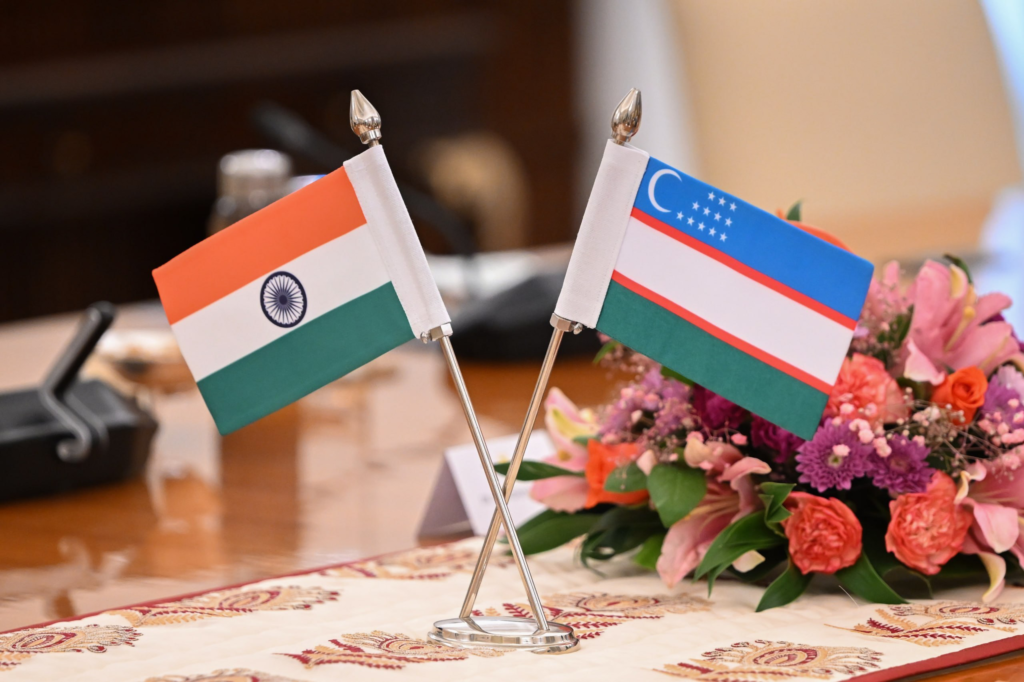
At the 81st United Nations General Assembly in New York on September 23, Saida Mirziyoyeva, Head of Uzbekistan’s Presidential Administration, offered a compelling articulation of responsible statecraft for an increasingly fractured world.
Against a backdrop of war, geopolitical tension, declining trust, and inequality, she declared that Uzbekistan had made its choice. Asked, in effect, which side it would take, her answer was neither East nor West: “Our choice is human dignity,” together with openness and dialogue. Equally significant was her assertion that “power is not above the law.”
These were not simply moral propositions. They also reflected a pragmatic understanding of a changing international order.
We are entering an increasingly multipolar world, but multipolarity does not automatically produce stability. Mirziyoyeva’s formulation resonates strongly with India’s own strategic journey.
India: Choosing Not to Choose Sides
India was a founding leader of the Non-Aligned Movement (NAM), but non-alignment was never intended to mean indifference or isolation. At its core was the assertion that sovereign countries ought to be free to make decisions according to their interests rather than act as appendages of competing power blocs.
Contemporary India has transformed that inheritance into strategic autonomy and multi-alignment. India engages the United States while maintaining its longstanding relationship with Russia; participates in the Quad while remaining an important member of BRICS and the Shanghai Cooperation Organisation; engages all players in West Asia; and seeks partnerships without surrendering its freedom of judgement.
The objective is not neutrality for its own sake. It is strategic optionality.
India has similarly maintained that conflicts ultimately require dialogue and diplomacy. Prime Minister Narendra Modi’s formulation that “this is not an era of war” has been accompanied by repeated advocacy of dialogue, diplomacy, sovereignty, and peaceful resolution of disputes.
Mirziyoyeva’s declaration that openness is not weakness finds a striking parallel in India’s own approach: engagement is not endorsement, dialogue is not surrender, and strategic independence does not require strategic isolation.
Vasudhaiva Kutumbakam: The World as One Family
There is also a deeper civilizational resonance.
India’s concept of Vasudhaiva Kutumbakam (“the world is one family”) places human welfare, at both the everyday and the ontological level, above narrow divisions of geography, ideology, nationality, class, or ethno-religious identity. It should be understood not as a political ideology but as a perspective anchored in the dignity of the human person and in the conviction that peace remains possible despite human frailty and moral failing. This outlook makes no claim to exceptionalism and offers no cure-all for an international system often described as anarchic and in need of repair. It does, however, keep alive the hope of peace, in which reasoned dialogue can avert conflict and settle differences without demanding the unconditional surrender of the other side.
During India’s G20 presidency (2022-2023), Prime Minister Modi translated this philosophy into the theme “One Earth, One Family, One Future,” which he described as a call for human-centric development rather than a narrowly GDP-centric conception of progress.
That closely echoes Mirziyoyeva’s assertion that a country’s true strength should not be measured solely by its military or economic capacity, but by its ability to protect human dignity, rights, and interests.
Under Prime Minister Modi since 2014, India has attempted to translate this human-centric philosophy into governance through financial inclusion, sanitation, housing, healthcare, digital public infrastructure, food security, and direct delivery of welfare benefits.
The results are significant. India’s multidimensional poverty rate declined from an estimated 29.17 percent in 2013-14 to 11.28 percent in 2022-23, with approximately 248 million people estimated to have escaped multidimensional poverty. (PIB)
There is an obvious parallel with Mirziyoyeva’s emphasis on Uzbekistan’s domestic transformation. She highlighted rising purchasing power, an economy that grew from roughly $50 billion to $147 billion, poverty falling to 4 percent, declining infant mortality, and an increased life expectancy. Her essential point was that the true value of reform must ultimately be visible in people’s lives.
Human-centric development is, in essence, the growth of the whole person and of entire peoples across their spiritual, social, and material lives, rather than economic expansion alone.
Afghanistan: Engagement Is Not Endorsement
Perhaps the strongest convergence appears regarding Afghanistan.
Mirziyoyeva warned that “Viewing Afghanistan solely as a source of danger will not solve the problem” the region faces. Nor, she argued, should Afghanistan’s multi-ethnic population be abandoned to its difficulties. This echoes the history of Indo-Afghan relations, especially over the past two decades. India’s relationship with Afghanistan transcends regimes, factions, and goes beyond geopolitics. Likewise, Indo-Uzbek solidarity also reflects a shared spiritual legacy. Governments change; geography, people, and enduring interests remain. Afghanistan cannot perpetually be viewed through the ideological identity of whichever regime controls Kabul. Engaging Afghanistan does not mean endorsing its government.
India’s relationship with Afghanistan illustrates this distinction. Its engagement is not restricted to inter-governmental interactions; it concerns infrastructure, education, healthcare, capacity building, trade, and people-to-people connections. The underlying principle is that Afghan citizens should not remain prisoners and voiceless subjects of the regime governing them.
Afghanistan also illustrates a broader geopolitical reality. It sits within an interconnected strategic geography linking Central Asia, Iran, South Asia, the Gulf, and the Arabian Sea. Factors such as political instability, trade, energy, connectivity, terrorism, and great-power competition have consequences across this space. Uzbekistan’s doctrine is therefore not idealism divorced from geopolitics. It is pragmatic statecraft.
From Non-Alignment to Leadership of the Global South
Mirziyoyeva’s call for reform and expansion of the UN Security Council, together with Uzbekistan’s forthcoming chairmanship of the Non-Aligned Movement, points to another transformation: the emergence of a Global South increasingly unwilling to be merely an arena for competition among great powers.
Here again India’s experience is relevant.
India’s journey from a leader of the Non-Aligned Movement to an increasingly influential voice of the Global South reflects the evolution of the international system itself. During its G20 presidency, India deliberately sought to amplify developing-country concerns, arguing that the Global South should no longer be excluded from decisions affecting its future.
Uzbekistan would endorse Prime Minister Modi’s declaration at the 18th BRICS Summit in New Delhi this past September: “The Global South is today in the front row of global crises, but in the back row of decision-making. We must transform this ‘pyramid of privilege’ into a ‘platform of partnership,’ where every country has a voice, every member has a stake, and the advancement of humanity remains at the heart of every endeavor.”
India’s successful advocacy for the African Union’s permanent membership of the G20 was a practical manifestation of that approach.
To be sure, the Global South does not want another rigid bloc. It wants greater agency: the capacity of countries to pursue their interests, preserve sovereignty, and participate meaningfully in shaping international institutions.
Responsible AI and Human Agency
Mirziyoyeva applied the same human-centric philosophy to artificial intelligence, arguing that technology must be used with respect for human rights, security, equality, and accountability. Her question was simple but profound: does technology serve mankind, or must mankind adapt to technology?
India is confronting the same question as it seeks to become a major AI power while advocating safe, inclusive, and responsible technology. India’s emerging responsible-AI framework emphasises transparency, explainability, accountability, and human oversight, while Prime Minister Modi has repeatedly called for balanced international governance that encourages innovation while protecting humanity.
Technology, like geopolitics, must ultimately remain human-centric.
A Shared Philosophy for a Multipolar Age
Taken together, human dignity, dialogue, sovereign choice, inclusive development, responsible technology, and engagement over isolation, coupled with a rejection of “might-makes-right” and needless geopolitical ambition, express a coherent philosophy of statecraft rather than a set of separate policy propositions. Mirziyoyeva’s address mirrors India’s experience, resonates with its civilizational principles, and extends beyond Uzbekistan.
India’s journey from non-alignment to strategic autonomy, from strategic autonomy towards strategic consequence, and from a leading member of NAM to an increasingly important voice of the Global South also demonstrates that refusing binary geopolitical choices does not imply passivity.
A country can engage competing powers without becoming subordinate to them. It can pursue national interest while advocating dialogue. It can accumulate economic and technological power while insisting that development ultimately be measured by material and spiritual improvements in human lives.
That may be the larger significance of Mirziyoyeva’s question: “Which side do you choose?”
In an age once again tempted to divide the world into competing camps, perhaps the more consequential answer is not choosing one bloc over another, or even worse, pitting one proxy against another. Whatever its shortcomings, and there are certainly some, Uzbekistan chose human dignity over domination, dialogue over perpetual confrontation, development over exclusion, and strategic agency over dependency.
Uzbekistan expressed that choice at the United Nations. India, drawing upon its civilizational philosophy and its own long journey since independence, offers another powerful expression of the same idea.
In the uncertain multipolar order now emerging, such responsible statecraft may prove not only morally persuasive but strategically indispensable.

Add comment